A Walk Through the Bathroom, With Falls in Mind
A room-by-room walkthrough of the bathroom changes that actually reduce falls for older adults — grab bars, toilets, lighting, and what not to buy.
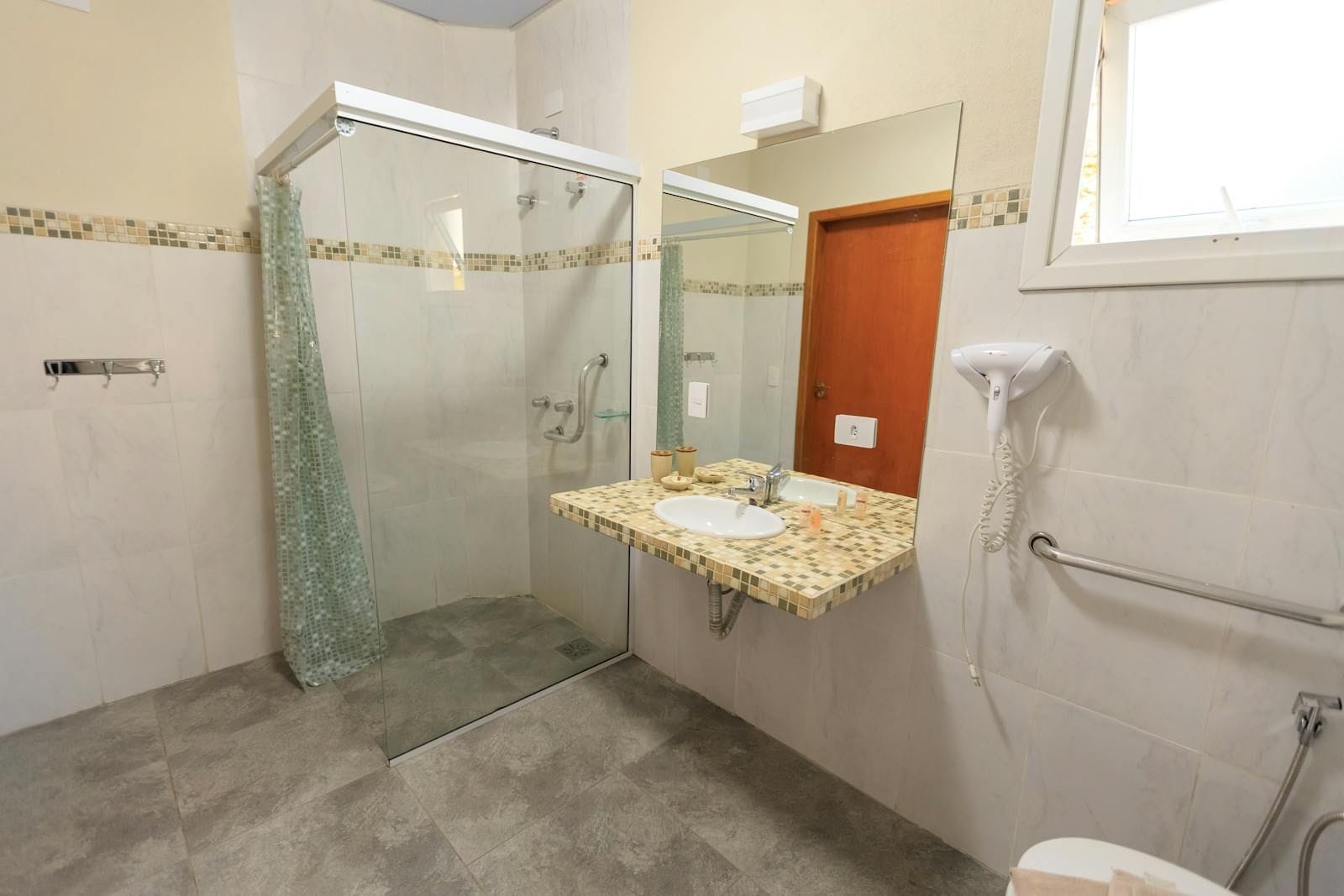
Walk into your parents' bathroom and look at it the way an occupational therapist would. Not at the towels or the tile color. Look at the floor between the door and the toilet, at the rim of the tub, at the height of the seat, at where the closest thing to grab actually is. Most home bathrooms were designed for an adult in their forties who can step over a tub edge without thinking. The same room used by the same person thirty-five years later is the most hazardous square footage in the house.
The bathroom holds a disproportionate share of the falls that send older adults to the emergency room. A 2015 analysis of National Electronic Injury Surveillance System data found that 22.7 percent of at-home fall-related ED visits in adults sixty-five and older originated in the bathroom, and that the share rose to 26.1 percent in adults eighty-five and over. Nearly four in ten of those bathroom-fall patients ended up hospitalized. The Centers for Disease Control and Prevention estimates that one in four adults sixty-five and older falls every year, that the fall death rate has risen 21 percent since 2018, and that falls are now the leading cause of injury-related death in older adults. The good news folded into all of those numbers is that bathroom falls are unusually responsive to physical changes in the room — more so than falls in any other space at home. The rest of this guide is a walk through the room itself, in roughly the order a person uses it, with the changes that actually move the needle.
The Quarter of Falls Most Households Walk Past Every Morning
Two facts make the bathroom dangerous out of proportion to its size. The first is water — every floor and surface is intermittently wet, and the coefficient of friction on a wet tile is roughly half that of a dry one. The second is the choreography. Almost every bathroom task involves a transfer — getting on or off the toilet, in or out of the tub, up off a low seat, around a corner with damp feet. Each transfer requires a moment of single-leg balance, the same moment an older adult is least likely to have available. Stack the two together — wet surface plus single-leg balance — and the room becomes mathematically more dangerous than the kitchen or the bedroom by a wide margin.
The intervention that works is not vigilance. Older adults who fall in the bathroom are usually not careless; they are doing exactly what they have done every morning for fifty years, in a room whose risk profile has slowly changed without them. The intervention is the room itself. Re-engineer it once, and the daily vigilance bill drops to zero.
The Floor: Where the Walk Starts, and Where Most Trips Begin
The bathroom floor is where the walk in begins and the walk out ends, and where a surprising number of falls happen on dry tile. The throw rug at the door is the single most common culprit — a small woven rectangle that bunches under a slipper, slides on tile, or catches the front wheel of a walker. The fix is direct: remove every loose rug, and replace any rug that absolutely must stay with a low-pile mat that has a continuous rubber-grip backing. The threshold strip at the door is the second culprit — a half-inch metal lip that an older foot doesn't always clear. A bevelled transition strip glued over the existing one solves it for under twenty dollars.
Inside the room, the tile choice matters more than most homeowners expect. Polished porcelain looks beautiful and is dangerous when wet; matte-finish tile with a Dynamic Coefficient of Friction (DCOF) rating of at least 0.42 — the threshold the American National Standards Institute uses for wet-area flooring — is the right specification for any tile replacement. Short of a re-tile, an anti-slip floor treatment (an acid-etching product applied once, lasting several years) can be brushed onto existing tile and raises the wet-floor friction by an order of magnitude.
Outside the tub or shower, a long absorbent bath mat catches the water that drips off the body before it reaches the rest of the floor. The trick is that the mat itself has to grip. Cheap bath mats with paper-thin rubber backing slide as easily as anything else; look for a mat with continuous rubber dots or a textured silicone underside, and replace it the moment the grip starts to fail.
The Tub and Shower, From Step-In to Step-Out
The tub-and-shower fixture is the single most dangerous object in the home for an adult over seventy. Three quarters of bathroom falls involve it — usually during the step over the tub edge, sometimes during the moment of standing on a wet enamel surface, occasionally during the reach for shampoo. Every change that helps is built around two principles: shorten the transfer, and give the body something to hold.
If the existing fixture is a standard tub-shower combo and a full remodel is not on the table, three add-ons cover most of the risk. A tub transfer bench is a four-legged seat with two legs inside the tub and two outside; the user sits on the outer half, swings the legs over the tub wall while remaining seated, then slides into the inner half. The legs of the bench take all the body weight during the transfer, which is the moment a step-over would otherwise demand. A handheld showerhead on a six-foot hose lets the seated user direct water where it is needed without standing up. A non-slip surface inside the tub — adhesive textured strips for textured tubs, a weighted non-slip mat for smooth tubs — closes the wet-surface gap.
If the renovation budget allows, a curbless walk-in shower — sometimes called a zero-threshold or barrier-free shower — is the upgrade the geriatric occupational therapy literature points to. The threshold is eliminated entirely; a slight floor slope toward a linear drain handles the water. Inside, a fold-down teak or composite bench (mounted into studs at roughly 18 inches above the floor) lets the user sit when fatigue arrives. A handheld showerhead, an anti-scald thermostatic valve set to a 110°F maximum, and a properly placed grab bar finish the conversion. The same shower works for a walker, eventually a wheelchair, and an able adult of any age, which makes it one of the few aging-in-place changes that does not visibly date the room.
Walk-in tubs — bathtubs with a watertight door on the side — solve a different problem at a higher cost and with two practical drawbacks. The user sits inside the tub for the full fill cycle, which takes several minutes, and again for the full drain cycle, both of them in a wet chill. The door seal can also fail over years of use. A walk-in tub is a defensible choice for an adult who genuinely wants to soak and cannot use a curbless shower; for most households, a curbless shower with a bench accomplishes more for less.
The Toilet: The Sit-and-Stand That Costs the Most
Most American toilets are 15 to 16 inches from floor to seat — a height that suited the average adult of the 1950s when the design was set, and that asks an older adult to squat 4 to 5 inches lower than is comfortable. The sit is hard on the knees and hips; the stand is harder, and is the second-most-common moment for a bathroom fall after the tub transfer. The fix is the comfort-height toilet, also called chair-height: 17 to 19 inches from floor to seat, which is what the ADA specifies for accessible fixtures and what most major manufacturers now sell as standard.
Three paths reach the same height. The cheapest is a raised toilet seat that clamps onto the existing bowl and adds 2 to 5 inches; the seat itself runs $30 to $80 and installs in five minutes, and most include side handles that double as grab points. The next tier is a toilet safety frame — a freestanding aluminum frame that surrounds the toilet on three sides, giving the user something to push up against, sometimes paired with a raised seat. The full upgrade is a comfort-height bowl, which runs $200 to $600 for the fixture and a couple of hours of plumbing labor, and looks no different from any other modern toilet. Shorter adults under about 5'2" should sit on a chair-height seat in a showroom first; if the feet hang in the air, the height is wrong, and a slightly lower seat with a step stool tucked beside it works better.
A bidet attachment is the underdiscussed companion upgrade. Wiping is a balance task — leaning, twisting, sometimes shifting weight onto one buttock — and the failure of that task is one of the routine reasons family caregivers begin assisting with toileting. An electric or even non-electric bidet seat ($40 to $400) closes that gap, often delaying the need for personal-care assistance by years. The personal-care service families do eventually need usually arrives because of multiple compounding tasks, not just one; reducing the toilet-and-wipe task to a single seated motion lightens the load across the board.
Grab Bars, the Hardware That Holds 250 Pounds
The grab bar is the single highest-yield piece of hardware in the room, and the one most commonly bought wrong. A real grab bar is a 1¼ to 1½ inch diameter stainless steel or chrome-finished bar, mounted with screws driven into the wall studs (or with stainless toggle bolts rated for 500 pounds), and built to withstand 250 pounds of force applied at any point on the bar, the fastener, or the mounting plate. That specification — the 250-pound load rating from the U.S. Access Board's ADA standards — is what separates a true grab bar from the chrome-finished towel-bar look-alike that fails the first time someone leans on it during a fall.
Placement matters as much as the bar itself. Four locations cover most of the bathroom risk. A vertical bar at the shower or tub entry, between 33 and 36 inches above the floor, gives a hand to hold during the step-over. A horizontal bar on the back wall of the shower or tub, also at 33 to 36 inches above the floor, gives a surface to grip while washing. A horizontal bar on the side wall next to the toilet, 33 to 36 inches high and centered roughly 12 inches forward of the rear wall, takes the weight during the sit-to-stand. A fourth bar on the opposite wall, where geometry permits, gives a second hand for users who need both.
Installation belongs to a handyman, contractor, or certified aging-in-place specialist who can find studs reliably and torque the fasteners correctly. Local Area Agencies on Aging often subsidize the labor, and a small number of nonprofits — Rebuilding Together is the largest national one — install grab bars at no charge for income-qualifying households. Average installed cost in 2026 is $170 to $350 per bar.
One product to ignore: the suction-cup grab bar. The package will say "for steadying purposes only" or words to that effect, and most users do not register the warning. The suction releases without warning — when the wall is wet, when the temperature changes, when soap film breaks the seal — and at the exact moment a falling adult grabs for it, the bar comes off the wall. Bathroom-safety equipment manufacturers themselves do not recommend them for fall arrest. They are, at best, a balance assist for someone steady on their feet; at worst, they are a placebo nailed to a wall that gives way under load. Skip them.
Lighting Between the Bed and the Sink
Most nighttime bathroom falls do not happen in the bathroom. They happen on the walk to the bathroom — in the bedroom, the hallway, the dark stretch between the bed and the doorway. The older adult is half-asleep, the brain treats a familiar route as low-risk, and the foot finds something the eyes missed. The fix is a continuous chain of light from the bed to the toilet, soft enough not to wake the body fully and bright enough to show the floor.
Three motion-sensor plug-in night lights, placed in series, do the work. One goes in the outlet closest to the bed at floor level. One goes in the hallway between the bedroom door and the bathroom door. One goes at the bathroom entrance. As the older adult walks the route, each light activates in turn, then fades back to dark after a minute of stillness. A fourth — a small toilet-bowl rim light that clips onto the bowl edge and glows when motion is detected — illuminates the seat without forcing the overhead light on at three in the morning. The full set costs under $50 and takes longer to read the instructions for than to install.
Inside the bathroom, the overhead light should be on a switch the user can find from the doorway without crossing the room — a common older-house failure is a switch placed on an inside wall, requiring the user to step into the dark room to find it. A dimmer is worth installing; a 25-percent setting at night is enough to brush teeth by and not enough to fully wake the body. Bulbs themselves should be at least 60-watt equivalent (about 800 lumens) at the vanity, with a high color rendering index so the user can read pill bottles accurately.
The Door, the One That Opens Outward
An inward-swinging bathroom door is the worst design choice for a bathroom used by an older adult, and it is the most common one in American homes. The problem only shows up at the worst moment. If the user falls inside the bathroom and collapses behind the door, an inward-swinging door cannot be pushed open from the hallway — the body is the obstacle. Rescuers end up forcing the door, going through the wall, or in the worst cases waiting for a fire-department breach.
The fix is to re-hang the door to swing outward, replace it with a pocket door, or replace it with a sliding barn-style door. Re-hanging is half a day's work for a finish carpenter — usually under $300 — and requires the trim to be redone on the new hinge side. A pocket door is a more involved remodel because the wall has to be opened up to fit the door's slide pocket; figure $800 to $2,500. A barn-style sliding door is the simplest cosmetic-and-safety upgrade: the door rides on an exposed track above the opening, no wall demolition, $400 to $1,200 installed.
While the door is being reworked, two more details are worth pinning down. The interior lock, if any, should be the kind that can be released from the outside with a coin or a small screwdriver — every bathroom-door lock sold in the United States in the last fifty years includes this feature, but older locks often do not, and it pays to verify it before an emergency. The doorway width should be at least 32 inches clear (36 if a wheelchair is in the future); a standard 30-inch bathroom door is uncomfortably narrow for a walker and impossible for a chair.
What Gets Sold but Should Not Get Bought
The bathroom-safety market is full of products that look helpful and do not work. The suction-cup grab bar already covered above is one. A few more, in order of how often they get bought by well-meaning families:
The decorative throw rug at the bathroom door. It bunches under feet, slides on tile, catches walker wheels, and gets washed every other Saturday. If a rug must stay there for warmth, the only acceptable option is a low-pile mat with a continuous rubber backing. The decorative shag rug, no matter how soft, has to go.
The bath chair that is too short. A 12-inch-tall plastic shower stool puts the user lower than a comfort-height toilet. The user transfers down to it, struggles to transfer back up to standing, and the chair tips at the exact moment the user pushes off one armrest. Tub transfer benches and proper shower chairs are 18 to 22 inches tall for a reason. Skip the cheap stool.
The grab bar mounted with drywall anchors instead of stud screws. Some installers cut corners; some homeowners install bars themselves and don't realize a drywall anchor in standard half-inch sheetrock will not hold 250 pounds. The 250-pound load rating exists because that is the force a falling adult applies. A bar that pulls out of the wall when grabbed is worse than no bar at all, because the falling user is now also holding a 24-inch chrome projectile.
The bath lift that requires the user to lower themselves into a tub. Battery-powered bath lifts work for adults whose bathing-in-a-tub is genuinely valuable and who cannot reach a transfer bench. For most older adults the simpler answer is to stop bathing in the tub and start showering at a seated position over a teak bench. A bath lift adds a battery, a charging schedule, a slow descent the user is committed to, and a slow ascent on the way back up. The math usually does not work.
The "fall alert" pendant as a substitute for the room changes above. Personal-emergency-response pendants are a legitimate technology and a useful backstop after a fall has happened. They are not a substitute for the room changes — they catch you on the way down and after; they do nothing to keep you upright in the first place. Buy the pendant alongside the room redesign, not instead of it.
The Order Most Households Should Do This In
Not every household can afford the full conversion at once, and the highest-yield changes are not the most expensive. The list below is the order the National Institute on Aging's room-by-room fall-prevention guidance recommends, with the practical sequencing that occupational therapists actually use on home visits.
If you do one thing this week ($50, an hour of work): install three motion-sensor plug-in night lights along the path from the bed to the toilet, remove every throw rug between the bedroom and the bathroom, and put a continuous-rubber-backed mat outside the tub. The nighttime fall risk drops more from this single hour than from any single piece of hardware bought later.
If you do five things this month ($500–$1,200, a weekend's work): add the three night lights from above, install three properly anchored grab bars (shower entry, shower back wall, toilet side wall), add a tub transfer bench or shower chair, install a handheld showerhead on a slide-bar, and either swap the toilet seat for a 2- to 5-inch raised model or install a toilet safety frame. This list covers roughly 80 percent of bathroom-fall risk and is the standard occupational-therapy starter kit.
If you do a real remodel this year ($6,000–$20,000, two to four weeks of work): convert the tub to a curbless walk-in shower with a teak fold-down bench, a thermostatic anti-scald valve, and properly placed grab bars; swap the toilet for a comfort-height model and add a bidet seat; re-hang the bathroom door to swing outward or replace it with a pocket or barn door; and widen the doorway to a clear 32-inch (or 36-inch if a wheelchair is in the foreseeable future) opening. This is the once-in-a-decade upgrade that pays back for the next twenty years of the home's life and does not visibly age the room.
Most households do not need to make these decisions alone. Many county Area Agencies on Aging offer subsidized in-home assessments by a certified occupational therapist or aging-in-place specialist, and Medicare Part B covers an OT evaluation when ordered by a primary-care physician. For families already working with an in-home caregiving agency, an experienced caregiver can often walk through the bathroom with the family during the initial visit and flag the highest-priority changes — exactly the kind of practical assessment our personal-care teams in Bergen County and Monmouth County do alongside daily hygiene assistance. A mobility-care visit is a good moment to take the inventory; a broader senior-proofing walkthrough catches the rest of the house.
The bathroom is the room that quietly fails first. Reworking it before the fall, rather than after, is the single most cost-effective home-safety investment most American households ever make.
Frequently Asked Questions
Where do most senior falls in the home happen?
The bedroom, the stairs, and the bathroom — in that order — account for roughly seven out of ten home falls that send older adults to the emergency department, according to a CDC-sponsored analysis of 2015 emergency-department data published in the Journal of Safety Research. The bathroom is the most disproportionately dangerous given how little time most people spend there: around 22.7 percent of at-home fall ED visits in adults sixty-five and older originated in the bathroom, and the share climbs to 26.1 percent in adults eighty-five and over.
Are suction-cup grab bars safe?
Only for steadying — never as a fall arrest. Manufacturers themselves state that suction grab bars are not designed to catch a falling adult, and they detach unpredictably, especially on grout lines, textured surfaces, or tile smaller than 4 by 4 inches. A genuine grab bar is screwed into the studs behind the wall (or anchored with stainless toggle bolts rated for at least 500 pounds), and the bar itself is rated to hold 250 pounds applied at any point. The price is similar to a quality suction model; the safety margin is not.
Where should grab bars go in the bathroom?
Four locations, in priority order. One vertical bar at the shower or tub entry, mounted between 33 and 36 inches above the floor, gives a hand to hold during the step-over. One horizontal bar on the back wall of the shower or tub, also 33 to 36 inches high, gives something to grip during washing. One bar on the side wall next to the toilet, 33 to 36 inches high and centered roughly 12 inches forward of the rear wall, makes the sit-to-stand transition safer. A fourth bar on the wall opposite the toilet, where space allows, gives a second hand to use. Anchor every bar into studs, and prefer 1¼ to 1½ inch grip diameter.
What toilet height is best for an older adult?
Most people over seventy do better at 17 to 19 inches from floor to seat — what manufacturers call comfort height or chair height, and what the ADA specifies for accessible toilets. Standard toilets sit at 15 to 16 inches, which forces a deeper squat that is harder on knees, hips, and balance. The cheapest upgrade is a raised toilet seat that clamps onto the existing bowl and adds 2 to 5 inches; a more permanent option is to swap the bowl for a comfort-height model. For shorter adults under about 5'2", confirm the feet still reach the floor when seated — a too-tall toilet leaves the feet dangling and undoes the stability gain.
Is a walk-in tub worth the cost?
Usually not, compared with a curbless shower. Walk-in tubs solve the step-over hazard but introduce two new ones — the user has to be seated inside the tub for the full fill cycle and again for the full drain cycle, which means sitting wet and cold for several minutes, and the door creates a watertight seal that fails over time. A curbless or zero-threshold shower with a fold-down bench, a handheld showerhead, and an anti-scald valve solves the same problem at lower cost, with no fill-and-drain time, and is friendlier to a future wheelchair or walker. Walk-in tubs make sense when the user genuinely wants to soak and physically cannot use a curbless shower.
How much do bathroom safety modifications typically cost?
A worthwhile starter set — three to four properly installed grab bars, a raised toilet seat or comfort-height toilet, a non-slip mat inside and outside the tub, a handheld showerhead, two motion-sensor night lights, and a tub transfer bench — runs roughly $400 to $1,200 in materials plus $300 to $700 in installation labor if a handyman or aging-in-place contractor does the work. A full curbless-shower conversion is a different category: $6,000 to $20,000 depending on the existing plumbing and tile. Original Medicare does not cover home modifications, but some Medicare Advantage plans, VA HISA grants, and county Office on Aging programs do.
Should the bathroom door open inward or outward?
Outward, or be replaced with a pocket or sliding door, in any bathroom used by an older adult. An inward-swinging door is the worst-case option in an emergency — if the person falls and collapses behind it, a rescuer cannot push the door open. Outward swings and pocket doors clear that obstruction. The same change frees up interior floor space for a walker or wheelchair to turn. Re-hanging a door is a half-day job; converting to a pocket door is a one- to two-day remodel.
What is the single most important change to make first?
Lighting between the bedroom and the bathroom. Most nighttime bathroom falls happen on the way in or the way out, not inside the bathroom itself, because the older adult is in the dark, half-asleep, and walking on a familiar route their brain treats as low-risk. Plug-in motion-sensor night lights — one at the bedside, one in the hallway, one at the bathroom entry — create a continuous chain of soft illumination with no switches to find. They cost under fifty dollars for a set of three, install in seconds, and are the highest-yield first change in almost every home.