Lewy Body Dementia Stages: A Family Guide to Symptoms, Progression, and Care
The seven Lewy body dementia stages — early signs families miss, why medications matter, how progression unfolds, and where home care fits in.

The first sign was the dreams. Years before the diagnosis, before anyone in the family had even heard the word Lewy, the husband started kicking in his sleep. He had always slept like a log; now he was thrashing, shouting in the dark, swinging an arm with such force one night that his wife slept in the guest room for the first time in fifty years of marriage. He didn't remember any of it. The doctor said it was probably nothing. Maybe stress. Probably age.
Then came the small things. He misplaced the car at the supermarket parking lot and stood for a long time, blinking. He saw a cat that wasn't there, twice, on the porch in the late afternoon. He had a whole conversation with the kitchen one Tuesday afternoon and stopped, embarrassed, when his daughter came in. Some days he was completely himself; some days he wasn't. The hospital had checked him for a stroke after a fall, and the imaging was normal, and the discharge papers said something about cognitive change and recommended a follow-up.
It was eighteen months before a neurologist used the actual words. Lewy body dementia. The family had spent that year and a half hearing different things from different doctors, getting different medications, watching him sleep all afternoon, and trying to figure out whether to be more worried about the man who saw children that weren't there or the man who, on other days, could still beat his grandson at chess.
This is what Lewy body dementia looks like, and this is also why it is so often missed. It is the second most common form of progressive dementia in the United States, behind Alzheimer's. The National Institute on Aging estimates that more than a million Americans live with it , though the true number is almost certainly higher because so many cases are diagnosed as Alzheimer's first and quietly corrected later. This guide is for the families in the middle of that story — the ones who already know something is wrong but are not yet sure what road they are on.
What Lewy Body Dementia Actually Is
Inside the brain of a person with Lewy body dementia, a protein called alpha-synuclein has begun to clump into tiny abnormal deposits. These deposits — the “Lewy bodies” the disease is named for, after the neurologist who first described them — appear in regions of the brain that govern thinking, movement, sleep, mood, and the involuntary work of the heart, blood vessels, and digestive tract. As more deposits form, those systems begin to misfire, sometimes all at once.
The umbrella term LBD covers two closely related conditions: dementia with Lewy bodies, where cognitive symptoms come first or alongside movement changes, and Parkinson's disease dementia, where the movement problems of Parkinson's have been present for at least a year before dementia appears. The National Institute on Aging treats them as two faces of the same underlying disease , because under the microscope the brain changes are the same. For families, the practical effect is identical: a slow, fluctuating loss of who the person used to be, mixed with stretches of startling clarity.
Most people are diagnosed between sixty and eighty, with men slightly more affected than women. LBD is progressive — there is no cure and no medication that slows the underlying disease — but it is treatable in the sense that many of its individual symptoms can be eased. Average survival from diagnosis runs five to eight years, though the range is wide: some people live as few as two years after diagnosis, others as many as twenty. The Lewy Body Dementia Association notes that the trajectory of progression tends to mirror the speed of early symptom onset — slow starts often mean slower roads, faster starts often mean faster ones — but every family discovers their own pace.
The Early Signs Families Usually Miss
Lewy body dementia is one of the most commonly misdiagnosed conditions in geriatric medicine. Its earliest signs do not look like the early signs of Alzheimer's, and they often appear in a scattered, intermittent way that does not point neatly at the brain at all. Four early patterns show up again and again in families who later look back at the years before diagnosis.
Acting out dreams during sleep. The clinical name is REM sleep behavior disorder. In normal REM sleep, the body is temporarily paralyzed; in REM sleep behavior disorder, that paralysis fails, and the sleeping person physically enacts whatever the dream is doing — kicking, punching, shouting, falling out of bed. In the morning, the person has no memory of any of it. According to the Lewy Body Dementia Association , this sleep disorder can precede the cognitive and motor symptoms of LBD by years and sometimes by decades. It is one of the single most predictive early indicators of an underlying Lewy body disorder, and it is also one of the most frequently dismissed.
Visual hallucinations that are detailed and realistic. Up to eighty percent of people with LBD experience visual hallucinations, often early in the course of the disease. They are not vague, swimming impressions; they tend to be specific and formed — small children sitting on the couch, a cat that walks through the room, a stranger standing at the foot of the bed. Many patients early on know the visions are not real and find them more curious than frightening. That insight often fades as the disease progresses. The Alzheimer's Association explains that recurrent, well-formed hallucinations of this kind are one of the four core diagnostic features of dementia with Lewy bodies, and that their early appearance strongly distinguishes LBD from Alzheimer's, where hallucinations rarely show up until much later.
Fluctuating cognition and alertness. Families who have watched a loved one with LBD often describe a tide that goes out and comes back in. One day they are sharp and joking; the next day they are slumped in the chair, staring blankly, taking minutes to follow a simple question. These swings can happen across hours or weeks. They are different from the steady erosion of Alzheimer's, and they can closely mimic delirium — to the point where many people with LBD are initially treated for a urinary tract infection or a bad reaction to medication that they don't actually have. Fluctuating cognition is the symptom that most often makes outside family members think the primary caregiver is exaggerating, because relatives who visit on a good day see no problem at all.
Movement changes that look like Parkinson's. Stiffness in the limbs, slowness of movement, a shuffling gait, a blank facial expression, a soft voice that fades to a whisper, a fine tremor at rest. These are the same motor symptoms that define Parkinson's disease. In about thirty percent of LBD cases, according to the Family Caregiver Alliance , these movement problems appear first, before any cognitive symptoms are obvious. In the other seventy percent, the cognitive changes come first and the motor symptoms follow, sometimes by years.
A handful of less-discussed early signs round out the picture: a lost sense of smell, recurrent fainting or near-fainting from sudden drops in blood pressure on standing, intractable constipation, and acute episodes of confusion brought on by what should have been a routine procedure — a colonoscopy, an outpatient hernia repair, a winter cold. Each of these is unremarkable on its own. Stacked together, they form a pattern.
The Seven Stages, and Why They Are a Map, Not a Schedule
Unlike Alzheimer's, Lewy body dementia does not have a formally agreed-upon staging system in the medical literature. The LBDA itself is careful to note that there are no formally defined stages of LBD the way there are in Alzheimer's disease . What exists instead is a borrowed framework — the seven-stage global deterioration scale used in Alzheimer's research — that has been adapted by patient organizations as a rough roadmap for families. Use it as a map, not a calendar. People with LBD often skip stages, hover for years in one, or move quickly through several.
Stage 1: Preclinical. The Lewy bodies are forming in the brain, but the person has no noticeable symptoms. Some researchers believe this stage may last decades. There is nothing for families to do here, because nothing is yet visible.
Stage 2: Very mild cognitive decline. Subtle forgetfulness — names, where the keys went, what was on the shopping list. Easily dismissed as ordinary aging. REM sleep behavior disorder may already be present, often for years, but is rarely connected to the cognitive changes by anyone outside a sleep specialist's office. This is the stage during which most of the “he's just slowing down a little” conversations happen.
Stage 3: Mild cognitive decline. Trouble with concentration, multitasking, complex tasks at work, finding the right word in conversation. A first hallucination may appear and then not return for months. Some people in this stage are diagnosed with mild cognitive impairment; others receive no diagnosis at all and are quietly written off by friends as “a little off lately.” This is also when fluctuating cognition begins to show up — sharp weeks followed by foggy ones.
Stage 4: Mild dementia. The changes become hard to ignore. Driving is no longer safe. Paying bills becomes confusing. Visual hallucinations may become more regular. Family members start noticing the slowness of movement, the soft voice, the new fragility of balance. Many people are formally diagnosed in this stage, often during or after a hospitalization for an unrelated reason that triggered a sudden, dramatic worsening — the kind of unexplained postoperative confusion that is sometimes the first clue that there is an underlying Lewy body process.

Stage 5: Moderate dementia. The person can no longer live alone safely. They may forget the names of close family members, lose track of the day, get lost in their own home at night, or refuse to bathe because they no longer recognize the bathroom as theirs. Hallucinations and delusions may worsen. The motor symptoms often worsen too, increasing the risk of falls. Sleep is fragmented, with long daytime naps and disrupted nights. Most families are bringing in regular home care by this stage, if they have not already.
Stage 6: Severe cognitive decline. Speech narrows to a few words or short phrases. Walking becomes unsteady or requires a walker, then a wheelchair. Swallowing problems begin to appear, which raises the risk of choking and aspiration pneumonia. Continence is usually lost. Many people in this stage still experience flashes of recognition — a granddaughter's name, a favorite song, a familiar dog — and these flashes are often what families hold onto.
Stage 7: Late-stage Lewy body dementia. The person becomes largely bed-bound. Communication may be reduced to gestures, eye contact, or sounds. Swallowing is significantly impaired. Many people sleep most of the day. Late-stage LBD often lasts months rather than years, and death is most often caused by pneumonia, injuries from falls, or the consequences of immobility. This is the stage for which hospice care exists, and the families who plan ahead for it tend to have the gentlest endings.
Why the Medications Matter So Much
One of the most important things a family caring for someone with LBD can learn — and many learn it the hard way — is that people with Lewy body dementia have a profound, sometimes life-threatening sensitivity to many of the drugs commonly prescribed for the agitation, hallucinations, and confusion of other dementias. The classical antipsychotics, particularly haloperidol, are the most dangerous. Even some of the newer second-generation antipsychotics can trigger severe reactions in people with LBD: sudden, marked worsening of cognition; severe rigidity that locks the body up; spikes of fever; in the worst cases, neuroleptic malignant syndrome, a rare but potentially fatal condition.
This is not a hypothetical risk. The Lewy Body Dementia Resource Center notes that antipsychotic medications increase the risk of death in elderly people with dementia , and that risk is particularly pronounced in LBD, where even low doses can produce irreversible reactions. The danger is compounded by the fact that LBD is so often initially misdiagnosed: a person with undiagnosed LBD who is admitted to an emergency department for a hallucination episode may be given haloperidol as a first-line agent and emerge from the hospital catastrophically worse.
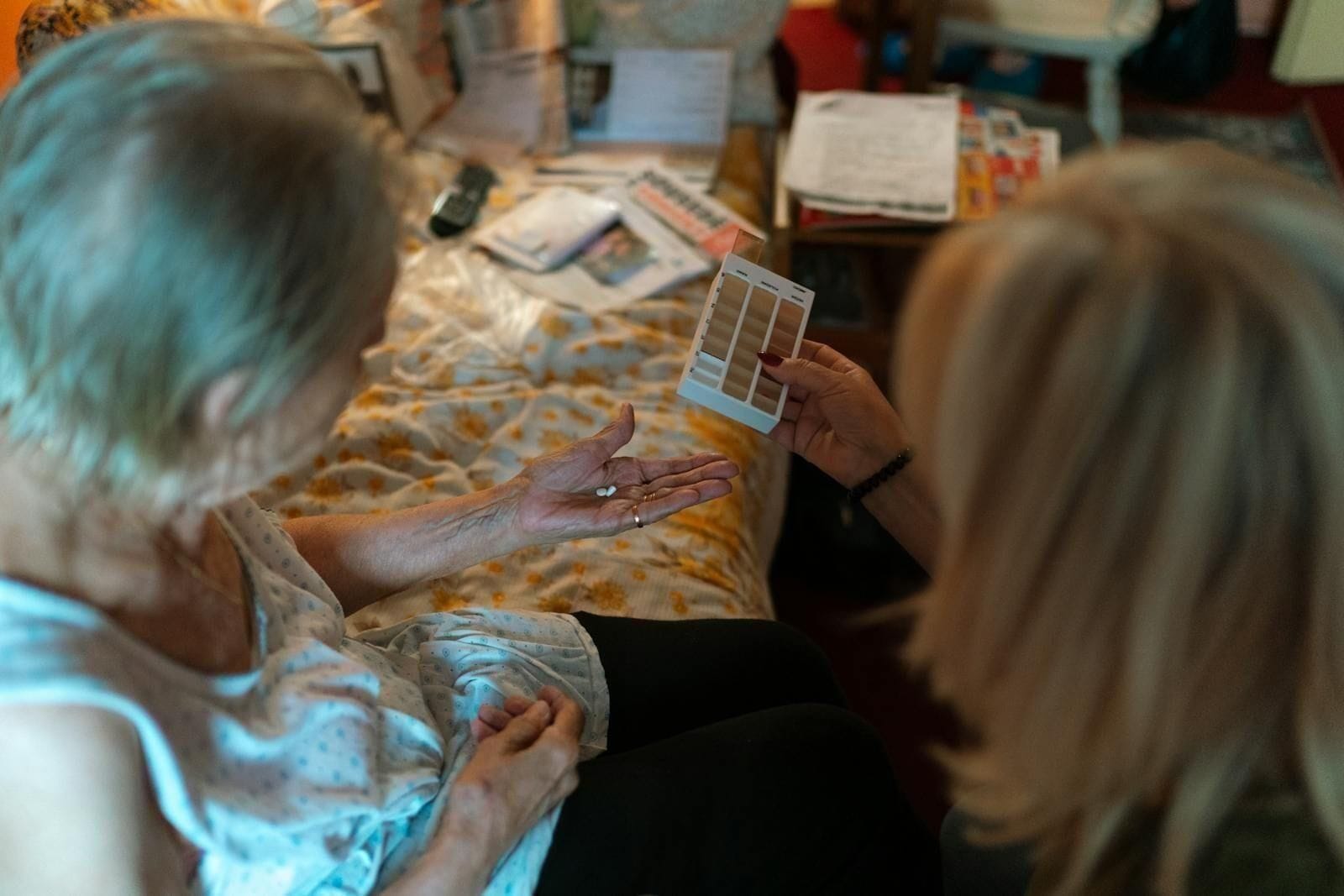
Families who know the diagnosis can do something about this. Most LBD clinicians ask families to keep a printed wallet card that identifies the diagnosis and lists the medications to avoid; to introduce themselves to every paramedic, ER physician, and hospital nurse with the words “he has Lewy body dementia and cannot have haloperidol”; and to bring a written list of safer options that the patient's neurologist has already approved. Quetiapine, pimavanserin, and in some cases clozapine are usually considered the safer choices for managing severe psychosis, but they must be used carefully and monitored closely. The most useful medication for the cognitive symptoms of LBD is often a cholinesterase inhibitor — donepezil or rivastigmine — which can sometimes improve attention, alertness, and even hallucinations without the dangers of an antipsychotic.
Anticholinergic medications — common in over-the-counter sleep aids, bladder medications, and some antidepressants — also tend to worsen cognition in LBD and are generally avoided. Dopamine agonists used for Parkinson's can sometimes intensify hallucinations. Sedatives can deepen the daytime drowsiness that is already a problem. It is not unusual for a careful review of an older patient's medication list, in the months after an LBD diagnosis, to reveal that several drugs they have been on for years are now doing more harm than good.
What Daily Caregiving Actually Looks Like
Lewy body dementia is one of the most demanding diseases to care for at home, not because the work is harder than other dementias but because it is harder to predict. Families describe weeks of steady progress and then a sudden Tuesday in which everything seems to fall apart, followed by another stretch of partial recovery. The caregiving load fluctuates with the disease, which means the help has to fluctuate with it.
Falls are the single largest physical risk. The combination of parkinsonian motor symptoms, dizziness from autonomic blood-pressure changes, fluctuating attention, and occasional hallucinations means that a person with LBD is at constant elevated risk of going to the floor. The home modifications used for any frail older adult become even more important: throw rugs out, electrical cords secured, grab bars installed in every bathroom, non-slip mats in the shower, bedside lighting, a clear path from the bed to the toilet at night. Nighttime is the riskiest time, because so many LBD patients have fragmented sleep and may wander, hallucinate, or simply forget that they need their walker.
The visual hallucinations require a particular kind of caregiving judgment. Early on, gently telling the person what is and is not real can be helpful and reassuring; later, as insight fades, arguing with the hallucination only causes distress. Many experienced LBD caregivers learn to redirect rather than refute. A wife who is insisting there are strangers in the kitchen is not going to be argued out of the belief by her husband; she may, however, be comforted by being walked into a different, well-lit room and asked to look at something familiar. Lighting matters more than most families expect. Dim rooms, busy patterned wallpaper, and the long evening shadows of late afternoon all worsen hallucinations.
REM sleep behavior disorder requires its own set of adaptations. Bed partners often move to a different room or to a separate bed in the same room to avoid being kicked or struck in the middle of a violent dream. The bed itself should be low to the floor, with no sharp furniture nearby; some families use mattresses on the floor for a time. Medications such as low-dose melatonin or clonazepam can reduce the severity of REM sleep behavior episodes, but they need to be managed by a clinician familiar with LBD. Disrupted nighttime sleep also helps explain the long daytime naps that so many LBD patients take, which in turn feed the disrupted nights — a cycle that is hard to break without help.
Autonomic symptoms — wild swings in blood pressure, especially the drops on standing that cause fainting; constipation; bladder problems; trouble with temperature regulation — round out the daily picture. They are easy to miss because they don't look neurological, but they make ordinary tasks like getting out of bed or eating a meal harder than they need to be.
The Fluctuations Are the Disease
More than almost any other dementia, LBD asks families to hold two truths at once: the person you love is still in there, and the person you love is changing in ways no one can fully predict. Good days are not improvement. Bad days are not the end. The fluctuating cognition that is one of the hallmarks of the disease is also the thing that most reliably tears families apart, because outside relatives often see only the good days and conclude that the primary caregiver must be making things sound worse than they are.
Practical advice from experienced LBD families: keep a simple daily log of what happened each day — alertness, mood, hallucinations, movement, sleep, appetite, falls. Over a month, the log reveals the underlying trend that the day-to-day variation hides. Doctors find these logs more useful than almost any other piece of information a family can bring to an appointment. They are also, on hard days, the single best argument against the natural human urge to believe that this morning's lucid hour means the disease is gone.
When to Bring in Outside Help
Most LBD families wait too long. The disease is unpredictable enough that families often catch themselves coping in the moment and postponing the bigger conversation about care, only to find themselves overwhelmed when a stage 5 episode lands them in the emergency department on a Saturday night. The most common pattern we see is families who first call for help in the middle of a crisis that, with a few hours a week of in-home support earlier in the year, would have been much smaller.
Our Alzheimer's and dementia care program is built around the way these diseases actually move — fluctuating, unpredictable, week to week, sometimes hour to hour. For families dealing with LBD specifically, the most useful version of this care tends to start small. A caregiver in the home for a few mornings a week, handling bathing safely so the spouse doesn't have to do the lifting, walking the patient outdoors when the weather is good, watching for the small autonomic problems that turn into bigger ones if missed. As the disease progresses, the schedule expands.
The other piece that LBD families benefit from disproportionately is overnight care . REM sleep behavior disorder, fragmented sleep, nighttime bathroom trips on unsteady legs, and the increased risk of falls in the dark all conspire to make the small hours of the morning the most dangerous part of a person with LBD's day. A caregiver who is in the house during those hours allows the family caregiver to actually sleep, which is more therapeutic than almost any other single intervention.
For families whose loved one has reached the moderately severe or severe stage and whose care needs have stopped looking like routine dementia care and started looking like the management of a complex medical condition, our specialized complex care program brings in nurses and caregivers experienced with the particular tangle of LBD — the medication landmines, the swallowing risks, the falls, the autonomic crises. Every plan is overseen by a registered nurse, because in LBD the line between “he's having a bad day” and “he's having a reaction to a new medication or a new infection” is often a clinical judgment, and that judgment is the thing that prevents emergencies.
Families across our service areas in Bergen County , Monmouth County , and the rest of central and northern New Jersey usually find us the way most LBD families find help: after the second or third episode that scared them, when they have realized that the disease is not going to slow down and the household routine that worked at stage three will not work at stage five. The earlier the call, the gentler the road.
Planning for the Years Ahead
Because LBD progresses on a five-to-eight-year arc on average, with enough variation to keep any prediction humble, the planning that matters most happens early — ideally in the first year after diagnosis, while the patient is still able to make their own decisions and articulate their own preferences. The Lewy Body Dementia Association's guidance on preparing families for end of life emphasizes that advance care planning conversations should happen as soon as the diagnosis is made, not years later when the person can no longer participate. Most families wait. Most families, later, wish they hadn't.
The conversations that matter are not glamorous. Where would you want to live if you can no longer manage at home? Who do you want to make decisions for you when you can no longer make them yourself? How do you feel about feeding tubes, hospitalizations, antibiotics in the late stages, hospice care? What music would you want playing in your last weeks? Families who have had these conversations describe the late stages of the disease as quieter, less anxious, and less marked by family conflict than the families who have not. The patient who has named the questions while still able to answer them has given the family the single greatest gift LBD allows.
One Last Thing
Lewy body dementia is, in some ways, two diseases. There is the disease that the books describe — the protein, the stages, the prognosis, the medications — and there is the disease that families actually live with, which is a long, fluctuating, often beautiful and often exhausting period in which a person you love changes by small and large degrees over years. The medical disease can be managed. The lived disease cannot really be managed; it can only be attended to, with patience and good company and small adjustments to a daily routine that has to be rebuilt every few months.
Most LBD families discover, somewhere in the middle of it, that their loved one is still themselves on the inside even when the outside looks like a stranger. The man who hallucinates a cat on the porch is the same man who held his daughter on the day she was born. The woman who cannot remember her grandson's name still recognizes the song she danced to at her wedding. The continuity of the person is not erased; it is filtered through a brain that is doing the best it can with the resources it has left, and on a good hour, that brain still does extraordinary things.
If your family is somewhere in this story — if the dreams have started, if the hallucinations have started, if the diagnosis has just been given and the road feels too long to walk — our care team is here . We will listen first. The right plan in the first year of LBD is rarely the plan a family pictures, because the disease has more shape and more change in it than most families know to expect. We can walk that with you.
Photographs by Dmitriy Tarasenko, Kampus Production, and Jsme MILA, licensed under the Pexels free-use license.