Walker or Rollator? How to Pick the Right Mobility Aid for an Aging Parent
Walker or rollator, plainly compared: how each one works, who each one is for, when a rollator is genuinely dangerous, and how to size and choose one well.
Roughly one in four Americans over sixty-five uses a mobility device of some kind — cane, walker, rollator, or wheelchair — according to a National Health and Aging Trends Study analysis published in the Journal of the American Geriatrics Society , and the share climbs sharply past seventy-five. A great many of those people are using the wrong device. Not catastrophically wrong — just wrong enough that the device is doing less than it could, or worse, doing harm. The most common mismatch is small and specific: someone who needs a standard walker is using a rollator, or someone who would do better on a rollator is still picking up a four-legged walker every step because nobody ever offered them an alternative.
The two devices look superficially similar in the catalog. They do completely different jobs. This guide is for the adult daughter or son standing in the medical supply store trying to pick one without a physical therapist in the room, and for the older adult who already owns one and is starting to wonder if it is still the right tool. The goal here is plain comparison, not product recommendation: what each device does, who each is for, when one becomes dangerous, and how to make the call with confidence.
The Difference, in One Sentence
A standard walker is for people who need to put weight on the device to take a step. A rollator is for people who need help with balance and endurance but can still carry their own weight. Confusing those two purposes is the most common, and most dangerous, mistake families make.
Everything else in this guide is detail around that one distinction.
How a Standard Walker Works
A standard walker is the simplest mobility aid on the market: a lightweight aluminum frame with four rubber-tipped legs, no wheels, adjustable in height, foldable for the car. To use it, the person plants the walker firmly in front of them, leans into the frame as they take a step, lifts the whole device a few inches off the ground, and places it forward again. Repeat. The gait it produces is slow and deliberate. It is also extraordinarily stable, because all four legs are in contact with the floor every time the person bears weight on the device.
The University of Arizona Center on Aging's clinician guidance, Choosing the Correct Walker , recommends a standard walker for patients who have an unstable gait and need to bear a significant amount of weight on the device — generally up to about half of body weight on each step. The standard walker is also the right answer for someone whose grip strength or reaction time is not reliable enough to operate hand brakes, and for someone whose balance is poor enough that a wheeled device could slide away under them.
A close cousin, the two-wheeled walker, swaps the front two rubber tips for small fixed wheels. The person no longer has to lift the frame to advance it; the front rolls and the back slides. It is slightly less stable than a standard walker but produces a more natural walking rhythm and is far easier on shoulders and wrists. The Mayo Clinic describes the two-wheeled version as a useful middle ground for people who need some weight-bearing help but find lifting a standard walker exhausting.
How a Rollator Works
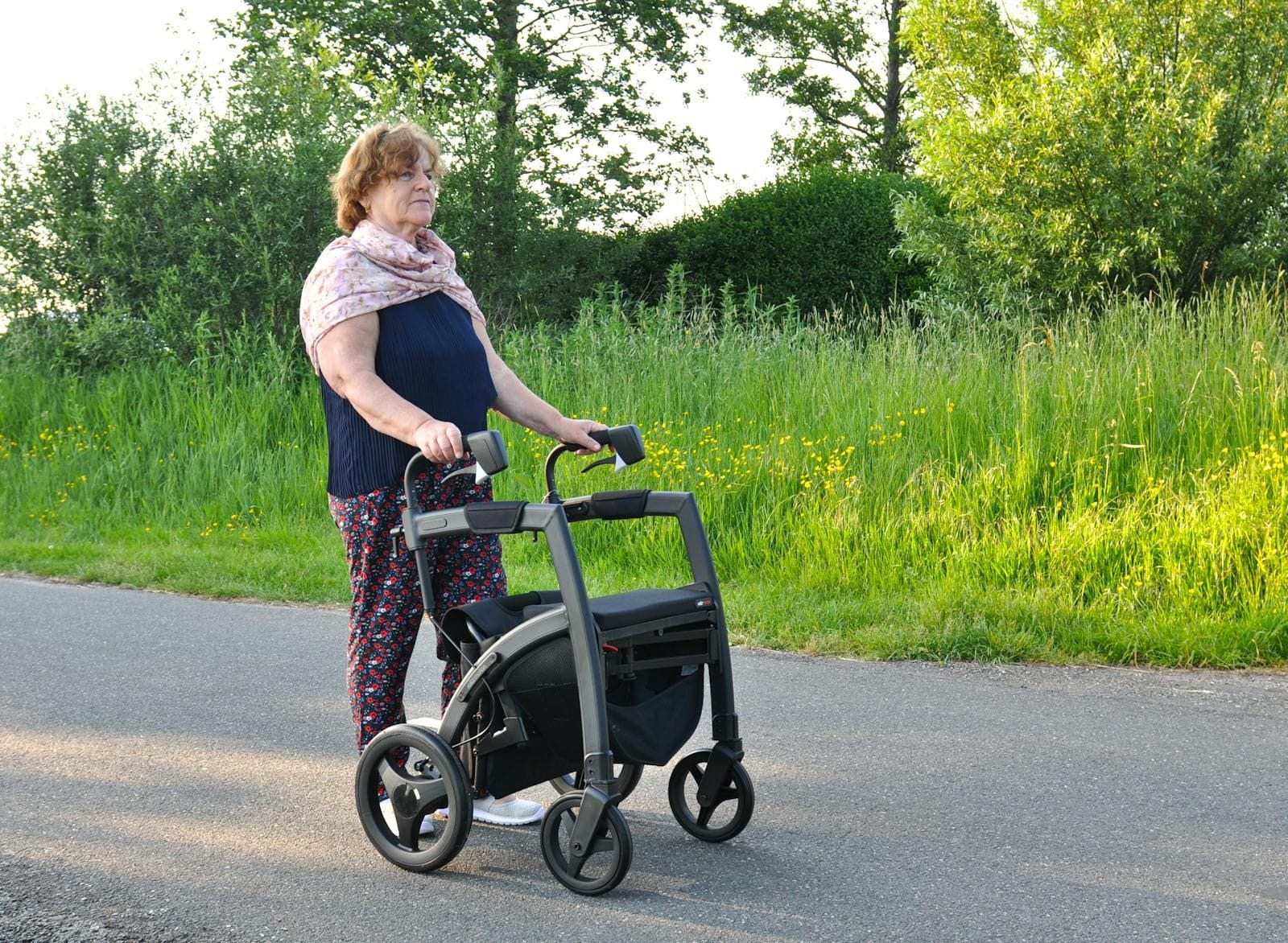
A rollator is a different machine wearing a similar name. The frame is heavier and taller. All four legs end in wheels, typically six to eight inches in diameter, with bicycle-style hand brakes on the grips and a built-in seat between the rear posts. Some models have three wheels instead of four, trading stability for tighter maneuverability in narrow halls. Most include a storage basket or pouch under the seat.
A person using a rollator does not lift the device at any point during normal walking. They push it forward on its wheels, hands resting lightly on the grips, ready to squeeze the brakes if the device starts to roll faster than they can keep up with. When they tire, they apply both brakes, brace the rollator against a wall or solid object, and sit down on the seat to rest. That seat is one of the rollator's biggest practical advantages: it lets people who used to give up on a walk because of fatigue finish the walk and rest along the way.
The trade-off is stability. Because the device rolls freely, it cannot be leaned on the way a standard walker can. Trying to put weight on a rollator that has not been braked is a common cause of falls — the device slides forward, the person follows it down. A 2019 systematic review of rollator-assisted gait published in the Journal of NeuroEngineering and Rehabilitation describes rollators as walking aids that improve mobility and endurance specifically by removing the lifting step, not by providing additional weight-bearing support. The clinical recommendation is consistent across the literature: rollators are for balance and stamina, not for weight.
Side by Side: Stability, Comfort, Storage, and Cost
The differences become easier to weigh when laid out directly:
- Stability. Standard walker, most stable — four legs planted at every step. Two-wheeled walker, slightly less. Rollator, least stable of the three, because nothing is anchored to the floor until the brakes are applied.
- Weight-bearing. Standard walker can support up to roughly fifty percent of body weight per step. Rollator is not designed for weight-bearing at all.
- Speed and gait. A rollator produces a far more natural walking pattern and a faster pace. A standard walker is slow and choppy. For many people, that gait difference is the difference between actually going for a daily walk and not.
- Rest. Only a rollator has a built-in seat. For someone whose limit is endurance rather than balance, the seat is the most important feature on the device.
- Indoor maneuverability. A standard walker fits through more doorways and turns more tightly in a small bathroom. A four-wheel rollator can feel bulky in older homes; a three-wheel rollator handles tight spaces better.
- Weight. A standard aluminum walker weighs five to seven pounds. A rollator usually weighs fifteen to twenty, sometimes more in bariatric or all-terrain models. Lifting one into a car trunk matters for whoever does it.
- Cost. A basic standard walker runs about thirty to sixty dollars. A solid four-wheel rollator with seat runs one hundred to two hundred and fifty. Lightweight or specialty models can climb past four hundred.
Who a Standard Walker Is Actually For
A standard walker is the right device for someone who:
- Needs to lean significant weight on the frame to take a step, whether because of leg weakness, severe arthritis, advanced Parkinson's, recovery from a hip or knee replacement, or generalized deconditioning after a long hospital stay.
- Has poor balance bad enough that a wheeled device would feel unsafe.
- Has grip strength or cognitive reaction time that makes operating hand brakes unreliable. People in moderate-to-late dementia, for example, often cannot be trusted to use brakes consistently.
- Mostly moves around indoors, on hard flat floors, and does not need to travel long distances at a stretch.
A frequent profile: the parent who was discharged from the hospital ten days ago after a knee replacement, is doing physical therapy three mornings a week, and needs to safely cross the kitchen to the bathroom. A standard walker, fitted and adjusted properly, is almost always the right tool for the first six-to-eight weeks. A rollator may become the right tool later.

Who a Rollator Is Actually For
A rollator is the right device for someone who:
- Can walk independently and carry their own weight, but feels unsteady on uneven ground or tires faster than they used to.
- Has been giving up activities they used to enjoy because they cannot make it back to a chair. The built-in seat changes that calculation completely.
- Wants to keep walking outdoors — to the corner mailbox, around the block, through a farmers' market, into a doctor's waiting room — and needs a device that handles the sidewalk.
- Has the grip strength and reflexes to operate the hand brakes promptly and reliably.
- Lives in a home where doorways and hallways can accommodate a larger frame, or is comfortable with a narrower three-wheel model for tight indoor spaces.
A frequent profile: a seventy-eight-year-old with moderate osteoarthritis, no recent surgery, who has stopped going on the daily walks she used to take because she runs out of steam halfway and panics about getting home. A rollator with a seat returns that walk to her almost overnight. The same person on a standard walker would probably leave it in the closet.
When a Rollator Is the Wrong Choice — and Dangerous
The honest version of this conversation: rollators are sold without prescription in big-box stores, marketed as the upgraded, more dignified option, and routinely bought by families for someone who actually needs a standard walker. The result is a predictable category of fall.
Three patterns turn a rollator into a hazard:
- Leaning into the frame. Someone who cannot walk without bearing weight on the device will instinctively lean on the rollator's grips. The wheels roll. The person keeps coming forward. The fall is usually onto the hands, knees, or face, often resulting in a wrist fracture or worse.
- Forgetting the brakes when sitting. The rollator seat is for resting against a wall or with brakes locked. A person who turns around and sits without engaging both brakes will find the seat sliding out from under them. This is one of the most common rollator injuries our caregivers see in clients new to the device.
- Outpacing the brakes on a slope. A rollator on a downhill driveway can accelerate faster than an older adult can react. People who live on hills, or who would routinely use a rollator on outdoor inclines, need either extra training, a heavier model with stronger braking, or a different device.
Cognitive impairment is the most important contraindication. A person in moderate dementia who can no longer learn a new motor routine reliably is not a safe rollator user, even if their physical mobility looks fine in clinic. The brakes have to be engaged at the right moment every time, and that requires judgment a moderately impaired brain may no longer provide. For households navigating Alzheimer's and dementia care , a standard walker or, in many cases, a wheelchair becomes the safer long-term tool. The presence of a trained caregiver during walking transfers — exactly the work our personal care aides do every shift — is often what allows someone with cognitive change to keep moving safely at home long after a family member alone could not provide enough hands.
What About a Cane?
A cane is a different tier of device, and it is worth naming briefly because many families move through it on the way to a walker or rollator. A cane provides one-sided support and can bear up to roughly a quarter of body weight, which is to say, it helps with mild balance issues or one-sided weakness — a sore hip, a healing ankle, mild general unsteadiness — but it does almost nothing for someone with two-sided weakness or significant balance loss.
The clinical rule of thumb from physical therapists is roughly this: a cane is for one-sided problems and mild balance issues; a walker is for two-sided weakness or poor balance with weight-bearing needs; a rollator is for endurance and balance without weight-bearing. People who progress from one to the next usually do so over months or years, not all at once.
Getting Sized, Fitted, and Trained
Whichever device is right, fit and training matter more than brand. A walker or rollator that is too tall makes the user lean back and lose balance. One that is too short makes them hunch forward, strains the back, and adds fall risk. The standard rule, repeated by physical therapy textbooks and equipment manufacturers alike: with arms relaxed at the sides, the grip height should land at the wrist crease. Elbows should bend about fifteen to twenty degrees when the person is standing tall and holding the grips.
Two practical steps that pay off enormously:
- Get a physical therapist involved. A single PT evaluation — covered by Medicare with a physician referral in most cases — produces a specific device recommendation, proper sizing, and a short course of training in safe use. The cost of the evaluation is trivial compared to the cost of one fall.
- Practice transfers at home before relying on the device. Getting up from a chair, sitting down on a toilet, navigating thresholds and rugs, opening doors — these are the moments where mismatched devices fail. Walking the rooms of the actual house with the device, ideally with a PT or trained caregiver beside the person, surfaces problems that look fine in a showroom.
Two home setup changes are worth doing the same week the device arrives: clear the floor of throw rugs and loose cords along the paths the person will travel, and put nightlights on the route between bed and bathroom. A separate primer on senior-proofing the home walks through the rest of the checklist.
Frequently Asked Questions
Is a rollator safer than a walker? No, not inherently. A rollator is safer for the right user — someone with balance and endurance needs but no weight-bearing requirement — and more dangerous for the wrong user. A standard walker is the safer device for anyone who needs to put weight on the frame.
Can someone use a walker outside? Yes, but it is slow going. The lifting motion required by a standard walker becomes tiring quickly on long walks, and the frame can catch on uneven sidewalk seams. People who want to walk outdoors regularly are usually better served by a rollator, assuming they have the balance and grip strength for one.
Does Medicare cover walkers and rollators? Original Medicare Part B covers walkers and rollators as durable medical equipment when prescribed by a physician for use in the home. Medicare typically pays eighty percent of the approved amount after the Part B deductible; supplemental insurance often covers the remainder. The prescription matters: buying off-the-shelf at retail without a prescription means no coverage and no fitting.
What is an upright walker? An upright walker is a relatively new style of rollator with chest-height grips designed to encourage straight posture and reduce lower-back strain. Some users love them; others find them awkward. They are worth trying in person before buying, since fit is more individual than with standard rollators.
Do you need a prescription to buy one? No, both walkers and rollators are sold over the counter. But you do need a physician's prescription if you want Medicare or most private insurance to cover it, and you generally need a physical therapy evaluation to get the right one. Buying without professional input is the most reliable way to end up with the wrong device.
How long do walkers and rollators last? A well-maintained standard walker can last five to ten years. A rollator typically lasts three to seven; the wheels, brake cables, and brake pads wear and need occasional replacement. Check rubber tips on standard walkers monthly — they wear smooth and become slip hazards when they do.
What if my parent refuses to use one? Common, and worth taking seriously. The resistance is usually about identity rather than the device. A few practical approaches: ask the doctor or PT to make the recommendation directly rather than having it come from an adult child; frame the device as something that protects independence rather than admitting decline; start with use only for specific situations (outside walks, after a fall) and let comfort build from there.

Making the Call at Home
For most families, the practical sequence looks like this. Call the primary care doctor and ask for a referral to outpatient physical therapy specifically for a mobility-aid evaluation. Use the PT visit to get the right device, the right size, and a short course of training. Bring the device home, walk the actual rooms with someone steady alongside, and notice where it works and where it does not. Adjust the home — rugs, lighting, thresholds — to match. Reassess in three months, because needs change, and a device that fit in May may not fit in November.
Across our service area in Monmouth County and Middlesex County , the families who do best with mobility devices are usually the ones who treat them as one piece of a larger setup — paired with a clear home layout, scheduled help for the high-risk moments of the day, and a willingness to swap devices as function changes. Our mobility care support is built to handle exactly that: the slow daily work of helping a parent or spouse use whatever device they have safely, transferring in and out of chairs, walking with a steady hand beside them, and noticing early when the device starts to outgrow them or they it.
If you are weighing the choice now and would like to talk it through with a nurse, our care team answers calls seven days a week. There is no perfect device that works for everyone, but there is usually one obvious right answer for any given person at any given point — and the right answer changes over time. The work is paying attention.
Hero photo by Rollz International via Pexels. Second photo by Spolyakov via Pexels. Third photo by Jordan Vilas via Pexels.