How to Manage Sundowning in Dementia: A Caregiver's Guide for Families
Sundowning makes evenings hard for people with dementia and their families. Here's what's happening, what helps, and when to bring in support.
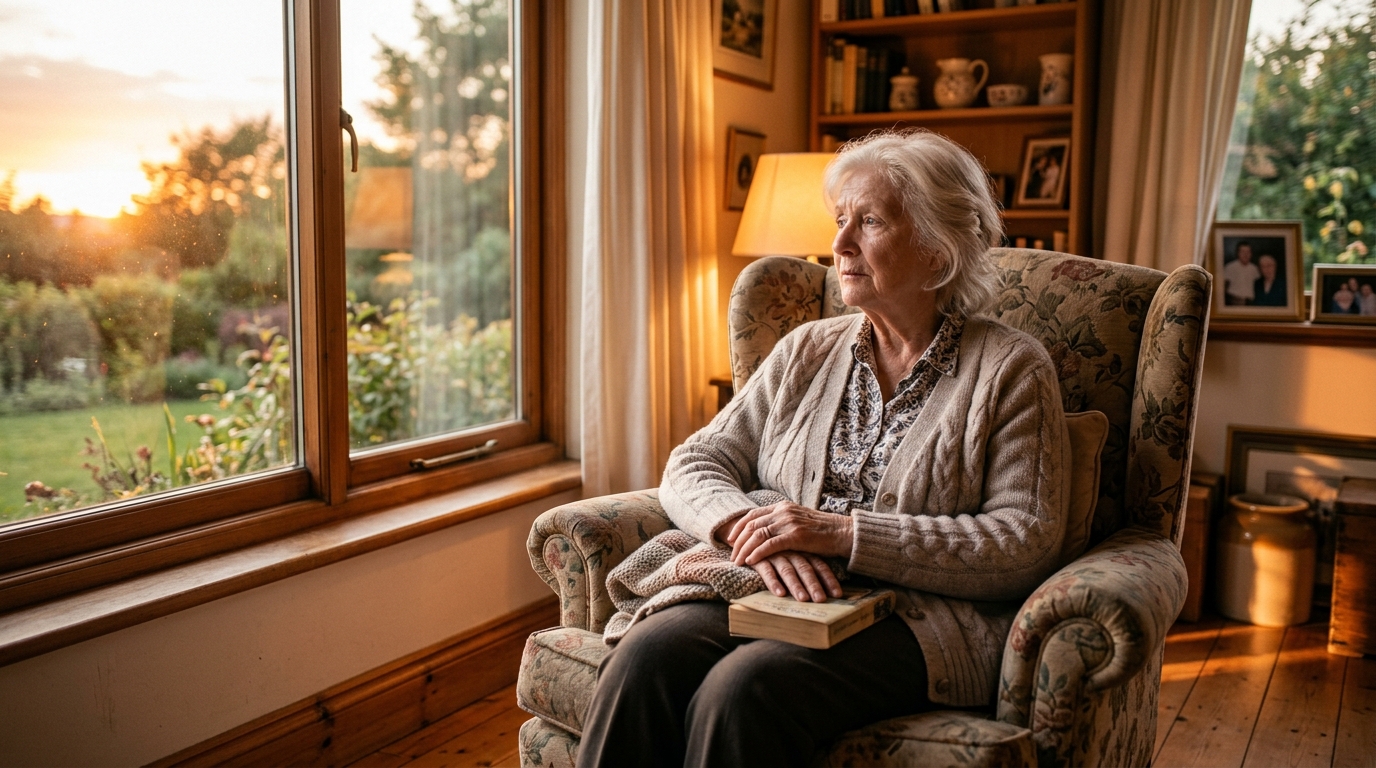
It almost always starts the same way. The afternoon was fine. Lunch was fine. Then somewhere around four o'clock, the light shifts. Your mother stops recognizing the kitchen she has cooked in for forty years. She insists it is time to go home — even though she is home. She paces. She is afraid of something she cannot name. By six, she is angry. By eight, you are exhausted and a little frightened yourself.
This pattern has a name. Clinicians call it sundowning, and once you have seen it a few times, you will recognize it like a season turning. It is one of the most disorienting parts of caring for someone with dementia at home — not because it is rare, but because it arrives every single day, on a schedule, and there is no real cure for it.
There is, however, a great deal you can do. Understanding what is actually happening — and what works to soften it — is one of the most useful things a family caregiver can learn. This is the guide we wish more families had on the day sundowning first appeared.
What Sundowning Actually Is
Sundowning is not a disease. It is a cluster of behaviors and emotional shifts that tend to appear in the late afternoon or evening in people living with dementia — most often Alzheimer's. The hallmark is timing. A person who has been relatively calm and oriented during the day becomes confused, agitated, anxious, or restless as the daylight begins to fade.
According to the National Institute on Aging , sundowning often shows up as restlessness, agitation, irritability, or confusion that begins or worsens as the day winds down. Some people pace. Some try to leave the house. Some demand to “go home” from the home they have lived in for decades. Others become tearful, suspicious, or hallucinate — seeing people or hearing sounds that are not there.
Researchers at Cleveland Clinic note that around 20 percent of people with Alzheimer's experience sundowning at some point during the disease. Other estimates run higher depending on how it is measured. What is consistent across the literature is this: it is common, it is real, and it almost always blindsides families the first time it happens.
Why It Happens (As Best We Understand It)
No one fully knows. The most honest answer researchers can give is that several different things probably stack on top of each other to produce a predictable late-day storm.
The leading theories include disruption of the brain's internal clock — the suprachiasmatic nucleus, the cluster of cells that governs our sleep-wake cycle, becomes damaged in many forms of dementia. Cumulative fatigue plays a role too. By late afternoon, a person with dementia has spent the entire day working harder than the rest of us to make sense of basic information. That cognitive load wears down what little reserve they have. The dimming light itself can be a trigger — shadows look like strangers, hallways look like tunnels, and the brain, already struggling to interpret what it sees, produces fear instead of recognition.
Pain, hunger, thirst, a full bladder, a urinary tract infection, a noisy environment, or a change in routine can each push someone into sundowning who might otherwise have a quiet evening. So can medication side effects. Sometimes — and this is worth saying out loud — the trigger is simply that the caregiver is also tired by 5 p.m., and the person with dementia feels it.

What Stage of Dementia Does Sundowning Occur In?
This is one of the most-asked questions families bring to us. The short answer is that sundowning can occur in any stage, but it is most commonly observed in the middle stages of dementia, sometimes continuing into the later stages and then easing as the disease progresses further.
In early dementia, families sometimes notice a precursor — a vague edginess in the late afternoon, a tendency to ask the same question over and over starting around dinnertime, a growing reluctance to be alone in a dim room. In the middle stages, the pattern becomes unmistakable: the same time each day, the same kinds of behaviors, the same exhaustion afterward.
The Alzheimer's Society describes sundowning as more frequent during the middle stage and later stages of the disease, often easing in the very advanced phases when overall alertness declines. Knowing that this is a phase, not a permanent new normal, can be quietly reassuring on the worst nights.
The Signs Worth Watching For
Sundowning rarely looks identical from one person to the next. But there are recurring patterns. If you have a parent or spouse with dementia, watch for these in the late afternoon and evening:
-
Increased restlessness, pacing, or wandering
-
Sudden anxiety, fear, or tearfulness without an obvious cause
-
Disorientation in a familiar room — looking at the kitchen as though it is a stranger's house
-
Repeating the same question or statement insistently (“I want to go home,” “Where is my mother?”)
-
Hallucinations, suspicion, or accusing family members of stealing
-
Resistance to bathing, changing clothes, or any caregiving task that was tolerable earlier in the day
-
Yelling, crying, or aggression that seems to come out of nowhere
One important note: a sudden change in pattern — sundowning that is dramatically worse than usual, or that appears for the first time in someone who has never had it — deserves a phone call to a doctor. It can be a sign of pain, infection, or a medication problem rather than the disease itself. The Alzheimer's Association recommends ruling out treatable causes before assuming an evening of agitation is “just sundowning.”
What Actually Helps
The most important thing to know is that nearly every recognized authority — from the National Institute on Aging to the Alzheimer's Association to the major teaching hospitals — recommends starting with non-medication approaches. Sedatives and antipsychotics can have serious side effects in older adults with dementia, and they are usually a last resort, not a first one. The everyday environmental and behavioral changes below are what tend to move the needle most.
Build the day around an early peak
People with dementia generally do best with a predictable rhythm. Schedule the most demanding activities — appointments, baths, visits from grandchildren, errands — in the morning, when cognitive reserves are highest. By mid-afternoon, the day should be tilting toward quiet and familiar. Save television, conversation, and stimulation for earlier hours.
Get sunlight early in the day
Bright light in the morning helps reset the circadian rhythm. A short walk outside, breakfast by a sunny window, or simply opening every blind in the house when your loved one wakes up can subtly anchor the brain's internal clock. This is one of the most consistent recommendations across every clinical guideline on sundowning.
Manage the light shift
As natural light fades, turn on indoor lights before the room starts to feel dim. Long shadows are one of the most common sundowning triggers. Close curtains as soon as the sun starts to set so that the visual transition from day to night is smooth, not abrupt. Soft, warm-toned lamps are friendlier than harsh overhead fluorescents.
Limit late-day stimulants
Caffeine after lunch, sugar at dinner, or a loud television in the early evening can each push someone into a worse sundown. So can a busy household — the dog wanting to go out, kids arriving home, two people talking at once. If you can quiet the environment for an hour starting around four, you have done more than most medications could do.
Rule out the boring causes first
When sundowning seems to start, do a quick check before assuming it is the disease. Are they hungry? Thirsty? Do they need the bathroom? Are they too hot or too cold? Is there a tag in their shirt scratching them? People with dementia often cannot articulate physical discomfort, so it surfaces as agitation. Solving the small thing solves the big thing more often than you would think.
Use distraction, not correction
When your father insists at 6 p.m. that he needs to pick up his children from school — and his children are 55 years old — arguing with the facts almost never helps. Acknowledging the feeling does. “You're worried about the kids. They're safe. Let's have some tea first.” A calm voice, a warm drink, a familiar song, a photo album, a task that gives the hands something to do — these often work better than explanation.
Have one quiet evening anchor
A small ritual at the same time every evening — folding warm laundry, listening to the same record, brushing the dog — can give the brain something to grip when the rest of the world stops making sense. Many families discover that the routine matters more than the activity. Same thing, same time, same place.

The Caregiver Piece No One Talks About
There is another part of sundowning that does not appear in clinical literature, and that we see in family after family: it is staggeringly hard on the caregiver.
Sundowning hits at the exact hour when most family caregivers — many of whom are also working full-time jobs, raising children, or running households — are at their most depleted. You are tired. Dinner is not made. The dishes from breakfast are still in the sink. And now your mother is convinced you are someone trying to harm her, and she will not be reasoned with.
The reason most home dementia care arrangements break down is not that the family stops loving the person. It is that the evenings become unsustainable. Sleep deprivation compounds. The caregiver's health begins to slip. Resentment shows up uninvited and brings shame with it. This is not a character failure. It is a predictable physiological response to caring for someone with sundowning alone, every night, for months or years.
If you recognize yourself anywhere in that paragraph, please hear this: it is not a sign that you are doing it wrong. It is a sign that the situation has outgrown what one person can do alone. That is the moment to consider bringing in support.
When Outside Help Becomes the Answer
There is a point at which the math stops working — when the late afternoons and evenings need more than one person can give, night after night. Professional caregivers who specialize in dementia can step in for the hours that are hardest, whether that is a few afternoons a week, every evening through bedtime, an overnight presence, or a fully live-in arrangement.
At Always Responsive Home Care , our caregivers are trained specifically for the rhythm of dementia — the redirection techniques, the calm voice, the patience to hear the same question for the fortieth time and answer it like the first. Many families bring us in for overnight care first, simply so the family caregiver can sleep. Others move toward live-in care when the sundowning hours have stretched into something closer to all night.
Every care plan we build is overseen by a registered nurse — because the difference between “just sundowning” and a UTI presenting as sundowning is sometimes a clinical judgment, and we want a clinician making it.
Families across Monmouth County and Middlesex County , along with our other New Jersey service areas, find their way to us most often through this exact challenge — the evenings that have started taking everything they have.
What to Hold Onto on the Hard Nights
Sundowning is not a character change in the person you love. The fear, the agitation, the strange certainty that this house is not their house — none of it is who they are. It is what is happening to a brain that is doing the best it can with a fading internal map.
The person you knew is still in there. The way they reach for your hand during a quiet moment, the music they hum without thinking, the way they laugh at something familiar — those things tend to come back, even after a rough evening. The sundown ends. Mornings, in our experience, are almost always softer than the night before.
And when it is too much — when the evenings have started to feel longer than the days — there are people whose entire job it is to walk into that hour with you. You do not have to do this alone. Most families discover, eventually, that they were never supposed to.
If you would like to talk through what care could look like for someone you love, our care team is here — and we are glad to listen first, before anything else.