Respite Care for the Elderly: A Complete Guide for Family Caregivers
What respite care actually is, what it costs, and how to find it. A practical guide for the family caregivers who haven't had a real break in months.

There is a particular kind of tired that family caregivers know and almost no one else does. It is not the tiredness that a weekend can fix. It is the kind that has settled into your shoulders and your sleep, that has quietly rearranged your social life and your savings account, that you no longer notice except in flashes — when a friend asks how you are doing and you hear yourself give an answer that is not quite the truth.
If any of that sounds familiar, this guide is for you. The thing you may not have a name for has one. It is called respite care, and it exists for exactly the kind of week you are having.
What Respite Care Actually Is
Respite care is short-term, planned relief for the family member or friend who is providing day-to-day care for an older adult. The older adult continues to receive the help they need — bathing, meals, medications, companionship, supervision — but from someone else, for a defined window of time. The family caregiver gets a break.
The National Institute on Aging describes respite as care that can last anywhere from a few hours to several weeks, delivered at home, in an adult day center, or in a residential setting like a nursing home or memory care community. The Family Caregiver Alliance puts it simply: respite is the “provision of short-term relief from the tasks associated with caregiving.”
Not a vacation. Not abandonment. Not failure. A scheduled, structured break designed into the care plan — because the math of full-time caregiving without one almost always breaks the caregiver before it breaks anything else.
Why It Matters More Than Most Families Realize
In 2025, AARP and the National Alliance for Caregiving released the most comprehensive look at family caregiving in the United States in nearly three decades. The headline number was sobering: 63 million Americans — almost one in four adults — are now providing ongoing care for a family member or friend. That is a 45 percent increase since 2015. Over forty percent of them now provide what researchers call “high-intensity care,” including medical tasks that used to happen only in hospitals. Roughly one in five reports being in poor health themselves. A quarter have taken on debt because of caregiving.
The Centers for Disease Control has tracked something quieter and just as important: caregivers are far more likely than non-caregivers to report frequent mental distress and clinical depression. The latest numbers put depression at 25.6 percent among caregivers compared with 18.6 percent among non-caregivers . The risk does not come from caring; it comes from caring without a break.
The most quietly heartbreaking finding in the AARP research, though, is about respite itself. Nearly four in ten family caregivers say they want respite services. Only fourteen percent receive them. Most have never used formal respite at all — many have never even heard the word.
That gap between “I need a break” and “I have one scheduled” is what this guide is here to close.

The Forms Respite Can Take
“Respite care” is an umbrella, not a single service. There are four common shapes it takes, and the right one depends on what your loved one needs and how your week is structured.
In-home respite
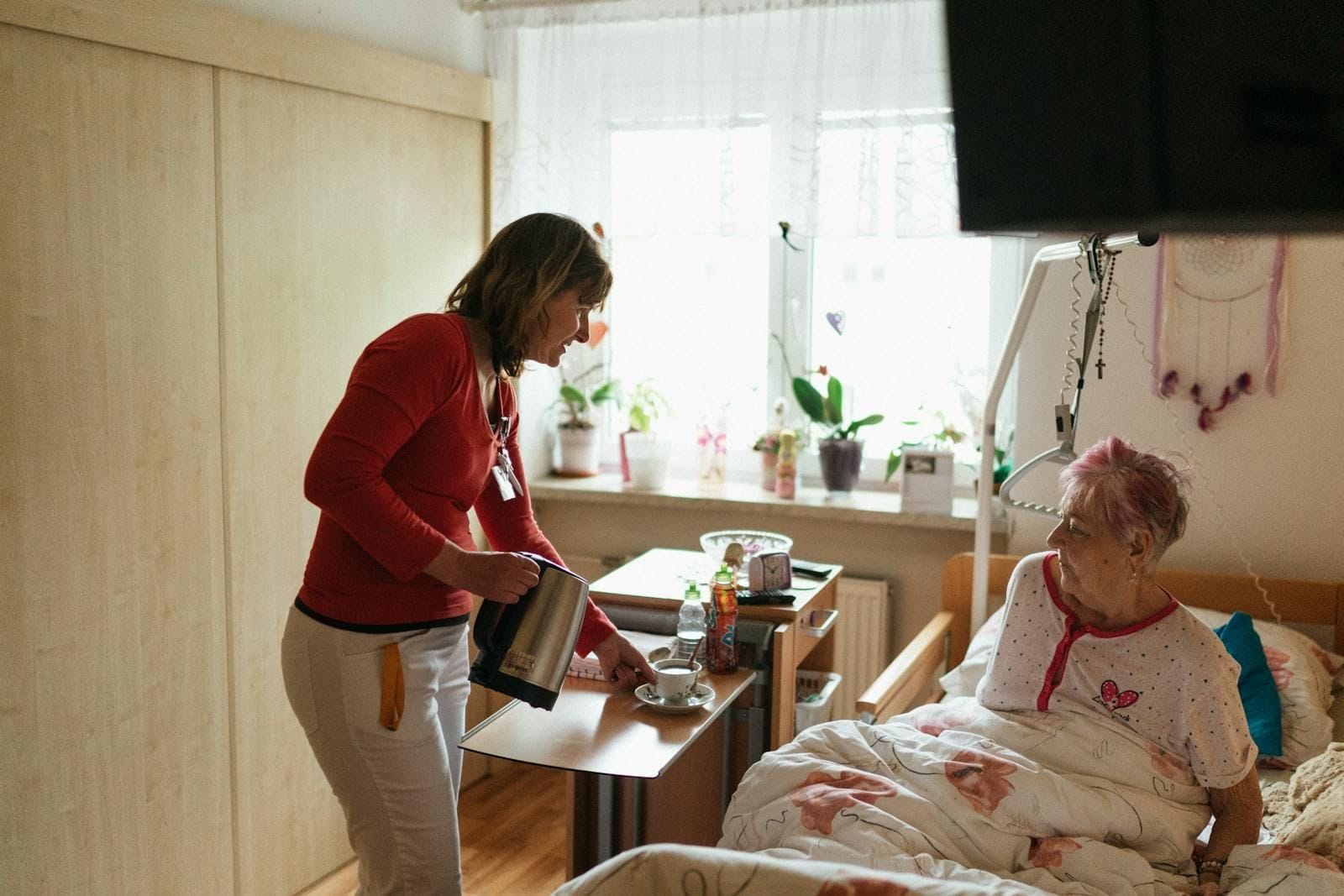
A trained caregiver comes to your home and takes over the day. They might sit with your mother for a few hours so you can run errands, drive to a doctor's appointment of your own, or have lunch with someone who is not going to ask you about her medications. They can help with bathing, toileting, meals, light housekeeping, supervision for someone with dementia, and gentle companionship. In-home respite is the most popular form of respite for families caring for someone with cognitive impairment, because it lets the older adult stay in the environment they know best.
Adult day services
Your loved one goes to a community center for part of the day — usually five to seven hours — and participates in activities with other older adults while professional staff supervise. Many adult day centers specialize in dementia care and offer therapeutic programming, meals, and basic health monitoring. This is often the most affordable form of respite per hour, and it has the side benefit of social engagement, which most homebound seniors are starved for.
Overnight or short-stay residential respite
Some assisted living and skilled nursing communities accept short-term residents for a few days to several weeks. This is the form of respite that lets families travel for a wedding, attend a funeral, recover from surgery, or simply sleep through the night for a week. The Alzheimer's Association maintains a thoughtful guide on choosing residential respite for someone with dementia, including what to ask about staff training and how to ease the transition.
Volunteer or informal respite
A neighbor, a faith-community visitor, a niece who can come for a Sunday afternoon. These breaks are precious and free. They are also, AARP's research has found, the kind most caregivers struggle to ask for and most often discover are too short to actually restore them. Informal respite is a wonderful supplement; it rarely works as the whole plan.
How to Tell You Need It
Most family caregivers are bad at noticing how depleted they have become, for the same reason that fish are bad at noticing water. The warning signs surface as small things first.
-
You have not had a full night's sleep in weeks, and you have stopped tracking how many.
-
You feel resentful — toward your loved one, your siblings, your spouse, yourself — and then you feel guilty for feeling resentful.
-
Your own doctor's appointments keep getting rescheduled. Your dental cleaning is overdue. You cannot remember the last time you exercised.
-
You have stopped returning calls from friends. Social events feel impossible to attend, then impossible to imagine.
-
You snap more easily — at the dog, at your kids, at the person you are caring for. Afterward, you cry in the car.
-
You have intrusive thoughts about how much easier life would be if your loved one were placed in a facility, immediately followed by shame.
-
You have started thinking, in a flat and matter-of-fact way, “I cannot do this much longer.”
None of those is a personal failing. They are predictable physiological and emotional consequences of providing intense care without scheduled relief. They are also, every one of them, signals that respite has stopped being optional.
What Respite Looks Like in Practice
Families come to respite in different ways. Some start small — a Tuesday morning every week, three hours at a time, just so the caregiver can go to the gym or sit at a coffee shop without their phone in their hand. Others start with a single weekend so the caregiver can finally attend a long-put-off family event. Many find their way to overnight respite first, because sleep is what has cracked open the rest of the problem.
The shape of the break matters less than the fact that it is scheduled, protected, and predictable. A respite arrangement that exists only “when you really need it” is a break that never quite happens. Caregivers don't reach for help in the moment they need it most; they reach for it after they should have. Building respite into the calendar before the next crisis is the entire point.
What It Costs and Who Pays
Respite is paid for in a patchwork of ways, and most families end up using more than one source.
In-home respite is generally billed by the hour. Adult day services charge a daily rate. Residential short-stay respite is priced per night, often at rates similar to assisted living. The exact figures vary by region and by level of care needed.
Most private health insurance plans do not cover respite, and standard Medicare home health care does not cover it either — with one important exception. If the older adult is enrolled in Medicare hospice , the program will pay for up to five consecutive days of inpatient respite at a contracted facility. Medicaid's Home and Community-Based Services waivers cover respite in many states, with substantial variation in eligibility and hours. Veterans may qualify for in-home respite and up to thirty days of residential respite annually through the VA. Some long-term care insurance policies include respite. Local Area Agencies on Aging frequently offer subsidized respite vouchers funded through the National Family Caregiver Support Program.
For everything not covered by those programs, families pay privately. Many are surprised to discover that even a few hours a week of in-home respite can be afforded by reorganizing existing spending — and that even modest respite is enough to change the shape of the year.
How to Find Respite That Fits
A few practical starting points, in roughly the order families work through them.
Begin with the ARCH National Respite Locator , a free directory maintained by the National Respite Network and Resource Center. It will surface state-specific programs and funding sources that most people never find on their own.
Call your local Area Agency on Aging. Every county has one, and they exist to point caregivers toward exactly the resources you are trying to identify. Many run their own subsidized respite programs.
If your loved one has dementia, contact the Alzheimer's Association's 24/7 Helpline (800.272.3900). Their care consultants are free and trained specifically to help families build a respite plan around cognitive impairment.
When you are ready to talk to a private home care agency, ask three specific questions early in the conversation. Are caregivers screened, trained, insured, and supervised? Is there a registered nurse overseeing the care plan? And — for families dealing with dementia — what specific experience do the caregivers have with cognitive impairment, including redirection, sundowning, and hygiene resistance? The answers will tell you quickly whether a given agency is set up for your situation.
Where Always Responsive Comes In
Most of what we do, day in and day out, is respite — even when the family doesn't use the word. A daughter caring for her mother who needs three afternoons a week to keep her own job. A husband caring for his wife with Parkinson's who can no longer safely transfer her alone. An adult son flying in from out of state who needs trustworthy overnight coverage so he can sleep on his visit. These are all respite arrangements, dressed in different language.
Our in-home respite care takes three shapes, depending on what the week needs.
Hourly care is the most common form of respite we provide — a few hours a day, a full day, or specific shifts each week. It is what most families need when they are looking for predictable weekly relief.
Overnight care is the form of respite that gives a family caregiver something they may have lost months ago: uninterrupted sleep. Our overnight caregivers manage toileting, repositioning, sundowning, and any nighttime emergencies so the family can rest with the door closed.
Live-in care is the deepest form of respite, often used when the situation has outgrown what a family can sustain at home alone but the family is not ready, or able, to consider a facility. A live-in caregiver becomes part of the household for extended periods, with relief shifts built into the schedule.
Every plan we build is overseen by a registered nurse, because the difference between “Mom is just having a hard week” and “Mom has a urinary tract infection that is presenting as confusion” is sometimes a clinical judgment, and we want a clinician making it. Most of our caregivers are specifically trained in dementia care — the redirection techniques, the calm voice, the hygiene strategies that work better than instructions.
Families across Monmouth County , Middlesex County , and our other New Jersey service areas typically come to us through exactly this door — the one labeled “I need a break, and I do not know how to take one.”
The Permission to Take One
The single most common thing we hear, from new clients, is some version of “I should be able to do this myself.” The single most common thing we say back is that no one was ever supposed to.
Caring for an aging parent or spouse used to be distributed across an extended family living within a few miles of one another. It is now, for most American families, the work of one or two people, often with full-time jobs and children of their own. The system has changed; the expectation hasn't kept up. Asking for respite is not a sign of weakness or a failure of love. It is the only way to make the love sustainable.
If you are not sure where to start, start small. Block out three hours next Tuesday. Have someone you trust come sit with your loved one. Go somewhere that is not your house and put your phone face-down on the table. Notice what happens to your shoulders.
And if you would like to talk through what respite could look like in your particular week, our care team is here . We will listen first, before anything else.
Photographs by Cottonbro Studio, Kampus Production, and Mila Photography, licensed under the Pexels free-use license.