Getting Through the Day With Arthritic Hands
What the finger-joint bumps mean, osteoarthritis vs rheumatoid, the treatments that work, and the daily workarounds that keep arthritic hands going.
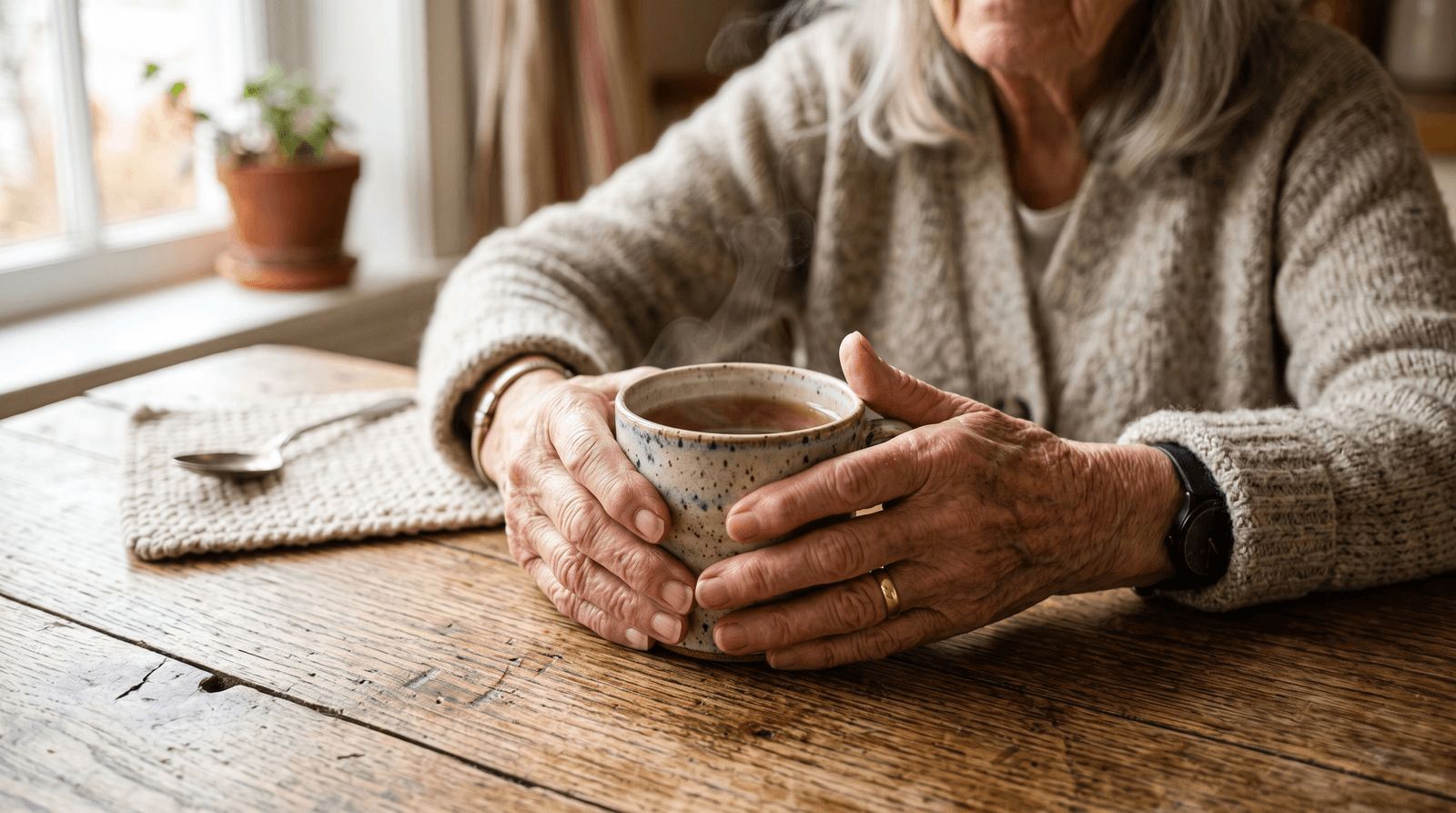
It usually announces itself over something small. A jar of jam that will not give. A key that no longer turns cleanly in the lock. A shirt button that takes three tries before breakfast. The hands have done these things ten thousand times without a thought, and then one ordinary morning they protest, and stay protesting.
If that is where you are, start with a piece of reassurance. Arthritis in the hands is common after 50, but it is not, as the Centers for Disease Control and Prevention puts it, a normal or inevitable part of aging, and a great deal of what makes it hard can be softened at home. The joints will not go back to being twenty, but the day can be made to fit the hands you have. The best way to see how is to walk through an ordinary one, hour by hour, and fix the moments where it bites.
First, the Good News
Most hand arthritis is osteoarthritis, the wear-and-repair kind, in which the smooth cartilage that cushions a joint gradually thins and the bone underneath thickens. It settles most often into the end and middle joints of the fingers and the joint at the base of the thumb, the one you use for every pinch and grip. The classic signs are a deep ache that worsens with use and eases with rest, stiffness that is worst in the morning and loosens as you move, a grip that has quietly lost its strength, and sometimes small bony bumps on the finger joints that look knobby and feel tender.
Those bumps have names, and knowing them takes some of the alarm out of watching a finger change shape. A bony swelling on the joint closest to the fingernail is a Heberden's node; the same swelling on the middle joint of the finger is a Bouchard's node. Both are the body's attempt to steady a joint whose cartilage has thinned, laying down new bone at the edges over a period of years. They are the most visible sign of hand osteoarthritis: a 2022 multi-center cohort study of people with diagnosed hand osteoarthritis found Heberden's nodes in 86 percent of them and Bouchard's nodes in 37 percent, most often on the third finger.
The good news is in the detail. A node that has fully formed is usually painless; what hurts is the joint underneath, and the months while the node is still developing. The same study found that Bouchard's nodes went along with measurably reduced hand function while Heberden's nodes on their own often did not, so a knobby fingertip is not a forecast of losing your grip. A lump that appears suddenly, looks red or warm, or sits on a joint other than those two is a different matter and worth having looked at, since cysts, gout, and rheumatoid nodules can all resemble it.
A less common but more urgent form is rheumatoid arthritis, an inflammatory disease that tends to hit the same joints on both hands at once, brings morning stiffness that lasts an hour or more, and can make you feel generally unwell. That distinction matters, and we will come back to it, because inflammatory arthritis needs a doctor's treatment to protect the joints. For the ordinary wear kind, though, the day is yours to manage, and it begins the moment you wake up.
7 a.m. — The Stiff-Handed Start
Arthritic hands are stiffest in the first hour, when the joints have been still all night. The instinct is to force them open and get on with things; the better move is to warm them first. Run them under warm water at the sink, soak them in a bowl of warm water for a few minutes, wrap them around the first hot mug of the day, or keep a microwavable heat pack on the nightstand. Heat is the single most reliable thing you can do for a stiff joint, and it costs nothing.
Once the hands are warm, wake them gently before you ask them to work. Open and close each hand into a loose fist a few times, spread the fingers wide and relax them, and slowly touch the thumb to each fingertip. This is not the exercise routine, just a two-minute unlocking, and it makes the buttons and the coffee scoop that follow far less of a fight.
Getting Dressed Without the Fight
Buttons, zippers, and clasps are designed for nimble fingers and a firm pinch, which is exactly what hand arthritis takes away. The fix is partly tools and partly technique. A button hook and a zipper pull turn fiddly fastenings into a single easy motion, and choosing front-closing clothes, larger buttons, elastic waists, and slip-on shoes removes whole categories of struggle from the morning.
The technique is a principle worth carrying through the entire day, the one occupational therapists call joint protection: use your biggest, strongest joints for the job, and avoid a tight pinch whenever a broader grip will do. Push a drawer with a flat palm rather than a hooked finger; carry a bag on your forearm, not pinched in your fingers; spread a load across two hands instead of one. For anyone who finds dressing and grooming has become the hardest, most tiring stretch of the day, a caregiver's hand with personal care can take the strain out of it and return the morning to something calm.
Breakfast and the Jar That Won't Budge
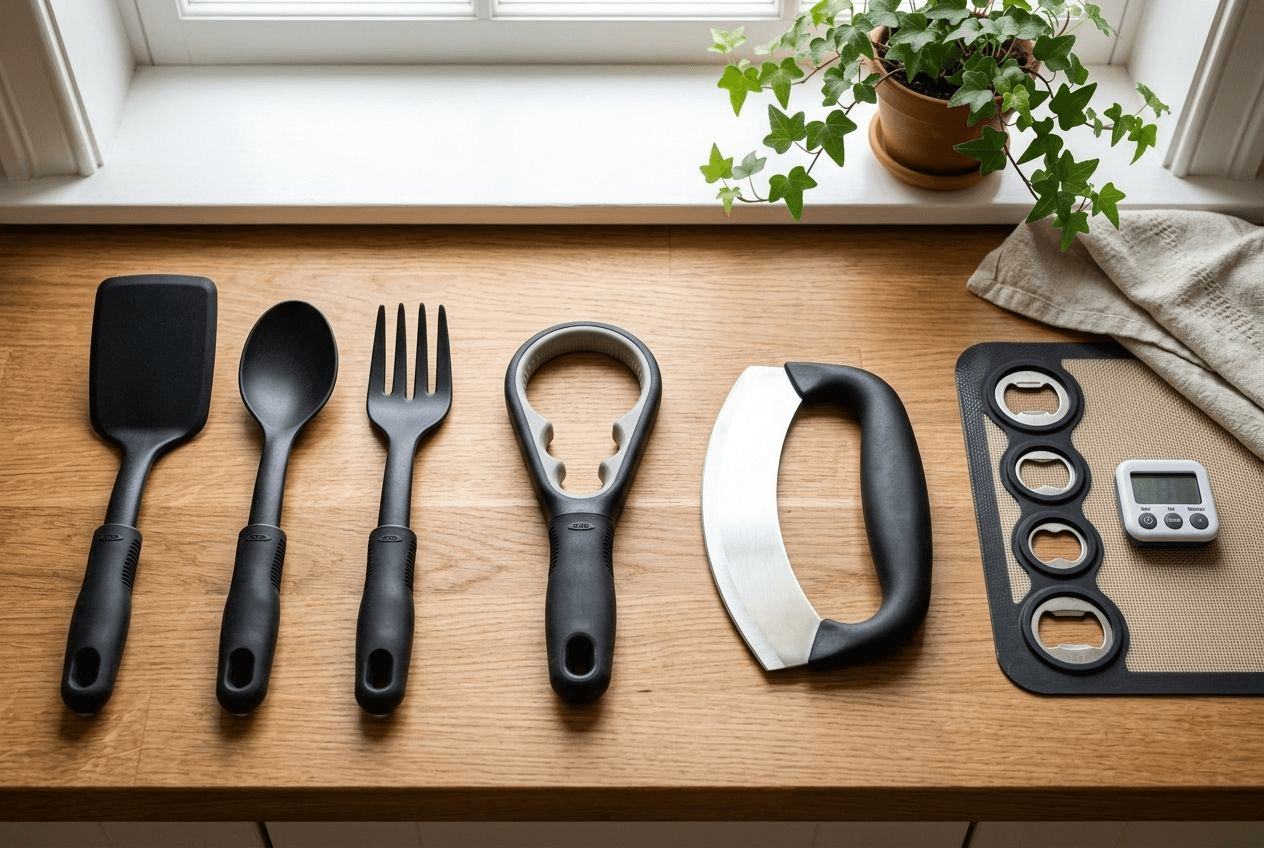
The kitchen is where hand arthritis shows off, because so much of it is grip and twist: jar lids, can openers, peeling, chopping, lifting a full pan. Almost every one of those has a workaround that shifts the effort off the small finger joints and onto bigger muscles and simple leverage.
- Lids and jars. A wall-mounted or electric jar opener, or a rubber grip pad, does the twisting for you. Better still, buy foods in easier packaging when you can, and loosen a stubborn lid by running it under hot water first.
- Cutting and peeling. Keep knives sharp, since a dull blade demands far more force, and choose fat, cushioned handles that fill the palm. A rocker knife lets you cut with a downward press instead of a grip.
- Lifting. Slide heavy pots rather than carrying them, use two hands and a padded mitt, and pour from a lightweight kettle rather than a heavy full one.
When cooking and the daily round of the kitchen have simply become too much on their own, that is a common reason families first ask about help at home. A little homemaker support with meal preparation and the tasks that lean hardest on the hands can keep someone eating well and living independently without every jar becoming a defeat.
Out the Door: Keys, Doorknobs, and Pill Bottles
Leaving the house is a gauntlet of small twisting motions, each one aimed squarely at the base of the thumb. Round doorknobs are among the worst offenders; swapping them for lever-style handles, which you can push down with a whole hand or even an elbow, is one of the highest-value changes you can make in a home. The same goes for lever faucet handles at the sink.
For the rest, small aids do a lot. A key turner gives you a fat lever to grip instead of a thin key to pinch, and there are versions for car doors and ignitions too. Ask your pharmacist to dispense medications in easy-open caps rather than child-resistant ones, and use a weekly pill organizer with large, easy-to-open compartments so you are not wrestling a bottle every morning. None of these cost much, and together they quietly remove a dozen daily provocations.
The Afternoon Hand Workout
Somewhere in the day, ideally when the hands are warm rather than cold, give them a few minutes of gentle movement. Range-of-motion and light strengthening exercises will not reverse arthritis, but they keep the joints from stiffening, maintain the muscles that support them, and can ease pain, which is why the Arthritis Foundation and Mayo Clinic both recommend them. Move slowly, stop short of pain, and skip the squeezing exercises on days a joint is hot and flaring.
- Gentle fist. With the hand open and fingers straight, slowly curl into a loose fist with the thumb resting on the outside, then open and spread the fingers wide. Repeat about ten times per hand. Do not squeeze.
- Finger bends. Holding the hand up, bend one finger at a time down toward the palm, hold a second or two, and straighten it. Work through each finger and the thumb.
- Make an O. Curve all the fingers inward until the tips touch the thumb, forming a rounded O, hold for a few seconds, then straighten.
- Thumb walk and touch. Touch the tip of the thumb to the base of the little finger and back, then touch it to each fingertip in turn, keeping the movements smooth.
- Table lifts. Rest the hand flat on a table and lift one finger at a time a short way off the surface, hold, and lower it. This works the small muscles without any gripping.
A soft foam ball or a piece of therapy putty adds gentle resistance once the joints tolerate it, but leave those out during a flare. If you are unsure which movements suit your particular joints, an occupational or physical therapist can build a routine around them and check your form.
When a Flare Hits
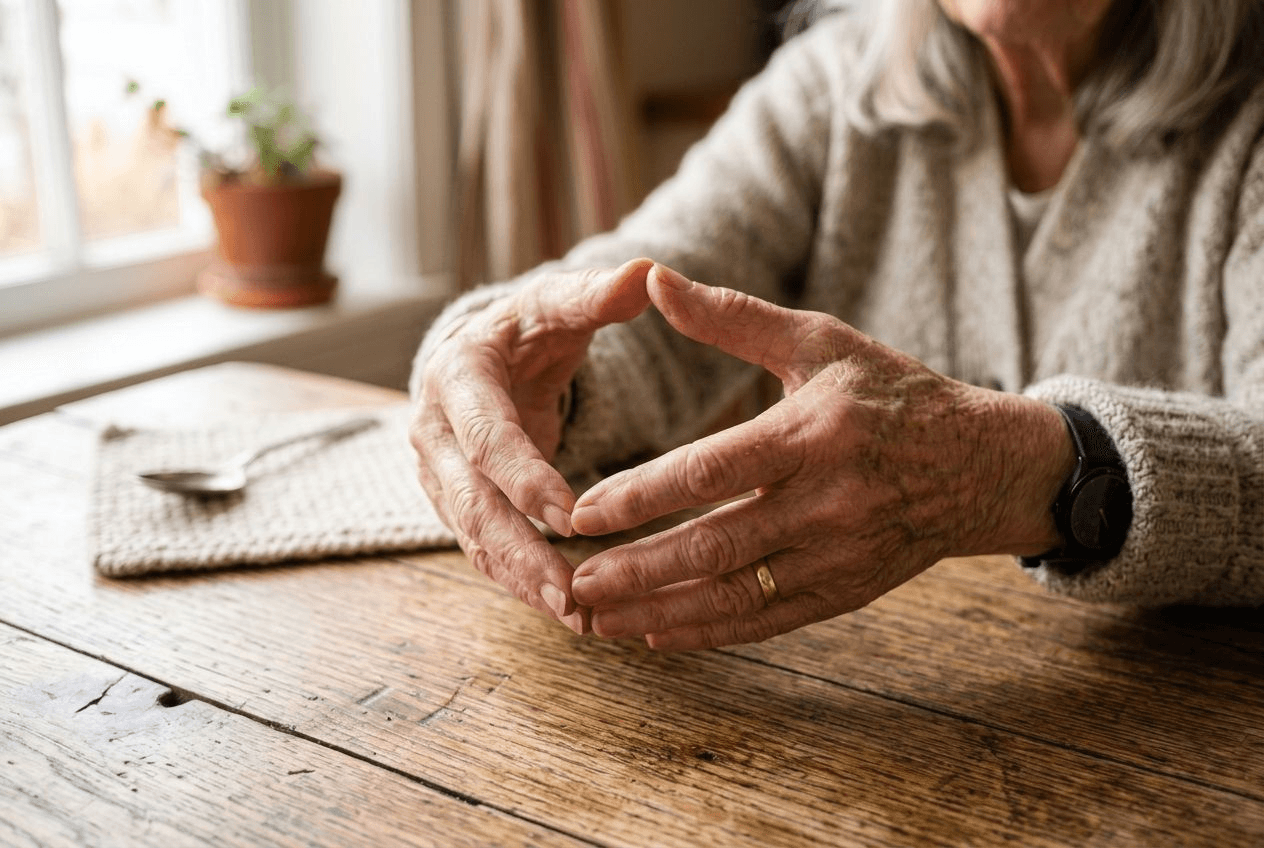
Some days a joint wakes up hot, swollen, and cranky no matter how careful you have been. A flare is not a failure; it is a signal to change gears for a day or two. Rest the angry joint rather than pushing through, and reach for the opposite of the morning's advice on temperature: where heat loosens a stiff joint, a cold pack is often better for calming one that is inflamed and swollen. Try each and use whichever brings more relief.
A snug splint that rests the joint, particularly one supporting the base of the thumb, can take the load off while it settles, and an over-the-counter topical cream or pain reliever can bridge the worst of it, though it is worth asking a pharmacist or doctor which is safe with your other medications. Drop the resistance exercises until the flare passes, keep up only the gentlest range-of-motion movement so the joint does not stiffen, and go easy on yourself. Flares come and go; the day after is usually kinder.
Evening: Setting Up Tomorrow
A little care at night pays off at the stiff-handed start you already know is coming. A warm soak while you wind down leaves the joints looser going to bed. Some people find a light night splint keeps a painful thumb or wrist from settling into an awkward position overnight and eases the morning; a doctor or therapist can advise whether that fits your case.
Then set the next morning up to be easy. Lay out front-closing clothes, leave the button hook and the key turner where your hands will find them, and load the pill organizer while the hands are at their warmest and most cooperative, in the evening, rather than fumbling with it cold at dawn. Small preparations like these are how a good day is quietly built the night before.
When It's Time to Call the Doctor
Most hand arthritis is managed at home, but some signs mean the hands need a professional look rather than another gadget. Call a doctor if a joint turns suddenly and markedly hot, red, and swollen, which can indicate an infection or gout rather than wear. Get evaluated if several joints flare together, if the same joints on both hands are stiff, swollen, and warm, or if morning stiffness routinely lasts more than an hour, since that pattern points toward rheumatoid or other inflammatory arthritis, which needs prompt treatment to protect the joints. A fever alongside a hot joint is a reason to be seen the same day.
Telling osteoarthritis from rheumatoid arthritis is most of what that visit is for, and the two leave different fingerprints. Osteoarthritis is wear. It builds slowly and usually lopsidedly, one thumb or one index finger giving out before its twin, and it settles into the joints closest to the fingertips, the middle finger joints, and the base of the thumb. Its morning stiffness fades inside half an hour, and the ache comes back at the end of a long day of using the hand. As Harvard Health's comparison of the two puts it, osteoarthritis rarely makes a joint feel warm to the touch and almost never brings fatigue or fever with it.
Rheumatoid arthritis is an autoimmune disease, in which the immune system attacks the lining of the joints. It tends to arrive over weeks or a few months, in both hands at once and in mirror image, favoring the knuckles, the middle finger joints, and the wrist, and it typically spares the joint closest to the fingernail, the inverse of the osteoarthritis pattern. Morning stiffness lasts an hour or longer and usually comes with visible swelling, warmth, a flu-like tiredness, and sometimes a low fever. The National Institute of Arthritis and Musculoskeletal and Skin Diseases notes that early treatment with disease-modifying drugs dramatically slows the joint damage untreated rheumatoid arthritis causes, which is why a rheumatology referral matters so much more here than it does for ordinary wear.
A rheumatologist settles the question with a careful physical exam, blood tests for rheumatoid factor and anti-cyclic citrullinated peptide (anti-CCP) antibodies, and X-rays. A positive blood marker is close to conclusive; a negative one is not, because roughly a quarter of people with rheumatoid arthritis never test positive for either.
Short of an emergency, it is also simply worth telling your doctor when hand pain is steady, waking you at night, or eroding what you can do, rather than assuming nothing can be done. A referral to an occupational therapist, in particular, is one of the most useful things a person with hand arthritis can get; it is their specialty to match tools and joint-protection habits to your exact difficulties.
The Treatment Ladder Doctors Actually Climb
When the measures at home stop being enough, what comes next follows a well-mapped order. The 2019 American College of Rheumatology and Arthritis Foundation guideline for hand, hip, and knee osteoarthritis is the clearest map of what the evidence supports, and for the hand it puts four things at the top with strong recommendations: exercise, self-management programs, a splint for the base of the thumb, and oral anti-inflammatory drugs. Heat treatments including paraffin baths, corticosteroid injections into a joint, kinesiotaping of the thumb base, topical anti-inflammatories, and chondroitin sulfate all earned weaker, conditional support.
What came off the list is just as worth knowing. Topical capsaicin is not recommended for the hands, because of how easily it ends up in an eye. Acetaminophen lost the first-line place it held in the older guideline, since the accumulated trial evidence found its pain benefit small and short-lived, though it remains a reasonable short-term substitute for someone who cannot take an anti-inflammatory, as long as they know the Tylenol side effects to watch for in older adults and the lower daily ceiling that comes with age. The drugs that work in rheumatoid arthritis, TNF inhibitors and interleukin-1 blockers, do nothing for osteoarthritis, and stem cell injections lack the standardization and the evidence to count as care at all.
Read practically, the ladder looks like this. Start where this article started, with exercise, joint protection, and the tools that keep load off the small joints. Add a thumb-base splint when the base of the thumb is the main trouble. Reach for a topical anti-inflammatory first for breakthrough pain, since it carries less whole-body risk than a pill, then oral anti-inflammatories, then a cortisone injection for one stubborn joint. Surgery enters the conversation only after six months or more of doing the rest properly.
Splints, Heat, and Creams: What the Evidence Says
A well-fitted splint for the base of the thumb is one of only four interventions that guideline strongly recommends, and there are two common kinds. A thermoplastic splint is moulded by a hand therapist directly to your thumb and wrist and sets rigid. A neoprene splint is a softer, lower-profile sleeve that supports the joint without immobilizing the wrist. Both reduce thumb-base pain in short trials, and neither has been shown to prevent eventual surgery in advanced disease, so a splint is there to manage symptoms and keep the hand working rather than to change the course of the arthritis. Most people wear the soft one more faithfully because it gets in the way less; the rigid one tends to come out at night or for specific painful jobs.
Heat holds up well under scrutiny. Paraffin baths, warm-water soaks, and microwavable rice or flaxseed packs all loosen stiffness, and the usual protocol is ten to fifteen minutes before exercises or before a task you know will hurt. The mechanism is unglamorous: warmth makes tissue more pliable and quiets the pain signal. The effect is short-lived, which is precisely why it belongs at the front of the morning rather than saved for later in the day.
Among the creams, topical diclofenac, sold over the counter as Voltaren Arthritis Pain since 2020, has the most evidence behind it. It is a particularly good choice for adults over 75, for anyone with a history of gastrointestinal bleeding, and for people on blood thinners or with reduced kidney function, all of whom have reason to avoid the whole-body exposure of an oral anti-inflammatory. The catch is handwashing: the gel has to stay on the skin to work, and hands get washed all day. People who get results from it tend to apply it after the last real handwashing of the morning, before bed, or both.
Cortisone Injections and the Surgical Conversation
An injection of corticosteroid straight into the joint capsule through a fine needle is conditionally recommended for hand osteoarthritis. The evidence behind it is thinner than for the same injection in a knee, but the procedure is low-risk and the relief, when it comes, can last weeks to several months. The usual reason to reach for one is a flare at the base of the thumb or in a single badly symptomatic finger joint. Most physicians limit any one joint to about three or four injections a year, on the concern that more frequent steroid exposure can speed up cartilage damage.
Surgery becomes a conversation mainly for severe arthritis at the base of the thumb that has not answered to a genuine six months of splinting, exercises, anti-inflammatories, and an injection or two. The standard operation is a trapeziectomy with ligament reconstruction and tendon interposition: the small trapezium bone at the base of the thumb is removed, and a tendon graft is woven into the space it leaves for cushioning and stability. Recovery runs about four weeks in a thumb spica splint, with gentle motion starting in the first week, strengthening at six to eight weeks, and unrestricted activity at ten to twelve weeks, while heavy pinching and grip-intensive work waits several months more. Long-term results are generally good and the pain relief durable, though grip strength often stays a little below the other hand.
For the finger joints themselves the options are narrower. Fusing a badly arthritic end joint trades away movement at that one joint for a stable, pain-free finger, and finger joint replacement exists but is reserved for selected cases. Either way the decision belongs with a hand specialist rather than a primary care physician, and it sits at the end of the ladder rather than in the middle of it.
Steadier Hands, One Day at a Time
Living well with arthritic hands is rarely about one big intervention. It is a hundred small adjustments spread across an ordinary day: the warm soak before the buttons, the lever handle instead of the knob, the jar opener on the counter, the two minutes of gentle movement in the afternoon, the pill organizer filled the night before. Each one removes a little friction, and together they hand the day back to you.
When the tasks that lean hardest on the hands start to crowd out the rest of life, a bit of steady help is often what keeps someone in their own home and their own routine. Across our Middlesex County, New Jersey service area and beyond, our caregivers take on the buttons, the jars, and the meal prep that stiff hands find hardest, so the day stays about living rather than wrestling with it. The joints set the terms; the goal is simply to make the day fit the hands you have.
This article is for general information and is not medical advice. Talk with your doctor or an occupational therapist about diagnosing and managing hand arthritis, and before starting a new exercise or treatment.
Frequently Asked Questions
What are the first signs of arthritis in the hands?
The earliest sign is usually stiffness that is worst first thing in the morning or after the hands have been still for a while, easing once you start moving them, typically within ten to thirty minutes. Alongside it comes a deep ache in the finger joints or at the base of the thumb that gets worse with use and better with rest, and a quietly weakening grip that turns everyday tasks like opening jars, turning keys, and buttoning shirts into a struggle. Over time, osteoarthritis can leave small bony bumps on the middle and end joints of the fingers, which may look knobby and feel tender. Occasional swelling, a grinding or clicking sensation in a joint, and a loss of the smooth, full range of motion round out the picture. Any one of these on its own is common; several together, in an older adult, usually points to hand arthritis and is worth mentioning to a doctor.
Are the bumps on my finger joints a sign of arthritis?
Most likely yes, and most likely osteoarthritis. A bony swelling on the joint closest to the fingernail is called a Heberden's node; the same swelling on the middle joint of the finger is a Bouchard's node. Both form slowly over years as cartilage thins and the body lays down new bone at the edge of the joint to steady it. A 2022 multi-center TLAR cohort study of people with diagnosed hand osteoarthritis found Heberden's nodes in 86 percent of them and Bouchard's nodes in 37 percent. Once a node has fully formed it is usually painless; what hurts is the joint underneath, and the months while the node is still developing. A lump that appears suddenly, looks red or warm, or sits on a joint other than those two is worth having looked at, since cysts, gout, and rheumatoid nodules can all resemble it and are managed differently.
What is the best way to relieve arthritis pain in the hands?
No single thing works for everyone, so the goal is to stack several small, low-risk measures. Warmth is the most reliable: a warm soak, a paraffin bath, a heating pad, or simply holding a warm mug loosens stiff joints and eases the morning ache, while a cold pack can calm a hot, swollen joint during a flare. Resting an irritated joint for a day or two, rather than pushing through, often settles it faster than gritting through the pain. A snug thumb or finger splint supports the joint and is especially helpful for arthritis at the base of the thumb. Gentle range-of-motion exercises keep the joint from stiffening further, and over-the-counter topical creams or oral pain relievers can take the edge off; ask a pharmacist or doctor which is safe alongside your other medications. If pain is constant or waking you at night, that is a reason to see a clinician about stronger options.
Do hand exercises actually help arthritis?
Yes, within limits. Moving a joint through its full range keeps it from stiffening, maintains the strength of the muscles that support it, and can reduce pain and improve day-to-day function. The exercises are not a cure and will not reverse the joint damage, but they help the hand stay usable, which is the practical aim. The evidence is stronger than most people expect. The 2015 SARAH trial in The Lancet randomized adults with rheumatoid arthritis of the hands to a tailored daily home program or to usual care, and after twelve months the exercise group's hand function had improved roughly twice as much; a follow-up found the gains disappeared in people who stopped doing the exercises, which is the important practical detail. A separate randomized trial in women with hand osteoarthritis found significant improvements in grip strength, about 54 newtons in the dominant hand, along with better pinch strength and daily function, and the 2019 American College of Rheumatology guideline strongly recommends exercise for hand osteoarthritis. The rules matter: move slowly and smoothly, stop short of pain rather than forcing a motion, and keep the effort gentle, since squeezing and gripping exercises can aggravate a hand that is in an active flare. A few minutes once or twice a day beats one long session, and warming the hands first makes everything easier. An occupational or physical therapist can tailor a routine to your specific joints, and many people see the most benefit when exercise is paired with joint-protection habits rather than done on its own.
What is the best cream for arthritis in the hands?
Topical diclofenac, sold over the counter as Voltaren Arthritis Pain gel since 2020, has the most evidence behind it. The 2019 American College of Rheumatology guideline conditionally recommends topical anti-inflammatories for hand osteoarthritis, and they are a particularly good choice for adults over 75 and for anyone with a history of stomach ulcers or gastrointestinal bleeding, reduced kidney function, or another reason to avoid the whole-body exposure of an oral anti-inflammatory. The catch is practical rather than medical: the gel has to stay on the skin to work, and hands get washed many times a day, so people who do well with it tend to apply it after the last real handwashing of the morning, before bed, or both. The same guideline recommends against topical capsaicin on the hands because of how easily it ends up in an eye. Ask a pharmacist or doctor before adding any of them alongside your other medications.
What gadgets help with arthritis in the hands?
The useful ones all share a principle: they let you use big muscles and open hands instead of small joints and tight pinches. In the kitchen, an electric or grip jar opener, fat-handled utensils, a rocker knife, and a kettle or pan you can lift with two hands spare the fingers. Around the house, lever-style door handles and faucet levers replace round knobs that demand a twisting grip, key turners give leverage on stiff locks, and a button hook or zipper pull makes dressing far less of a fight. Ask your pharmacist to swap child-resistant pill caps for easy-open ones, or use a weekly pill organizer with large compartments. Book stands, tablet holders, and voice controls take the load off the hands for reading and calls. None of this is expensive, and an occupational therapist can point you to the specific tools that match the tasks you find hardest.
How can I tell if it is osteoarthritis or rheumatoid arthritis in my hands?
The pattern is the biggest clue. Osteoarthritis, the wear-related kind, tends to come on gradually, often affects the joints unevenly, favors the end and middle joints of the fingers and the base of the thumb, and brings stiffness that lasts only a few minutes in the morning. Rheumatoid arthritis is an inflammatory, autoimmune disease that more often strikes symmetrically, the same joints on both hands, favors the knuckles and middle finger joints, and produces morning stiffness that drags on for an hour or more along with warmth, marked swelling, and a general run-down, feverish feeling. Rheumatoid arthritis also tends to appear at a younger age and can involve other joints and the whole body. The distinction matters because inflammatory arthritis needs prompt medical treatment to protect the joints, so any hand that is persistently hot, swollen, and stiff, especially on both sides, deserves a doctor's evaluation. One more pattern helps: rheumatoid arthritis usually spares the joint closest to the fingernail, which is the inverse of the osteoarthritis picture. A rheumatologist settles the question with a hands-on exam, blood tests for rheumatoid factor and anti-cyclic citrullinated peptide (anti-CCP) antibodies, and X-rays.
When does someone with hand arthritis consider surgery?
Surgery is usually a conversation only after at least six months of conservative care has genuinely failed, meaning a real trial of exercises, a splint worn during painful activities, topical or oral anti-inflammatories, and often a corticosteroid injection or two. The most common operation for hand osteoarthritis is a trapeziectomy with ligament reconstruction and tendon interposition at the base of the thumb, done when arthritis at that joint has reached what hand surgeons call Eaton stage III or IV with persistent pain and lost function: the small trapezium bone is removed and a tendon graft is woven into the space for cushioning and stability. Recovery starts with about four weeks in a thumb spica splint, strengthening around six to eight weeks, and unrestricted activity at ten to twelve weeks, though grip-heavy work is usually deferred several months. Outcomes are generally good and the pain relief is durable, but grip strength may stay slightly below the other hand, and the decision belongs to a hand specialist rather than a primary care physician.
Can arthritis in the hands be reversed?
No, but it can be slowed and managed for decades, which is closer to the question most people are actually asking. The cartilage that wears away in osteoarthritis does not regrow on any timeline that matters, and the bony nodes the body builds at the joint edges are permanent. What does change is how much pain a joint produces and how well the hand works, and both respond to consistent exercise, a splint during heavy use, tools that shift load off the small joints, and a well-timed anti-inflammatory or injection. Rheumatoid arthritis is a different case: disease-modifying drugs can sometimes push it into clinical remission, though joint damage already done stays done, which is why an early diagnosis matters so much more there.