What Podiatrists Wish Older Adults Knew About Their Feet
Foot care for older adults — what aging feet need daily, what Medicare covers, and the two-minute habit that replaces most podiatry visits.

Ask a podiatrist what they wish every older adult knew about their feet, and the answer almost never starts with shoes. It starts with the number a third of older adults belong to without realizing it — the third with chronic foot pain, stiffness, or aching that the American Geriatrics Society estimates is quietly reshaping the way they move through a normal day. Foot pain is the single most underreported variable in fall risk. Most patients live with it for years before they mention it; many never mention it at all. The Centers for Disease Control and Prevention's STEADI fall-prevention program lists foot pain alongside reduced ankle flexibility, weak calf muscles, neuropathy, and bunions as the foot-related risk factors that quietly drive the one-in-four older-adult fall rate the CDC has tracked for over a decade. None of those factors will show up on a basic-metabolic panel. All of them can be felt by the person wearing the foot.
What follows is a walk through the corrections a podiatrist tends to make over and over in clinic — the assumptions older patients and their families bring in, and the ones the evidence actually backs. Most of these are not expensive. None require an emergency visit. Most are about the difference between a foot problem caught early and one diagnosed after a fall.
The Number Most Households Walk Past at the Sock Drawer
The conversation about senior foot health usually starts in the wrong room. It starts at the doctor's office, after a fall or an ulcer. It should start at the sock drawer.
Roughly one in three adults over sixty-five has foot pain, stiffness, or aching feet bad enough to limit daily activity, according to the American Geriatrics Society's HealthInAging primer. By the same source, up to eighty-seven percent of adults have had painful feet at some point. The proportion who tell their primary care doctor about it is far smaller. There are reasons — pain is normalized as "old age," the appointment is for something else, the patient does not want to undress at the visit, the family does not see the limp. The result is that foot problems compound silently. Nobody knows the toenail has been thickening for two years until the shoe stops fitting. Nobody knows the heel has been hurting until the gait has already changed. Nobody knows the diabetic peripheral neuropathy has progressed until a callus turns into an ulcer.
None of that is necessary. The single biggest gain in geriatric foot care is not a treatment; it is the act of noticing. A foot that has been looked at, dried carefully, and palpated for two minutes by someone — the patient, a spouse, a caregiver — every two or three days is a foot that almost never produces a surprise.
Aging Feet Change in Ways the Mirror Cannot Catch
The visible changes most older adults notice are the obvious ones — a wider shoe size, slightly looser skin, a few hammertoes, a thickening big-toe nail. The structural changes that actually matter to a podiatrist are the ones you cannot see in a mirror.
The fat pad under the heel and the ball of the foot thins by about thirty to forty percent between age forty and age seventy. That pad is the body's built-in shock absorber, and its loss is why an older adult standing in stocking feet on a tile floor experiences pressure the same person would not have felt at fifty. Ligaments and tendons stretch slowly; the arch falls; the foot lengthens by as much as a full size and widens by as much as a half-width across the same decades. Skin loses sebum and elasticity, which is why heel fissures appear in the seventies and not in the forties. Circulation slows; nerves in the feet send weaker signals; the proprioceptive cues that tell the brain where the foot is on the floor become noisier. None of these are pathologies. All of them are normal, predictable consequences of a foot that has been walking on the Earth for seven or eight decades.
The practical implication is that the foot you bought shoes for in 1985 is not the foot you have today. The pair that always fit may not fit now, in ways neither the foot nor the shoe will report cleanly. A measurement at the shoe store every couple of years is not vanity; it is data.
The Two-Minute Inspection Almost No One Actually Does
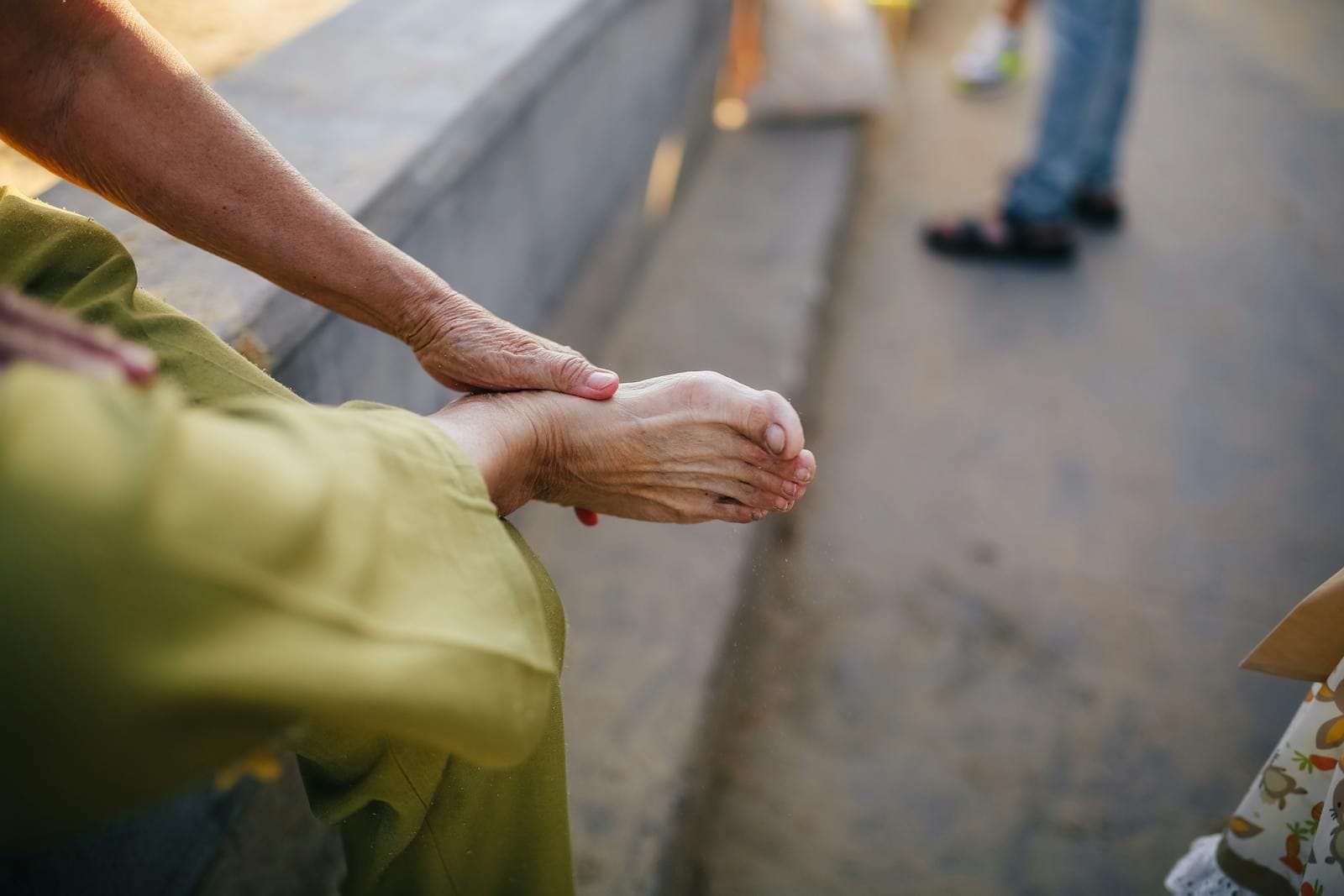
The single most evidence-backed habit in senior foot care is also the simplest. It is the daily foot inspection — about two minutes, ideally in the evening after the socks come off, with reasonable light and a hand mirror for the bottom of each foot if the back will not bend. It is the routine the CDC recommends for every adult with diabetes and that the American Geriatrics Society recommends as a baseline for any older adult with neuropathy, circulation problems, or a history of foot trouble.
The inspection itself is short. Look for cuts, blisters, scrapes, redness, swelling, callused or cracked skin, color changes between the two feet, and anything new since the last look. Run a hand across the sole — a temperature difference between the two feet, or a hot spot on one foot, is the kind of signal that does not register visually but does register to a palm. Check between the toes for moisture or the white maceration that suggests athlete's foot. Press the nail beds and watch the color return; sluggish refill is a circulation cue. Then dry between the toes carefully with the corner of a towel; moisture left there is the most common cause of fungal infection in older adults.
The reason most households skip this is that nothing usually changes from one day to the next, and so the inspection appears to produce nothing. That is exactly the point. The inspection is not a daily diagnostic. It is the early-warning system that catches the one day in three hundred when something has changed — the small blister from a new shoe, the unfamiliar callus on a metatarsal head, the soft spot under a toenail that means a fungal infection has loosened the nail bed. Catching any of those on day one is the difference between a five-minute home treatment and a six-week course of care.
The Pumice Stone Is Not a Treatment Plan
Calluses build up where the foot bears more weight than the body wants it to — on a bunion, on a fallen arch, under a hammertoe, at the back of a heel that takes the brunt of a stiff-soled shoe. The drugstore aisle answers this with pumice stones, callus shavers, and over-the-counter "callus removers" loaded with salicylic acid. None of these treat the underlying problem. The pumice stone removes a layer of skin; the body, registering the same mechanical stress, lays it back down within a week or two. The salicylic-acid products thin the skin in a less controlled way and can erode adjacent healthy skin, which is why the CDC explicitly advises adults with diabetes never to use them and why most podiatrists prefer their non-diabetic older patients avoid them as well.
The right callus question is not how to grind the callus down. It is what is loading that part of the foot in the first place. Sometimes the answer is a shoe with a wider toe box, or a metatarsal pad placed just behind the ball of the foot, or a custom orthotic that redistributes pressure off the painful spot. Sometimes the underlying cause is a hammertoe that has been quietly cocking the second toe for a decade, or a bunion that has been throwing the first metatarsal off-axis. None of those are pumice-stone problems. All of them are addressed durably with the right footwear and the occasional in-office reduction by a podiatrist who shaves the callus safely and looks under it for the skin breakdown the patient cannot see.
Thick, Yellow Toenails Are a Diagnosis, Not a Cosmetic Problem
A toenail that grows thicker, harder, more yellow, and more crumbly over a couple of years is the most common nail change in older adults. It also has a name and a diagnosis: onychomycosis, a fungal infection of the nail bed, present in something like a third of adults over seventy and a high majority of adults with diabetes. The fungus invades the nail plate from underneath, slowly disorganizing the keratin and producing the texture older adults recognize without ever being told what it is.
Most patients try to manage it cosmetically — trim more, file more, hide it under polish, give up and ignore it. The reasons not to ignore it are practical. A nail thickened by onychomycosis presses upward on the toe inside a shoe, which causes pain, callus formation, and sometimes a pressure sore at the nail bed. A loosened nail bed traps moisture and offers a route for bacterial infection. In diabetic patients especially, the same fungal infection that is cosmetic for one person is the gateway to a forefoot ulcer for another. Current dermatologic guidance treats onychomycosis as a medical infection, not a styling problem, and recommends a clinical diagnosis before treatment because the same yellow nail can have several different causes — fungus, psoriasis, an old trauma — and each is treated differently.
Treatment options have improved meaningfully in the last decade. Topical solutions like efinaconazole and tavaborole work for mild to moderate cases over six to twelve months; the older topical ciclopirox is less effective but available over the counter. Oral terbinafine is the most effective option for moderate to severe cases and produces complete cure rates around forty to fifty percent, with periodic liver-function monitoring during the three-month course. Laser treatment is FDA-cleared for "temporary increase in clear nail" but the published data on durable clearance is weaker than the marketing implies. The most useful thing to know is that a thickening yellow nail is rarely worth treating yourself without a diagnosis — the appointment that confirms what the nail actually is, is the appointment that decides whether any treatment is worth running.
The Foot That Stops Hurting Is the One to Worry About
This is the single most counterintuitive thing a podiatrist will tell a family. Foot pain is unpleasant but informative; it announces the problem. The foot that quietly stops sending pain signals — the one a patient describes as "feeling fine, just kind of numb" — is the one that produces the wounds, the ulcers, and the amputations.
Peripheral neuropathy, the slow degradation of the small sensory nerves in the feet, is the most under-recognized condition in geriatric foot care. It can be caused by diabetes, which accounts for the majority of cases, but also by long-term alcohol use, B-12 deficiency, certain chemotherapy regimens, untreated hypothyroidism, and several genetic and autoimmune conditions. The CDC estimates that nearly half of adults with diabetic peripheral neuropathy have no symptoms they would describe as pain. They have numbness, the absence of a signal — which is precisely the danger. A small pebble in the shoe is felt at fifty and discovered at the end of the day. The same pebble in a seventy-five-year-old foot without sensation can grind a hole through the skin of the metatarsal head before the patient notices the shoe is uncomfortable. By the time the wound is visible the infection has often begun.
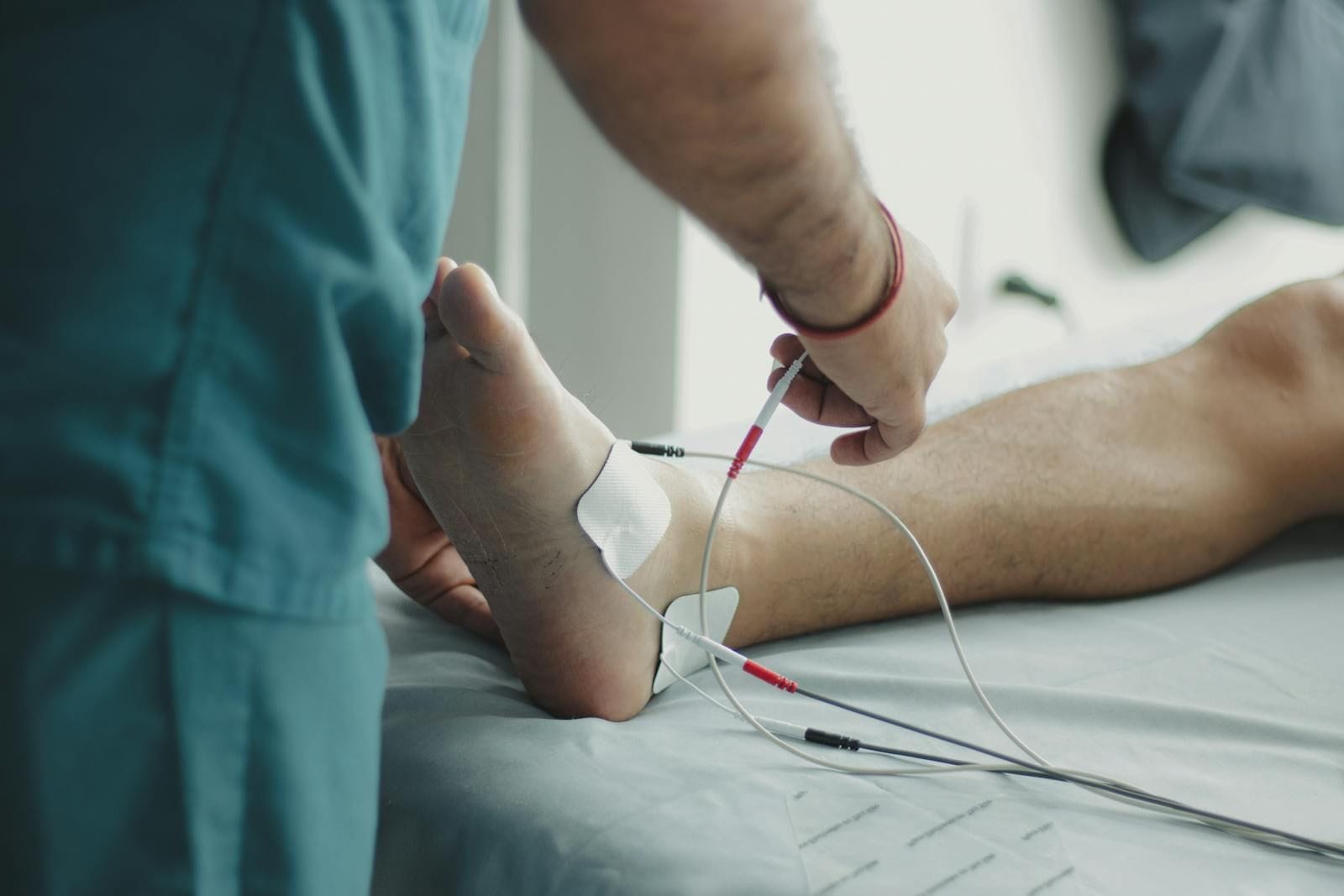
The screening for this is two minutes in any primary care office. A 10-gram Semmes-Weinstein monofilament — a thin plastic strand calibrated to bend when ten grams of pressure are applied — is touched to five spots on the bottom of each foot with the patient's eyes closed. If the patient cannot feel the strand at one or more sites, they have lost protective sensation. The monofilament test is the strongest single predictor of foot ulceration in adults with diabetes. Every adult with diabetes should have this test at least once a year; many primary care offices forget, and many patients should ask for it.
Shoes Are the Cheapest Fall-Prevention Tool a Family Will Ever Buy
The CDC's STEADI fall-prevention guide spells out the specifications for an older adult's everyday shoe in less than a paragraph. The shoe should fit well, with a properly measured length and width and roughly a half-inch of space between the longest toe and the front of the shoe — measured at the end of the day, when feet are at their largest. The sole should be firm but flexible, with a textured pattern that grips wet and dry surfaces. The heel should be no more than one inch, broad and beveled rather than stacked. The collar should hold the heel firmly so the foot does not slide forward in the shoe. The closure should be a lace or a Velcro strap, not a slip-on. The midsole should be thin enough that the foot can feel the floor — too much cushioning dampens the sensory input the brain uses for balance.
The category of footwear that should not be worn for daily walking is also short. Soft, well-loved slippers without backs are the single most common shoe found on older adults who fall at home. Worn-out athletic shoes whose foam has lost its rebound and whose tread has gone smooth are nearly as bad. Sandals without back straps slide off mid-step. Heels above an inch — even on a familiar dress shoe — measurably increase postural sway. Walking in only socks on tile or hardwood is documented as a fall risk in the same CDC guidance; an indoor shoe or a non-slip slipper with a real sole is the alternative. For families who have already started the home conversation about safer floors and grab bars, the bathroom safety walkthrough is a useful companion piece — the rooms and the shoes are part of the same fall-prevention picture.
Shoes do not last forever. The midsole of a quality walking shoe compresses out of usefulness somewhere between five hundred and seven hundred miles of use, or roughly twelve months of daily wear. The outsole tread goes smooth somewhere in the same range. After that point the shoe is doing visual duty only — the structural reasons it was supportive when new are gone. A replacement pair every year, properly measured, is one of the most cost-effective fall-prevention purchases a household will ever make.
What Medicare Will and Will Not Pay For
Original Medicare covers more podiatric care than most older adults realize, but the rules are specific and unforgiving. Medicare Part B does not cover what it calls "routine foot care" — trimming healthy toenails, removing healthy calluses, paring corns, hygienic care of the feet — for adults without complicating conditions. The rationale is that a healthy adult can do these tasks at home; the routine-care exclusion was written when "home" assumed an adult capable of reaching, seeing, and using nail clippers safely.
Medicare Part B does cover routine-style foot care when a documented systemic condition makes self-care dangerous. The qualifying conditions are listed in CMS Local Coverage Determination L35138 and include diabetes mellitus with peripheral neuropathy or vascular disease, peripheral arterial disease, chronic venous insufficiency, end-stage renal disease, rheumatoid arthritis affecting the feet, and a long list of others. With a qualifying diagnosis, Medicare typically covers a podiatry visit roughly every nine weeks for nail and skin care. The CMS coverage determination for mycotic nail debridement spells out the criteria in detail. Medicare also separately covers diabetic-shoe and inserts at one pair per year for adults with diabetes plus documented foot disease.
Outside the covered visits, podiatric care is generally affordable on a self-pay basis: a routine nail-and-callus visit at a podiatrist runs between forty and ninety dollars in most U.S. markets. Compared with the median cost of an emergency-department visit for a foot infection — typically two to four thousand dollars before hospitalization — the math is unsubtle. Families caring for an aging parent who cannot safely cut their own nails should treat the podiatry visit the way they treat the dental cleaning: routine, scheduled, not optional.
Diabetic Feet Get Their Own Rulebook
Diabetes changes everything about the foot. High blood sugar damages the small nerves that supply sensation and the small vessels that supply blood, in a one-two combination that is responsible for the great majority of non-traumatic lower-limb amputations performed in the United States. The United Kingdom's National Institute for Health and Care Excellence reports that diabetic foot ulcers precede more than eighty percent of diabetes-related amputations, and that mortality after an amputation is grim — roughly seventy percent of patients die within five years. The numbers are not meant to alarm; they are meant to motivate the small daily habits that almost completely prevent the cascade.
The diabetic foot rulebook is short. Inspect the feet every single day, including the bottoms and between the toes, using a mirror if needed. Wash daily in lukewarm water — never hot, because numb feet cannot warn the brain about a scald — and dry the spaces between the toes with the corner of a towel. Moisturize the tops and soles of the feet, but never between the toes, because trapped moisture in that interspace cultivates fungus. Never go barefoot — not on the lawn, not on the beach, not on the bathroom tile — because a numb foot cannot feel a splinter, a piece of glass, or a tack. Trim toenails straight across, never down into the corners, or have a podiatrist do it. Check inside the shoe with a bare hand before putting it on, because a pebble or a folded sock liner can grind a wound that is not felt until it is significant. See a podiatrist at least every six months — annually at the very minimum for low-risk patients, more often if there is a history of ulcers — and have a comprehensive foot exam with monofilament testing at each visit.
Families managing diabetes for an aging parent are in a position to add a second pair of eyes that the patient often cannot provide for themselves. The in-home mobility-care visits that home-care agencies in Middlesex County, NJ and Monmouth County, NJ provide for clients with diabetes regularly include a foot check by a trained caregiver — a person who knows what a freshly broken blister looks like and who knows the difference between a callus that has always been there and one that has just appeared. The check is not a substitute for the podiatry visit; it is the daily backstop the patient cannot reliably provide alone.
The Quiet Routine That Replaces Most Foot Problems
The foot care that prevents the cascades discussed above is unglamorous and almost suspiciously simple. It is not a product line. It is a routine.
Wash the feet daily in lukewarm water, soap optional, and dry between every toe. Moisturize the tops and the soles, not between the toes — every day, with a fragrance-free lotion. Inspect both feet at the same time, looking and feeling for anything new. Trim toenails straight across, no shorter than the tip of the toe, with sharp nail clippers (not scissors), after a shower when the nail is softer. Wear properly fitting shoes with closed backs every time the feet leave the bed, even inside the house. Replace those shoes once a year. See a podiatrist annually if the feet are healthy; every six to nine weeks if they are not. Mention foot pain at every primary care visit, even when it seems trivial, because foot pain is not normal aging and does not need to be lived with quietly.
Almost every foot problem that drives an older adult to the emergency department, to a podiatrist's office, or eventually to a wound-care center is a problem that started earlier and was caught later than it should have been. The two minutes a night spent at the side of the bed, with the socks off and the lamp on, is the cheapest insurance policy in geriatric medicine. Some families build it into the evening alongside medication review and the bedtime walk; some hand the responsibility off to a personal-care visit from a home-care aide who folds the foot inspection into the bathing routine. Either model works, and either model is dramatically more effective than the alternative most households default to, which is to notice the feet only when they hurt.
Aging feet are not a problem to solve; they are a system to maintain. The maintenance is light, the dividends are large, and the cost of skipping it shows up not in the foot but in everything the foot lets a person do — the morning walk, the evening cooking, the simple act of standing up from a chair without thinking about it. Take the feet seriously now, the way podiatrists wish every patient did, and the rest of the body has a much longer runway to enjoy.
Photographs via Pexels.