The Earned Benefit That Helps Pay for a Veteran's Home Care
The VA Aid and Attendance benefit adds up to $2,424 a month, tax-free, toward a veteran's home care. Who qualifies in 2026, and how to claim it.
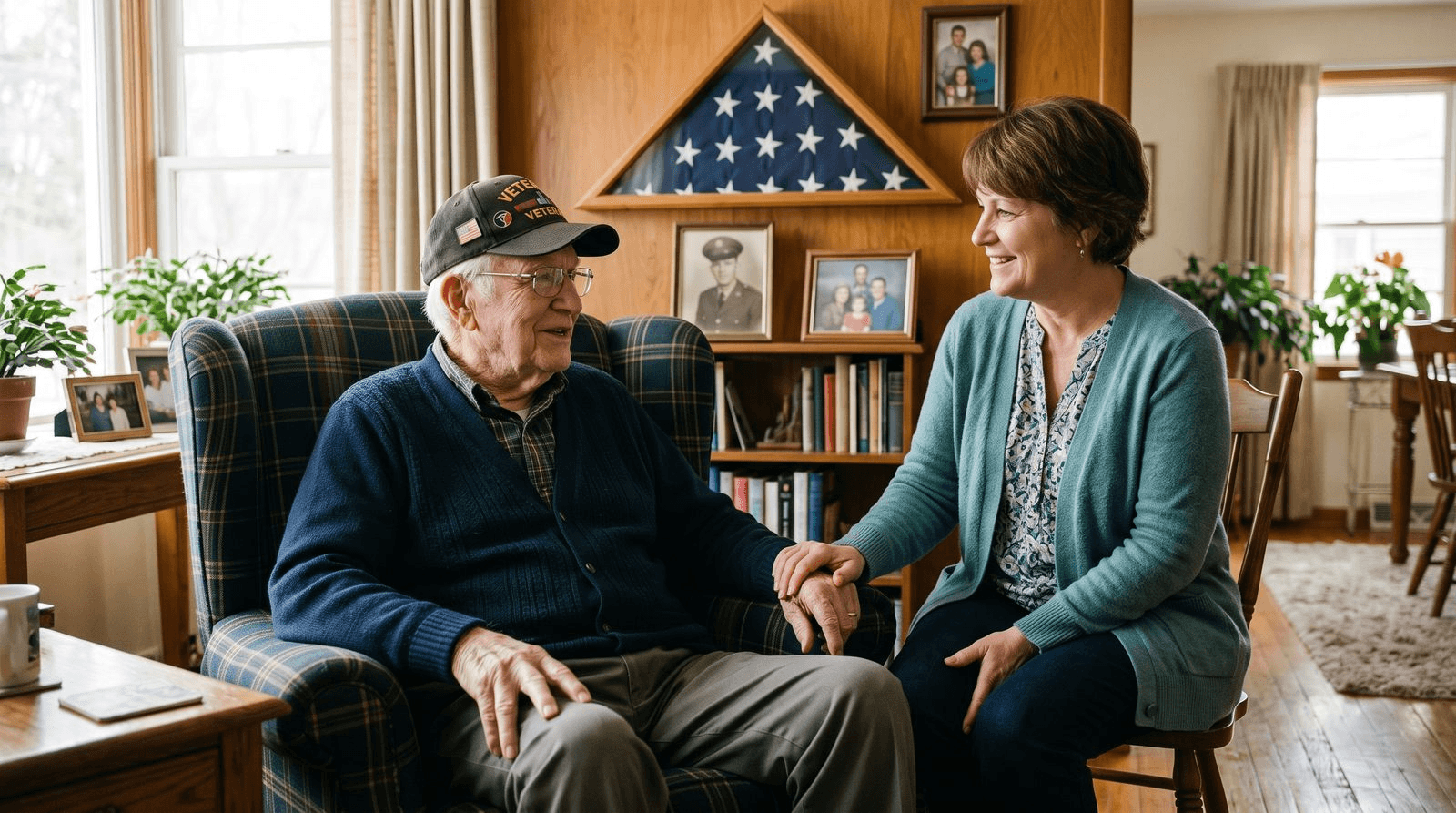
Here is what a lot of families never hear until it is almost too late to matter: a veteran does not need a combat wound, a service-connected disability, or a stay in a VA nursing home to get real money toward care at home. There is a separate, needs-based benefit built for exactly this moment, when an aging veteran or their spouse starts needing a hand with the ordinary business of the day. It is called Aid and Attendance, and in 2026 it can add more than $2,400 a month, tax-free, to a household's income.
The catch is not the rules. The catch is that almost nobody knows it exists. One study of the program found that in a given year only about one in ten veterans already receiving a VA pension newly picked up the Aid and Attendance add-on, and researchers keep attaching the same word to it: underutilized. Thousands of people who earned this benefit through their service, and would clear every requirement, simply never file. This is a plain-language guide to what the benefit is, what it pays in 2026, who qualifies, and how to claim it without paying anyone for the privilege.
A Benefit Most Families Never Hear About
Start with what Aid and Attendance actually is, because the name is unhelpful. It is not a standalone program and not a second check that stacks on top of VA disability compensation. It is an enhanced tier of the VA's needs-based Veterans Pension, an increase paid to a wartime veteran or surviving spouse who needs the regular help of another person. The money is tax-free, it does not have to be paid back, and, crucially, the VA sends it to the veteran, not to a care provider. What the household does with it is up to the household.
That last detail is what makes it so useful for care at home. Unlike programs that route services through an approved vendor, Aid and Attendance lands in the beneficiary's own account as ordinary income. A family can put it toward a private-pay caregiver, an assisted-living bill, or a nursing home, whatever the situation calls for. For a veteran who wants to stay in the house they raised a family in, that flexibility is the whole point.
What the VA Actually Pays in 2026
The amounts changed on December 1, 2025, when a 2.8 percent cost-of-living increase took effect and set the rates that hold through November 30, 2026. These are the maximum monthly benefits, published in the VA's current pension rates:
| Who is receiving care | 2026 maximum per month | Yearly total |
|---|---|---|
| Single veteran | Up to $2,424 | $29,093 |
| Veteran with a spouse or dependent | Up to $2,874 | $34,488 |
| Two married veterans who both qualify | Up to $3,845 | $46,143 |
| Surviving spouse | Up to $1,558 | $18,697 |
Read the word maximum carefully, because it does real work. The VA does not simply hand every approved applicant the top number. It pays the difference between that maximum and the household's countable income. A veteran with very little income may receive close to the full amount; one with a healthier pension may receive less. That sounds like it would shut out middle-income families, and it would, if not for the rule almost no one expects.
The Rule That Surprises People: Your Care Costs Are the Key
When the VA figures your countable income, it first subtracts your unreimbursed medical expenses, and the ongoing cost of care counts as a medical expense. Home-care fees, assisted-living charges, and similar recurring costs come off the top before the benefit is calculated. So a veteran whose gross income looks too high to qualify can drop well below the line once a real monthly care bill is subtracted.
This is the piece that turns a benefit for the near-destitute into a benefit for ordinary families who are spending down on care. The very expense that is straining the household budget is often what unlocks the payment that helps cover it. It is also why it is worth applying even when the numbers look borderline on paper: the calculation the VA runs is not the one most families run in their heads.

Who Qualifies: Service, Health, and Money
Eligibility comes down to three tests, and an applicant has to clear all three. The first is service. Generally the veteran must have served at least 90 days of active duty, with at least one of those days during a recognized wartime period, and left with a discharge other than dishonorable. Those windows cover World War II, the Korean War, the Vietnam era, and the Gulf War period, among others. The veteran did not have to see combat or serve overseas; one day of active service inside a wartime window is the standard.
The second is medical need. A physician has to certify that the person needs the regular aid of another to manage activities of daily living, such as bathing, dressing, eating, toileting, and moving safely, or is largely confined to home, has severely limited eyesight, or lives in a nursing home. This is the same daily, hands-on help that a personal-care aide provides, which is why the medical requirement and the care itself tend to line up so neatly.
The third is money. For the December 2025 to November 2026 period, the household's net worth plus annual income must sit below $163,699. That ceiling sounds low until you learn what it leaves out: the primary home and one vehicle do not count. One caution worth flagging early, the VA applies a 36-month look-back on assets given away or sold below value, and a disqualifying transfer can trigger a penalty period, so it is wise to talk to an accredited representative before moving any money around.
What the Money Can Actually Buy
Because the payment is simply income, families use it for the care that fits their life. The most common use for a veteran determined to stay put is in-home help: a caregiver who comes for a few hours a day or around the clock to assist with bathing and dressing, prepare meals, handle light housekeeping and errands, offer medication reminders, and steady a parent on the walk down the hall. It is the unshowy, daily presence that keeps a small wobble from becoming a hospital stay, and it is exactly the kind of home care built around a veteran's needs that Aid and Attendance is designed to help fund.
A point on how the two fit together, because it matters and it is easy to get wrong. We are a private-pay home-care company, not a VA-contracted agency, and the VA does not send us a check. The benefit is paid to the veteran, and the veteran or their family then arranges and pays for care the way any private client would. Families near Joint Base McGuire-Dix-Lakehurst in Ocean County and in veteran-dense retirement communities around Sarasota, Florida do this all the time: the earned benefit covers part of the cost, and in-home care fills the day-to-day need.

How to Apply Without Paying for the Privilege
The paperwork is more manageable than its reputation. The core of a claim is the Veterans Pension application, VA Form 21P-527EZ for a living veteran or 21P-534EZ for a surviving spouse, filed alongside VA Form 21-2680, the examination a doctor fills out to document the need for aid and attendance. You can file online at VA.gov, by mail, or in person at a regional office. If you are still gathering records, submitting an intent to file, VA Form 21-0966, first can secure an earlier effective date so any back pay reaches further.
One rule protects you and is worth repeating: help with a first-time claim should be free. VA-accredited Veterans Service Officers, available through your county veterans office and organizations like the VFW and the American Legion, will prepare and file the claim at no charge, and federal law bars anyone from charging a fee just to prepare an initial claim. If a company or individual asks for a percentage of your benefit or an up-front fee to fill out these forms, that is your cue to walk away and call an accredited officer instead.
Putting an Earned Benefit to Work
If there is a wartime veteran in your family who is starting to need help at home, the practical next steps are small and worth taking this month. Gather the discharge paperwork, a rough list of income and assets with the house and car set aside, and a sense of the monthly care costs you are facing or expect to. File an intent to file to start the clock. Then call a VA-accredited service officer to walk the claim in, at no cost to you.
A benefit that goes unclaimed helps no one, and this one was earned the hard way. When you are ready to think about the care itself, our team is glad to talk through what a day of in-home help would actually look like for your parent, and how families put a benefit like this to work alongside it. The service was given decades ago; the help it can pay for is available now.
Frequently Asked Questions
What is the VA Aid and Attendance benefit?
Aid and Attendance is a tax-free monthly add-on to the VA's needs-based Veterans Pension. It goes to wartime veterans and their surviving spouses who need help with everyday activities like bathing, dressing, eating, or moving safely around the house. It is not military retirement pay and not the same as VA disability compensation, and it does not require a service-connected injury. The money is paid directly to the veteran or surviving spouse, who can use it to help cover the cost of care at home, in assisted living, or in a nursing home.
How much does VA Aid and Attendance pay in 2026?
For the rate period running December 1, 2025 through November 30, 2026, the maximum monthly Aid and Attendance benefit is up to $2,424 for a single veteran, up to $2,874 for a veteran with a spouse or dependent, up to $3,845 when two married veterans both qualify, and up to $1,558 for a surviving spouse. These are maximums; the actual payment equals the maximum minus the household's countable income, which is why unreimbursed care costs matter so much. All amounts are tax-free and adjust each December with the VA's cost-of-living increase.
Who qualifies for VA Aid and Attendance?
Eligibility rests on three things. First, wartime service: generally at least 90 days of active duty with at least one day during a recognized wartime period, and a discharge other than dishonorable. Second, medical need: a doctor must certify that the person needs help with activities of daily living, is largely housebound, has severely limited eyesight, or lives in a nursing home. Third, finances: for 2026 the household's net worth plus annual income must fall below $163,699, a figure that excludes the primary home and one vehicle.
Can VA Aid and Attendance be used to pay for in-home care?
Yes. Because the benefit is paid as cash to the veteran or surviving spouse rather than to a provider, the family decides how to spend it. Many households put it toward professional in-home caregivers who help with bathing, dressing, meals, medication reminders, and getting around the house safely. The cost of that care also works in the applicant's favor: unreimbursed care expenses reduce countable income in the VA's calculation, which is often what makes a veteran with a decent pension check eligible in the first place.
How do you apply for VA Aid and Attendance?
File the Veterans Pension application (VA Form 21P-527EZ for a living veteran, or 21P-534EZ for a surviving spouse) and attach VA Form 21-2680, the aid-and-attendance exam a physician completes. You can apply online at VA.gov, by mail, or in person at a VA regional office. Filing an intent to file first (VA Form 21-0966) can lock in an earlier effective date for back pay. A VA-accredited Veterans Service Officer will help you prepare the claim at no charge, and the VA prohibits charging a fee to prepare an initial claim, so no one should ask you to pay up front.