How to Record Your Parent's Life Story
A practical guide to recording your parent's life story: methods that actually work, questions that unlock real memories, and how to keep it.
Since 2003, the oral-history nonprofit StoryCorps has sat ordinary people down with a microphone and a person they love, recorded the conversation, and quietly archived hundreds of thousands of those interviews at the Library of Congress. None of the speakers were famous. That is the whole point. The recordings exist because someone decided that an ordinary life, told in an ordinary voice, was worth keeping before it was gone.
Most families never make that decision until it is too late to act on it. The stories we mean to ask about, how our mother got her first job, what our father remembers of his grandfather, the year everything changed, tend to live only in one person's head, and they leave when that person does. The good news is that capturing them is easier and cheaper than it has ever been. You already own the equipment. What this guide offers is the rest: why the project is worth your Sunday afternoon, how to actually do it, the questions that pull real stories loose, and how to turn the result into something your family will still have in fifty years.
The Case for Pressing Record
It is tempting to file this under sentimental nice-to-have, but the benefits run in both directions, and they are well documented. For the person telling the stories, the act of looking back has a name in psychology: life review. Researchers at Baylor College of Medicine describe reminiscing as a tool that can lift mood, ease depression, and restore a sense of purpose in later life, as an older adult reflects on what they built and what they learned. It is especially valuable for people who feel adrift after retirement, giving shape and meaning to a life that can otherwise feel like it is mostly behind them.
The listeners gain something too. A body of research on intergenerational family stories, summarized in a 2022 review in the journal Frontiers in Psychology, links a strong "family narrative," the sense that you know where you come from, to higher self-esteem and resilience in children and grandchildren. Knowing how your grandmother survived a hard year turns out to be more than trivia; it is a quiet form of inheritance. And there is a softer dividend that shows up again and again in this work: families who sit down to record often end up reconciling, laughing, and understanding one another in ways the everyday rush never allowed.
Pick a Method You'll Actually Finish
The most common reason these projects stall is over-ambition. People imagine a polished documentary or a bound autobiography, feel daunted, and never start. The fix is to choose the lightest method you will genuinely follow through on, because a wandering phone recording that exists beats a beautiful book that never gets made.
A few options, from simplest to most involved. The voice memo is the path of least resistance: the free recording app on any smartphone captures clear audio, costs nothing, and is forgiving of long pauses and tangents. Video asks a little more, but it keeps the gestures, the expressions, and the particular way a person laughs; prop the phone on a small stand a few feet away so it fades into the background. The written route suits families spread across the country: mail or email one question a week and let your parent answer at their own pace, building a small archive over a year. And for those who want help, a personal historian will conduct the interviews and produce a finished book or film for a fee, while subscription services send a weekly prompt and bind the answers for you. There is no wrong choice here, only the one you will keep up with.
Whichever you pick, a few mechanics matter. Record in a quiet room with the television off. Keep each session to thirty or forty-five minutes, since memory and stamina both flag after that. And resist the urge to correct dates or details in the moment; the goal is the story as your parent tells it, not a fact-checked transcript.
The Questions That Unlock the Best Stories
The single biggest difference between a stilted interview and a treasured one is the questions. Yes-or-no questions die on the vine. "Did you like school?" earns a shrug; "What do you remember about walking to school?" opens a door. Professional interviewers swear by the concrete and the sensory, the question aimed at a specific scene rather than a whole era, because a detail, a smell, a kitchen, a song, is what memory actually clings to.
It helps to move loosely through the chapters of a life. Here is a starter set you can pull from, organized by era. You will not get through all of them, and you should not try.
- Childhood: What was the home you grew up in like? What did you do for fun before television took over? Who was the character of the family, the one everyone told stories about?
- Coming of age: What did you want to be when you were young? What was your first job, and what did it pay? Was there a teacher, a mentor, or a moment that changed your direction?
- Love and family: How did you meet Mom (or Dad)? What do you remember about the day I was born? What did you find hardest about raising children, and what surprised you most?
- Turning points: What is a decision you are proud of? Is there a year that changed everything? What were you most afraid of, and how did it turn out?
- Wisdom: What advice would you give your twenty-year-old self? What do you know now that you wish you had known earlier? What do you most want your grandchildren to remember about you?
When an answer winds down, the most useful follow-up in the world is four words long: "What was that like?" It signals you want the feeling, not just the facts, and it is usually where the real story has been hiding. If you would rather your parent do the writing, a gentler on-ramp is our companion piece on using writing prompts to help seniors share their life stories, which works beautifully alongside recorded conversations.
When "I Don't Have Any Good Stories" Is the First Answer
Expect modesty, and do not take it as a final answer. A great many older adults are convinced their lives were unremarkable, partly because the extraordinary things, a war, a migration, a marriage that lasted sixty years, came to feel ordinary by living through them. The way around the wall is not to push harder but to lower the stakes. Call it a conversation, not an interview. Start with happy, easy memories rather than the heavy ones. And let your parent steer; a story they choose will always be richer than one you pried loose.
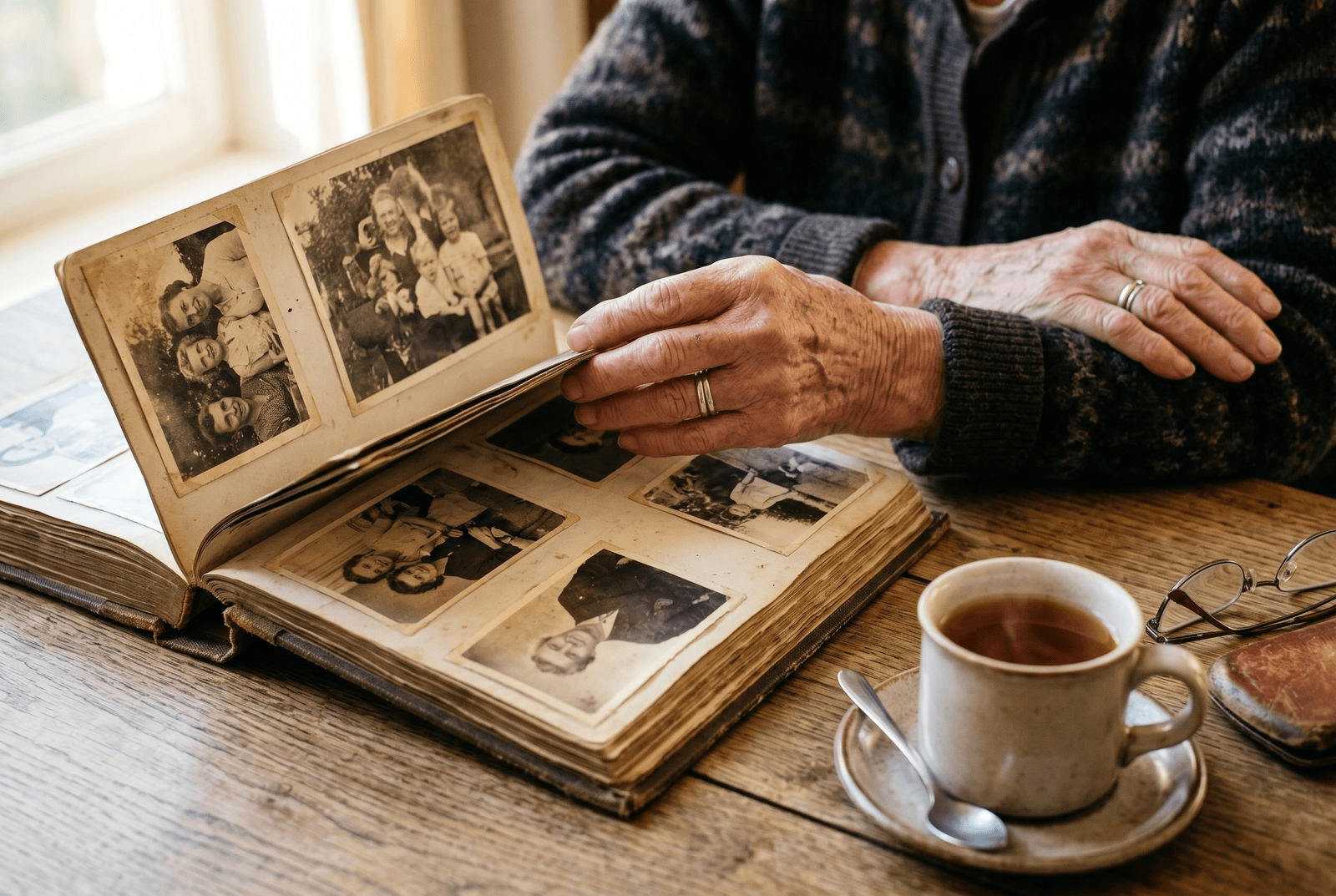
This is where memory triggers earn their keep. An old photo album, a song from their twenties, a recipe card in familiar handwriting, the smell of something baking, all of these reach the past more directly than any question can. Spread the photographs on the table and ask who is in them and what happened that day. Play the music they courted to. The stories tend to arrive sideways, attached to an object, long after a direct question would have come up empty. For families who want a patient, regular partner in this, a companion caregiver can turn a standing weekly visit into exactly this kind of unhurried conversation, recorder running, no clock to beat.
Recording Stories When Memory Is Fading
If your parent is living with dementia, do not assume the window has closed. One of the kinder quirks of how memory fails is that the oldest memories often endure longest; a person who cannot tell you what they had for breakfast may describe their childhood street in vivid, accurate detail. Drawing those memories out has real value beyond the recording itself, calming agitation and restoring a sense of dignity and competence in the moment, which is why reminiscence is woven into good Alzheimer's and dementia care.
The rules shift a little. Follow rather than lead, lean hard on music and photographs, and let go of the timeline entirely. Some answers will not line up with the facts, and that is fine; correcting them only causes distress and breaks the spell. The aim is no longer a tidy biography but connection and the sound of their voice, and on that score even a short, half-remembered story is a success worth keeping.
Turning Hours of Tape Into Something the Family Keeps
Recordings that live only on the phone that made them are one cracked screen away from vanishing, so the last step is the one that makes the effort last. At a minimum, save copies in more than one place, the phone plus a cloud account, or a couple of inexpensive USB drives kept in different houses. Free transcription tools can turn audio into searchable text, which is worth doing while the speaker is still around to fill in the gaps.
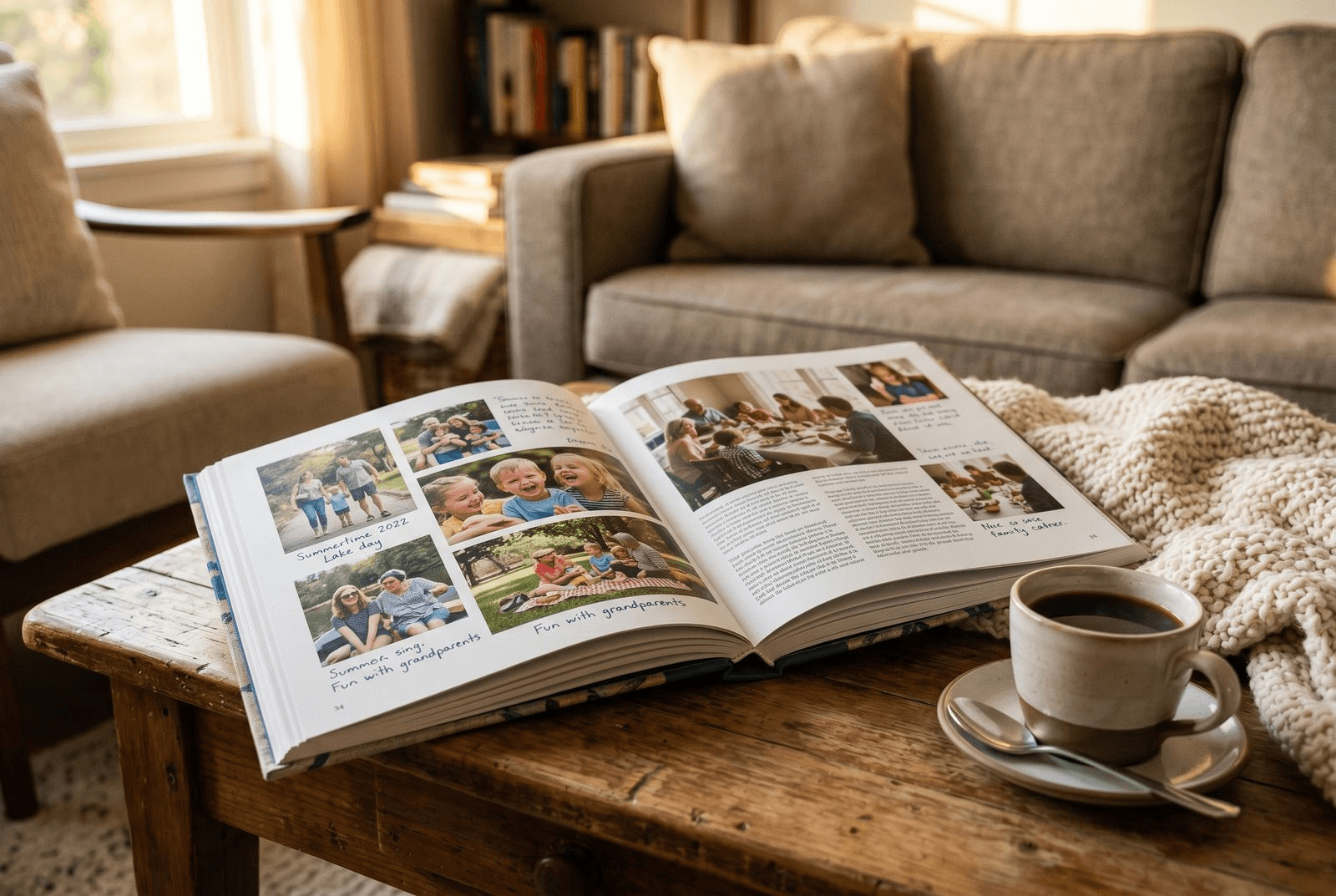
From there, do as much or as little as you like. Some families are happy with a clearly labeled folder of audio files shared with everyone. Others edit the highlights into a short video set to family photos, or use a print service to lay the stories alongside scanned pictures into a bound book, the kind of keepsake that ends up on the coffee table and gets pulled out at every holiday. The polish is optional. The preservation is not.
Start With One Question This Sunday
The trap is treating this as a project that needs a free weekend you never seem to have. It does not. It needs one question and ten minutes. Call your mother and ask how she met your father. Sit with your grandfather over coffee and ask about his first job, and let the phone record while he talks. You can always do more later, and you almost certainly will once you hear how much is in there. What you cannot do is go back and capture a voice after it is gone.
If distance, a packed schedule, or a parent's care needs make it hard to find that unhurried hour, that is part of what in-home support is for. For families across New Jersey, our caregivers serving Ocean County and the surrounding communities can sit with your parent on a regular visit and keep these conversations going between yours, so the stories get told even on the weeks you cannot be there. Either way, the best time to press record is the next time you are together. Start with one question.
Images generated for Always Responsive Home Care.
Frequently Asked Questions
What are good questions to ask your grandparents?
Skip the yes-or-no questions and ask ones that invite a story. Good openers include: what was the house you grew up in like, what did you do for fun as a kid, how did you meet your spouse, what was the hardest decision you ever made, and what advice would you give your twenty-year-old self. Questions tied to a specific scene or moment work better than broad ones like "tell me about your childhood," because a concrete prompt gives memory something to grab onto. When an answer trails off, the most useful follow-up is simply, "What was that like for you?"
How do I record my parent's life story?
Pick a method you will actually finish, then keep the sessions short. The simplest approach is to sit down with a few prepared questions and record audio on a smartphone using the built-in voice memo app, or video if your parent is comfortable on camera. Aim for thirty to forty-five minutes at a time rather than one marathon, let the conversation wander, and resist correcting the details. You can also write answers down, mail or email one question a week, or hire a personal historian. The best tool is the one that fits your family, not the most elaborate one.
What is the best way to record family stories?
For most families, a phone is enough. Modern smartphones capture clear audio with the free voice-memo app, and video adds gestures, expressions, and the sound of a laugh. Set the phone on a small stand a few feet away so it is not a distraction, record in a quiet room without a television humming in the background, and check the volume on the first answer. Whatever you record, back it up in more than one place, because a single phone or hard drive is not a safe long-term home for something irreplaceable.
How do I get a reluctant parent to share their stories?
Lower the stakes. Many older adults insist they have nothing interesting to say, so call it a conversation rather than an interview and start with easy, happy memories instead of big life events. Old photographs, a favorite song, or a family recipe are powerful memory triggers that loosen stories better than direct questions. Let your parent set the pace, do not push past visible discomfort, and remember that the recorder can simply keep running while you talk. The first session is often slow; the stories usually come once the novelty wears off.
Can you record memories with someone who has dementia?
Often, yes, and it can be deeply rewarding. In many forms of memory loss, long-term memories from decades ago stay accessible long after recent ones fade, so a parent who cannot recall this morning may light up describing their childhood street. Lean on familiar music, photos, and objects, follow their lead, and treat the goal as connection rather than a complete or accurate timeline. The point is the moment together and the sound of their voice, both of which are worth keeping regardless of how the facts line up.