The Quiet Genius of a Jigsaw Puzzle
Jigsaw puzzles engage eight thinking skills at once. How they help older adults, how to choose the right one, and ways to adapt them for any ability.
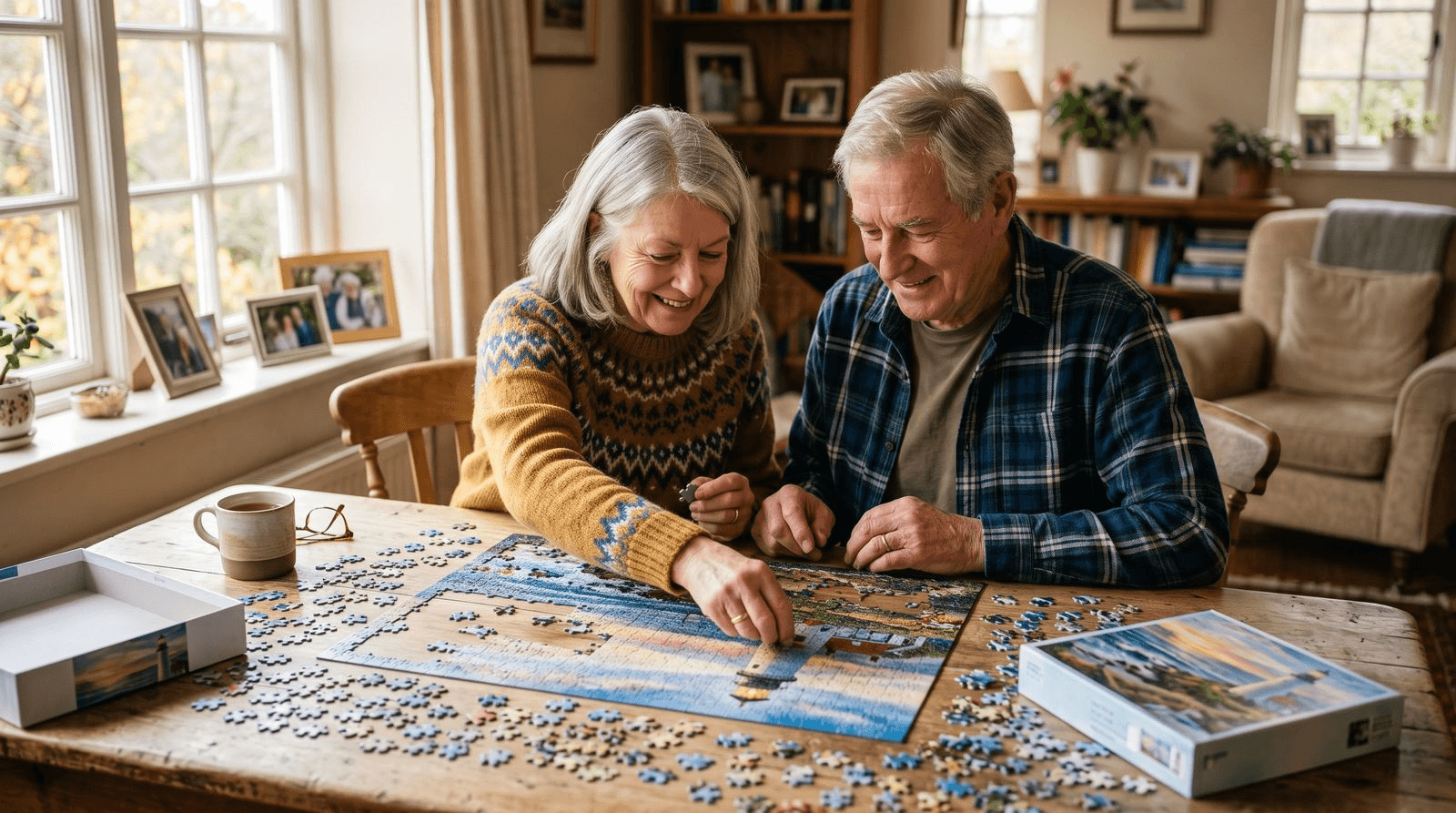
Sit an older adult down at a card table with a thousand loose cardboard pieces and a picture of a lighthouse, and something more interesting than a pastime is happening. When a team of German researchers set out to measure exactly what the brain does while it solves a jigsaw puzzle, they found the activity pulls on eight separate visuospatial skills at the same time: perception, mental rotation, working memory, reasoning, and more, all firing together to turn a heap of chaos into a coastline. Few leisure activities that cost less than twenty dollars ask that much of the mind.
That is the quiet appeal of the jigsaw puzzle in later life. It is cheap, screen-free, endlessly renewable, and it meets a person exactly where they are, flexing from a bright 24-piece farm scene to a punishing 2,000-piece field of wildflowers. What follows is what the research actually supports, what it does not, and how to pick a puzzle that leaves an older adult feeling capable rather than defeated.
Eight Skills, One Tabletop
The eight-skills figure comes from a 2018 study published in Frontiers in Aging Neuroscience, which took 100 cognitively healthy adults aged 50 and older and looked closely at what puzzling demands and whether it pays off. The researchers measured global visuospatial cognition by averaging eight abilities, from perception and mental rotation to flexibility, working memory, reasoning, and episodic memory. Puzzle skill turned out to be strongly related to all of them. And a lifetime of puzzling was linked to better visuospatial cognition even after the team accounted for the usual advantages like education and income.
It is worth being straight about the limits, because the same study is refreshingly honest. When participants were asked to puzzle for a month, that short burst did not produce a measurable jump in cognition compared with a group that simply received health counseling. In other words, the strong link is a long-game association, not proof that a weekend with a 500-piece puzzle rewires anything. Puzzling is best understood as one plausible way to keep a lifelong habit of mental engagement, not as a pill.
Other research points the same direction. A 2024 study from the Texas A&M School of Public Health tracked nearly 6,000 adults over 50 who had mild cognitive impairment and found that those who frequently engaged in games, puzzles, and reading held on to better memory, attention, and processing speed than those who did not. The researchers suggested aiming for these activities three to four times a week. The National Institute on Aging makes the broader case: staying mentally and socially active is one of the levers, alongside sleep, exercise, and heart health, that supports the aging brain.
The Part Nobody Measures
Set the studies aside for a moment, because the strongest argument for a jigsaw puzzle rarely shows up in a cognition score. It is the calm. Hunting for the one piece with a notch of red and a sliver of sky is absorbing in a way that quietly crowds out worry. Time loosens. The mind narrows to the small, solvable problem in front of it, and for many older adults that focused, unhurried state is the closest thing to meditation they will do all day.
A puzzle also gives a day its shape. For someone whose calendar has thinned out with retirement, or who can no longer manage vigorous exercise, a table with a half-finished scene on it is a reason to sit down, a project to return to, and eventually a finished thing to be proud of. That last part matters more than it sounds. So much of aging is framed as loss and management. Snapping the final piece into a completed picture is a small, clean, unambiguous win.
Better With Two Chairs
A jigsaw puzzle left out on a table has a way of gathering people. Someone walks by, drops in a piece, lingers. Grandchildren who would never sit still for a conversation will happily hunt for edge pieces. And because the puzzle carries the moment, no one is under pressure to fill the silence, which makes it a gift for anyone who finds visits awkward or tiring.
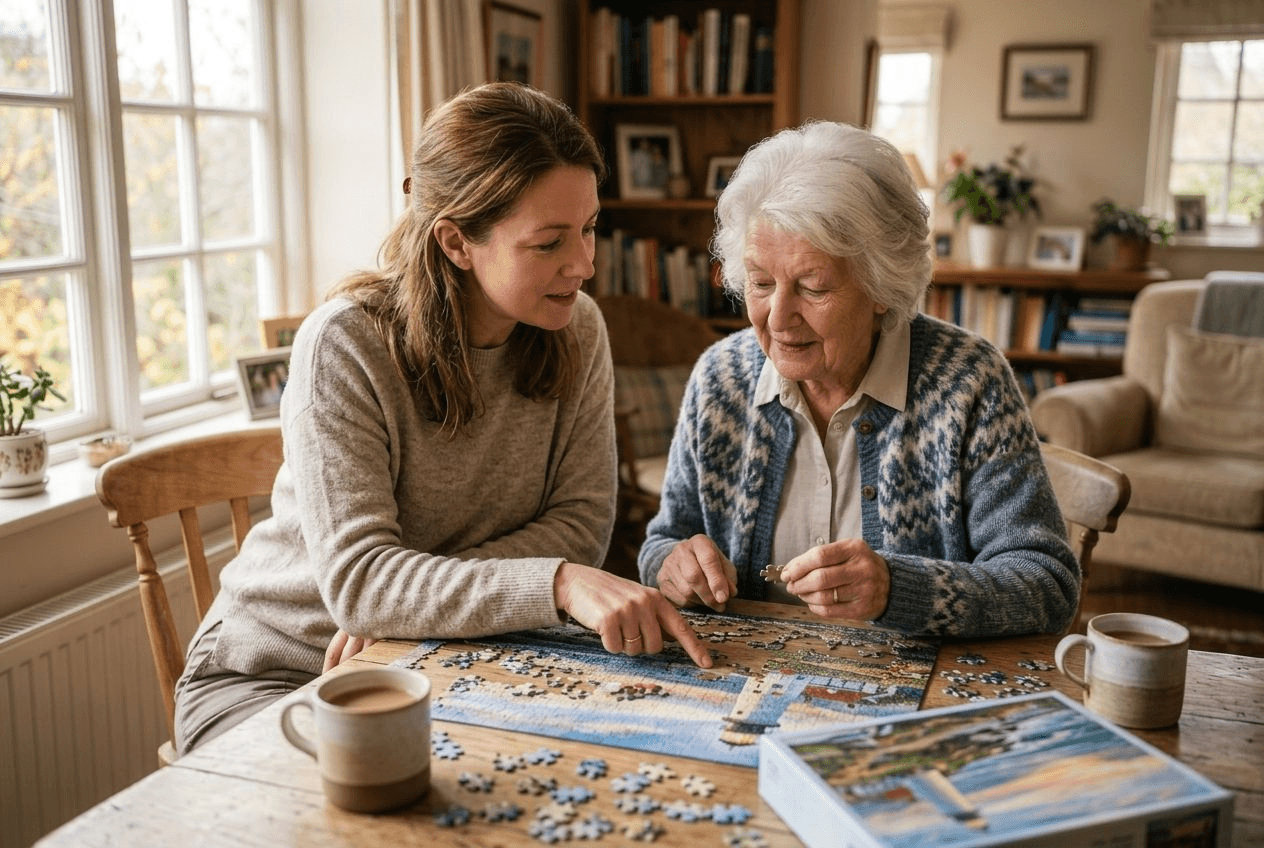
That low-pressure togetherness is exactly the kind of time a good companion caregiver is there to offer. Working a puzzle side by side is not filler between the real tasks; it is the point of companion care, the steady, unhurried presence that keeps an older adult connected and engaged rather than simply looked after. The same is true of an afternoon of puzzling with an adult child or an old friend. It is company that asks nothing and gives a great deal.
Picking a Puzzle That Fits the Person
Most puzzling frustration is really a mismatch. The single most important choice is piece count, and the rule is to match it to current ability, not to age. A lifelong puzzler may want 1,000 pieces and be insulted by anything less. Someone new to the hobby, or working with tired eyes, may do far better starting at 100 to 300 larger pieces. Aim for a puzzle that is challenging enough to be interesting but achievable enough to finish. Too hard, and it gets abandoned; too easy, and it feels like busywork.
The image matters just as much as the piece count. Look for clear, boldly colored pictures with plenty of visual variety, and be wary of large uniform expanses, an all-blue sky or a solid green lawn, which turn a pleasant challenge into a grind. Pick subjects that mean something to the person: the coast they honeymooned on, a breed of dog they raised, a market square from the old country. And favor sturdy pieces with a matte, low-glare finish, which are kinder to both hands and eyes than thin, shiny cardboard.
When Eyes, Hands, or Memory Need a Hand
The beauty of puzzles is how far they bend to meet a person. When vision is failing, reach for large or extra-large pieces, high-contrast images, and fewer pieces overall, and set everything up under a bright, glare-free lamp. When arthritis or weak grip is the obstacle, chunky pieces, thick cardboard or wooden pieces, and a nonslip board or mat make handling comfortable again. A shallow tray or an old muffin tin for sorting spares stiff hands the work of digging through a heaped pile.
Memory changes call for a gentler recalibration rather than retirement of the hobby. Puzzles designed for people living with dementia typically use 12 to 100 oversized pieces, clear high-contrast images, and dignified adult scenes, gardens, animals, vintage cars, never anything that reads as childish. Some are developed with geriatric specialists precisely so the challenge stays respectful. Here the aim is engagement and success, and a shared, calming rhythm, not difficulty. Puzzling can be one of the steadier, more contented parts of a day for a person with dementia, and it slots naturally into the routine of good Alzheimer's and dementia care. If a puzzle brings frustration, that is simply the signal to step down to fewer, bigger pieces, never to pack the hobby away.
Setting the Table for Success
A little staging turns a puzzle from a chore into a standing invitation. The most useful move is a surface the puzzle can live on without being cleared for meals, whether a dedicated card table, a lap-height puzzle board, or a roll-up mat that tucks a work in progress out of the way. Good light is next, ideally a lamp positioned to kill glare rather than cast it across the pieces.
- Prop up the picture. Stand the box lid or a printed copy of the finished image nearby as a map. Working blind is far harder than it needs to be.
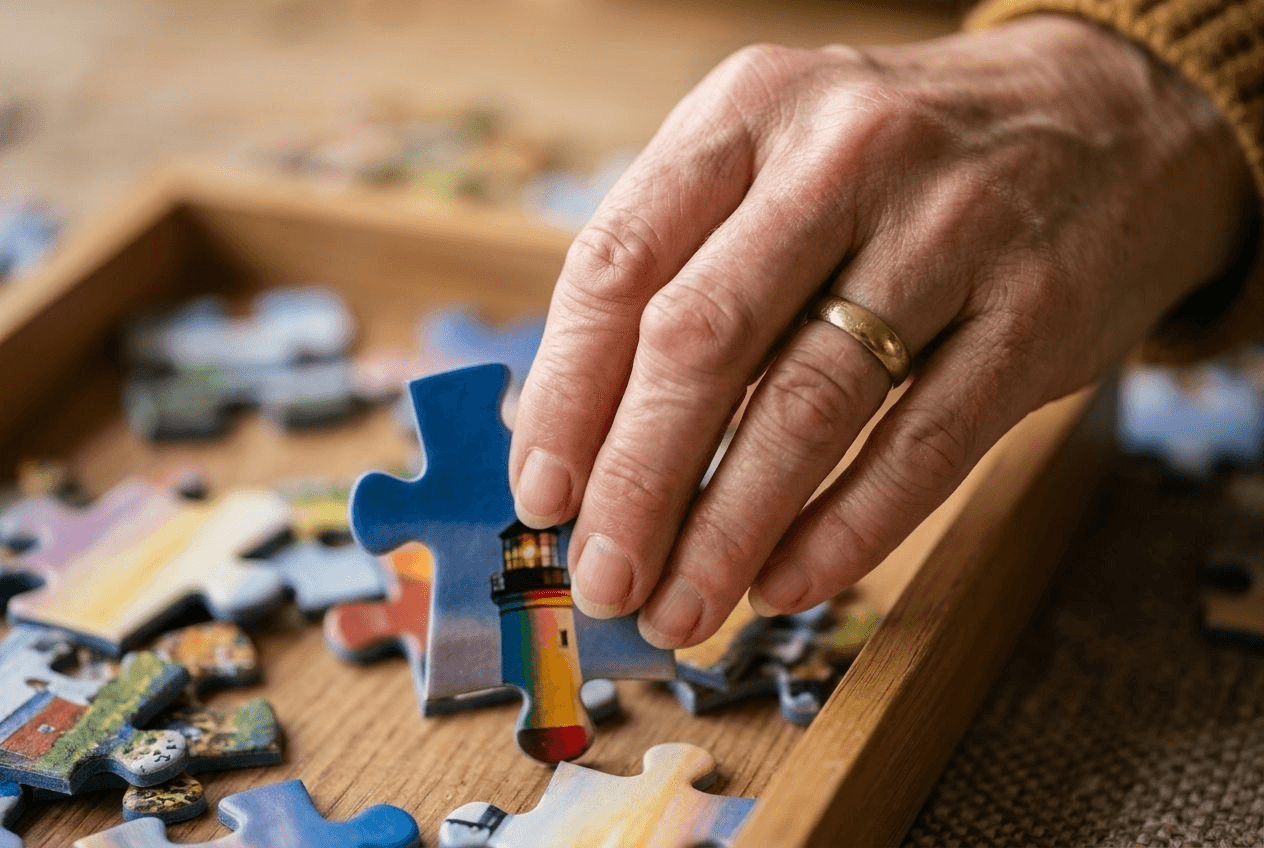
- Sort before you build. Separate the edge pieces first, then group the rest by color into trays or bowls. Half the work of a puzzle is finding, not fitting.
- Start with the border. Building the frame gives an early, satisfying win and a boundary to work inward from.
- Mind the body. A supportive chair, decent posture, and short, comfortable sessions keep a good afternoon from ending in a stiff neck.
Start With the Corners
The hardest part of any puzzle is the intimidation of the full, unsorted pile, and the cure is almost comically simple: tip out the pieces, find the four corners, and build the edge. Momentum takes it from there. That is worth remembering for anyone tempted to write puzzles off as too slow or too fussy for a parent, because the barrier to starting is about as low as a hobby gets, and the puzzle will still be waiting, patient and unfinished, tomorrow. That permanence is part of the gift.
It is also a hobby worth folding into a wider life rather than leaning on alone, and our roundup of other hobbies worth taking up later in life is a good place to look for company for it. For families arranging support, the right caregiver understands that time at the puzzle table is real companionship, not a way to pass the hours. That is how our teams across the Bergen County, New Jersey service area and beyond approach it: showing up, pulling up a second chair, and helping an older adult stay engaged in the small, absorbing pleasures that make a day feel like their own.
This article is for general education and is not medical advice. Jigsaw puzzles are a healthy pastime, not a treatment for any condition. Talk with a health care provider about cognitive concerns and about the right activities for your loved one.
Sources: Frontiers in Aging Neuroscience (Fissler et al., 2018) - Jigsaw Puzzling Taps Multiple Cognitive Abilities and Is a Potential Protective Factor for Cognitive Aging; Texas A&M University School of Public Health - Games, Puzzles and Reading Can Slow Cognitive Decline in the Elderly; National Institute on Aging - Cognitive Health and Older Adults.
Frequently Asked Questions
Are jigsaw puzzles good for seniors?
Yes. Jigsaw puzzles are inexpensive, screen-free, and engaging, and research suggests they are genuinely good exercise for the aging brain. A 2018 study in Frontiers in Aging Neuroscience found that solving a jigsaw puzzle recruits eight separate visuospatial abilities at the same time, and that people with more lifetime puzzling experience tended to have stronger visuospatial cognition. Beyond the mental workout, puzzles reduce stress, give the day a sense of structure, and offer the satisfaction of finishing something. They are also easy to adapt for changing vision, dexterity, or memory, which makes them one of the few hobbies a person can keep enjoying across a wide range of abilities.
Do jigsaw puzzles help prevent dementia?
Not in the sense of a guarantee. It is important to be honest here: no puzzle, game, or brain-training product has been proven to prevent dementia. What the research shows is an association. People who stay mentally active tend to hold on to cognitive function longer, and jigsaw puzzles are one good way to stay engaged. A 2024 study from the Texas A&M School of Public Health found that older adults with mild cognitive impairment who frequently did puzzles, games, and reading scored better on memory, attention, and processing speed than those who did not. The National Institute on Aging encourages staying mentally and socially active as part of overall brain health. So a puzzle is a reasonable, low-cost piece of a brain-healthy lifestyle, not a treatment.
Are jigsaw puzzles good for someone with dementia?
They can be, when the puzzle is chosen carefully. For a person living with dementia, the goal is engagement and a sense of accomplishment, not difficulty. Purpose-made dementia puzzles use a small number of large pieces, often between 12 and 100, with clear, high-contrast images and dignified adult subjects such as gardens, animals, or classic cars rather than childish pictures. Familiar and nostalgic scenes tend to spark the most connection. Done alongside a family member or caregiver, puzzling can be a calm, shared activity that reduces restlessness and offers gentle stimulation. If a puzzle causes frustration, it is a sign to step down to fewer or larger pieces, not to give up on the activity.
How many pieces should a puzzle for a senior have?
There is no single right number, because the best piece count depends on the person, not their age. Match the puzzle to current ability. A capable, experienced puzzler may relish 500 to 1,000 pieces or more, while someone new to the hobby or working with reduced vision or memory may do better with 100 to 300 large pieces. For a person with moderate dementia or significant vision loss, 12 to 100 extra-large pieces is often the sweet spot. The aim is a puzzle that is challenging enough to be interesting but achievable enough to finish. If it is abandoned in frustration, size down; if it is completed in ten easy minutes, size up.
What are the best puzzles for seniors with low vision or arthritis?
Look for large-format or extra-large pieces, which are easier to see and to grip. For low vision, choose puzzles with high-contrast, boldly colored images and fewer, bigger pieces, and set the puzzle up under strong, glare-free task lighting. For arthritis or reduced hand strength, chunky pieces, sturdy cardboard or wooden pieces, and a nonslip puzzle board or mat make handling far more comfortable. Several manufacturers now make large-piece puzzles designed specifically for older adults, some developed with geriatric specialists, that pair big pieces with adult imagery. Sorting pieces into shallow trays or a muffin tin also reduces the strain of hunting through a heaped pile.
How often should older adults do puzzles?
Regularly enough to make it a habit, but there is no prescription. In the Texas A&M research on cognitively stimulating activities, the recommendation was to engage in puzzles, games, reading, and similar hobbies at least three to four times a week. Just as useful is to treat puzzling as one part of a varied routine rather than the whole of it. Mixing puzzle types, adding social activity, physical movement, and good sleep does more for the brain than any single activity on its own. The best frequency, ultimately, is whatever the person genuinely enjoys and will keep coming back to.