The Lift Chair Questions Every Family Asks
A plain-language Q&A on lift chairs for seniors: the types, sizing, features, real costs, what Medicare covers, and how to pick the right one.

Roughly one in four adults 65 and older falls each year, and the most common everyday version of that risk is the plainest one: the moment of standing up. According to the Centers for Disease Control and Prevention, falls are the leading cause of injury for older adults, and a lot of them start with an unsteady push off a couch or an armchair. If you have watched a parent rock forward three times to build momentum, grip the armrests white-knuckled, and stagger the first step, you already understand why a lift chair exists.
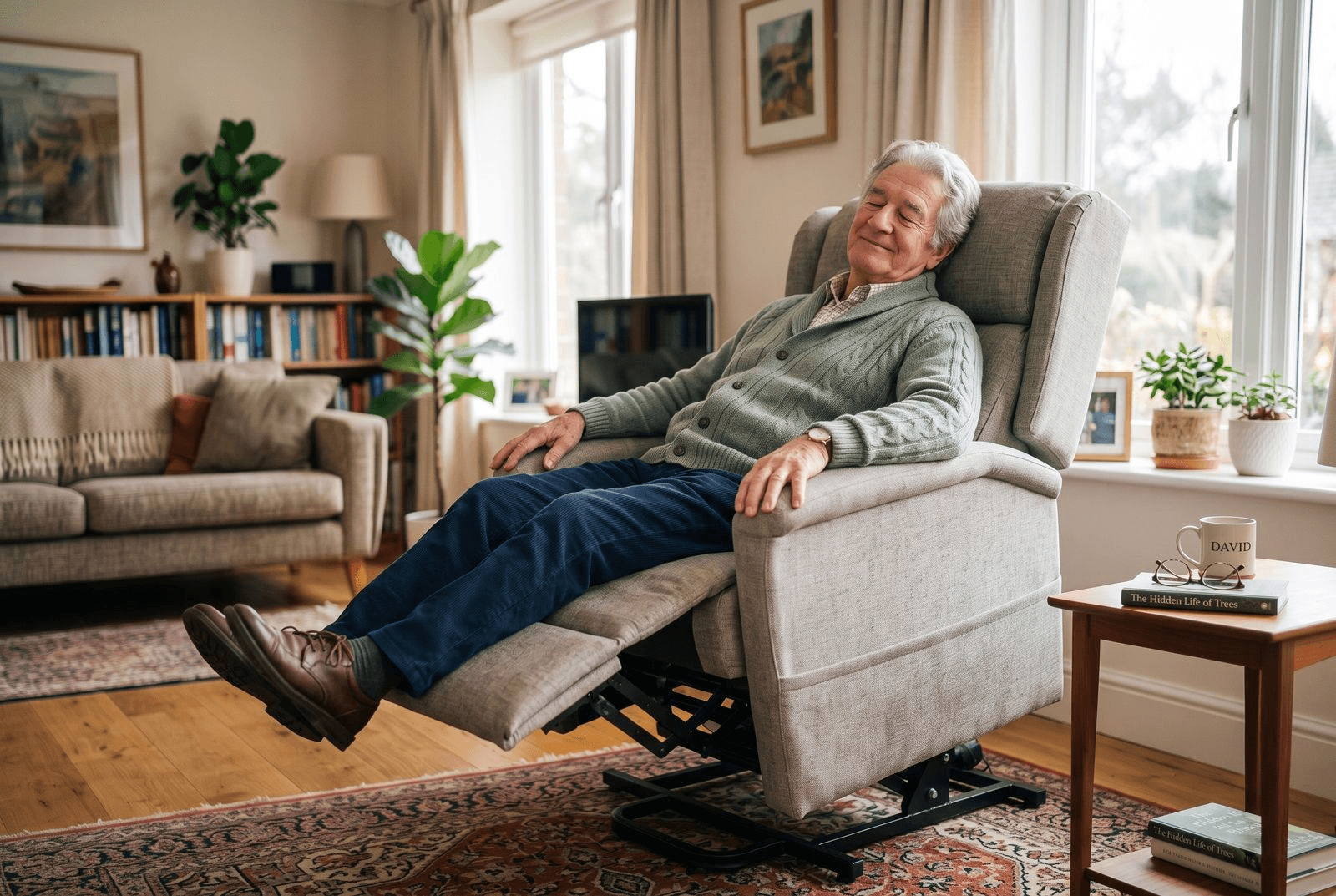
A power lift recliner takes that struggle out of the day. It looks like an ordinary recliner, but a motor tilts the whole seat forward and up until the person is nearly on their feet. Shopping for one, though, throws a wall of jargon at you: two-position, three-position, infinite-position, dual-motor, wall-hugger, zero-gravity. This guide answers the questions families actually ask, in the order they tend to come up.
Is a Lift Chair Really Different From a Recliner?
Yes, and the difference is the whole reason to buy one. A recliner reclines. A lift chair reclines and then does something a recliner cannot: it raises you back up. Press a button and the base tilts forward, lifting the seat toward standing so you step away instead of heaving yourself out of a low, soft chair.
That single motion is what makes a lift chair worth the extra money for the right person. For someone with arthritic knees, a weak hip, Parkinson's, or general frailty, the transition from sitting to standing is the hardest and most dangerous part of using any chair. A lift chair meets them at exactly that point. If a person can get up from an ordinary chair without pain or wobble, they do not need one. If getting up is a daily battle, no amount of cushioning on a regular recliner fixes it.
How Do You Know It's Time?
A few signs tend to show up together. The person avoids certain chairs because they are too low to escape. They plan their day around not having to stand more than they must. Someone has to brace and pull them up, which is hard on both people and a common way caregivers hurt their own backs. Or there has already been a near-fall in the wobbly second between sitting and standing.
A lift chair addresses the standing itself, but it does not replace hands-on help with everything else. If a person needs steadying to walk to the bathroom, help transferring in and out of bed, or someone nearby in case balance gives out, that is where in-home support comes in. Families we work with often pair a lift chair with mobility care for safe transfers and walking, or with personal care when daily tasks like dressing and bathing have also become risky. The chair handles one moment of the day well; a caregiver handles the moments a chair cannot.
Two-Position, Three-Position, or Infinite?
This is the choice that confuses people most, and it comes down to how far the chair reclines and how its motors move.
- Two-position. The most basic and compact. It sits upright or leans back to about a 45-degree angle, good for reading, watching television, and standing assistance. It is the lowest-cost option and fits smaller rooms.
- Three-position. Reclines much farther, close to flat, so it works for napping as well as sitting. The back and footrest move together on a single motor. This is the most popular type because it covers both resting and standing without the price of the top tier.
- Infinite-position. Uses two independent motors, so the backrest and footrest move separately. That unlocks positions a single-motor chair cannot reach, including zero-gravity, where the feet sit above the heart to ease pressure and swelling. It is the most flexible and the most expensive, and it suits all-day use, pressure relief, and, with a doctor's input, sleeping in the chair.
A quick way to decide: if the chair is mostly for getting up and light lounging, two-position is enough. If afternoon naps in the chair matter, go three-position. If the person will spend most of the day and possibly the night in it, or needs precise positioning for swelling or circulation, that is what infinite-position is for.
What Size and Weight Capacity Do You Need?
A lift chair only works well if it fits the body using it, and this is the step most online shoppers skip. Chairs come in petite, standard, tall, and heavy-duty sizes, with weight capacities that commonly run from around 300 pounds up to 500 or 600 on bariatric models. Two measurements matter most: the person's height, which decides whether their feet rest flat and their head is supported, and their weight against the chair's rating.
Getting this wrong is uncomfortable and unsafe. A petite person can be swallowed by an oversized chair, sliding forward instead of being supported, while a larger-framed person feels pinched in a standard model and stresses the mechanism. If there is any way to do it, have the person sit in the actual chair before buying, or at least try the same size in a showroom. Note whether the lift motion feels steady or tips them forward too sharply, which can unsettle someone with balance concerns.
Which Features Are Worth Paying For?
Lift chairs come loaded with add-ons, and not all of them earn their price. Focus on the few that affect safety and daily use:
- Dual motors. On mid and higher-end chairs, independent control of the back and legs is the upgrade people notice most, and it is what makes zero-gravity positioning possible.
- A battery backup. Small and easy to overlook, but it lowers the footrest and returns the chair to standing during a power outage, so no one is stranded reclined when the lights go out.
- Quiet, reliable motors. Well-regarded chairs use smooth, low-noise motors; a loud or jerky lift gets unpleasant fast when it happens a dozen times a day.
- Easy controls. A simple remote with large, clearly labeled buttons and a pocket to keep it in beats a fussy touchpad, especially for someone with poor eyesight or arthritic hands.
- Practical upholstery. A durable, wipe-clean fabric or performance material holds up to spills and daily wear far better than delicate cloth.
Heat and massage feel luxurious and some people love them, but they are comfort extras, not reasons to stretch the budget. Buy the safety and usability features first; treat the rest as nice-to-have.
How Much Should You Expect to Spend?
Lift chairs cover a wide price range, from around $300 for a basic two-position model to well over $2,500 for a premium infinite-position chair with dual motors, quality leather, and every feature. The good news in that spread is that you do not have to buy the top of the line to get meaningful help. A well-fitted three-position chair in the middle of the range serves most people for years.
Let the person's real needs set the tier rather than the fanciest option on the floor. Money spent on the right size and a smooth, reliable lift is money well spent. Money spent on massage rollers that get used twice usually is not.
Does Medicare Help Pay for One?
Partly, and it is important to understand exactly what "partly" means before you count on it. Medicare Part B treats the seat-lifting mechanism as durable medical equipment and covers about 80 percent of that mechanism after the annual Part B deductible, according to Medicare.gov. Two things surprise families: Medicare pays only for the motorized lifting part, not the chair, the fabric, or any extras; and coverage requires a doctor to document that the lift is medically necessary and to prescribe it, with the chair bought from a Medicare-approved supplier.
In practice, the covered amount is usually a few hundred dollars against a chair that costs considerably more, and you often pay upfront and file for reimbursement. So it is a genuine offset worth claiming if the person qualifies, not a route to a free chair. Medicare Advantage plans must cover at least as much as Original Medicare and sometimes more, so if the person has a Part C plan, call and ask before buying. (Always Responsive Home Care is private-pay and non-medical; we do not bill Medicare, and this is general information, not benefits advice.)
Where Does It Go in the House?
A lift chair earns its keep only if it lives where the person actually spends their time, usually the living room near the television and family, and sometimes a bedroom. Two placement details matter. A standard chair needs clearance behind it to recline, often a foot or more, and infinite-position models that lay farther back need more; if space is tight, a wall-hugger design slides forward as it reclines and can sit just inches from the wall. And the chair needs to be near a power outlet, with a clear, snag-free path in front so nothing trips the person during the lift.
While you are thinking about the room, it is worth looking at the rest of the home the same way, since the chair is one piece of a safer setup. Our guide to bathroom safety for seniors walks through the other spots where standing and balance most often go wrong.
How Do You Keep It Safe?
A lift chair is safe when it is used the way it was designed, and a few habits keep it that way. Keep the remote within easy reach and teach the person to raise the footrest fully before standing, never to slide off the front while it is reclined. Keep pets, cords, and clutter out from under the footrest, since the mechanism has real pinch points. Make sure the person's feet clear the floor before the lift finishes tilting them forward.
And remember what the chair does not do. It gets a person to their feet; it does not walk them across the room or catch them if their knees buckle two steps later. For someone whose balance is genuinely unreliable, the chair is one layer of safety among several. Households across our Ocean County, New Jersey service area and beyond often use a lift chair alongside a caregiver's steady arm, so the person has help through the standing and the walking that follows. The National Institute on Aging has a room-by-room checklist that pairs well with the chair for reducing falls at home.
Getting the Chair Right
Strip away the jargon and choosing a lift chair is a short sequence of honest questions: Does the person struggle to stand? Then which type fits how they will use it, what size fits their body, which few features actually matter, what is the real budget, and does any Medicare help apply? Answer those in order and the confusing wall of models narrows to two or three sensible choices.
Done well, the chair almost disappears into the room. It stops being a piece of medical equipment and becomes what it was meant to be: the seat someone can sink into for the afternoon and rise from with dignity, on their own, whenever they are ready to get up.
This article is general information, not medical, financial, or legal advice. Prices, product features, and Medicare rules change over time; confirm current details with the manufacturer, supplier, or your plan before buying.
Frequently Asked Questions
What is the difference between a lift chair and a recliner?
A recliner leans back for comfort but leaves you to get out of it on your own. A lift chair, also called a power lift recliner, adds a motor that tilts the whole seat forward and up, raising the person almost to a standing position so they can step away without hauling themselves up by the armrests. It still reclines like an ordinary recliner, but the lifting motion is the feature that matters for anyone whose knees, hips, or balance make standing hard. If getting up is the problem, a standard recliner will not solve it.
What size lift chair do I need?
Match the chair to the person's height and build, not to the biggest model on the showroom floor. A chair that is too tall leaves feet dangling and the lift pushing at the wrong angle; one that is too small feels cramped and unsupportive. Manufacturers make petite, standard, tall, and heavy-duty sizes, with weight capacities that commonly run from about 300 pounds up to 500 or 600 on bariatric models. Check the user's weight against the capacity, and if at all possible have them sit in the chair before buying so you can see whether their feet rest flat and their head is supported.
Does Medicare pay for a lift chair?
Medicare Part B covers only the seat-lifting mechanism, treated as durable medical equipment, and pays about 80 percent of that portion after the annual Part B deductible. It does not pay for the chair, the upholstery, or extras like heat and massage, which the buyer covers out of pocket. Coverage also requires a doctor to document that the lift is medically necessary and to prescribe it, and you generally buy from a Medicare-approved supplier and file for reimbursement. Because the covered amount is only a few hundred dollars of a chair that can cost far more, treat any Medicare help as a partial offset rather than a way to get a chair for free.
Is a two-position or three-position lift chair better?
It depends on how the chair will be used. A two-position chair sits upright or leans back to about a 45-degree angle, which is plenty for reading, watching television, and standing assistance in a compact, lower-cost package. A three-position chair reclines much farther, nearly flat, so it suits someone who wants to nap in the chair or rest more fully. The three-position model is the most commonly chosen because it covers both jobs. If naps in the chair are not part of the plan, a two-position model saves money and space.
Are lift chairs safe to sleep in every night?
For an occasional nap, a lift chair is fine, and many people doze in them comfortably. Sleeping in one every night is a different question. Some older adults sleep upright on purpose because of breathing, reflux, or swelling, and an infinite-position chair that reclines nearly flat can be well suited to that. But routine all-night sleeping should be a decision made with a doctor, not a default, because staying in a chair can affect circulation and skin over time. If nightly sleeping is the goal, look at infinite-position models and raise it with the person's physician first.
How much space does a lift chair need?
A standard lift chair needs clearance behind it so the back can recline without hitting the wall, often a foot or more, and infinite-position chairs that lay farther back need more. If floor space is tight, look for a wall-hugger or wall-away design, which slides forward as it reclines and can sit just a few inches from the wall. Also leave a clear, unobstructed path in front of the chair so there is nothing to trip over during the lift, and place it within reach of a power outlet.