Tai Chi for Seniors: How to Start, and Why It Works
Why tai chi has the strongest fall-prevention evidence of any senior exercise, and a beginner's path from first class to steady weekly practice.
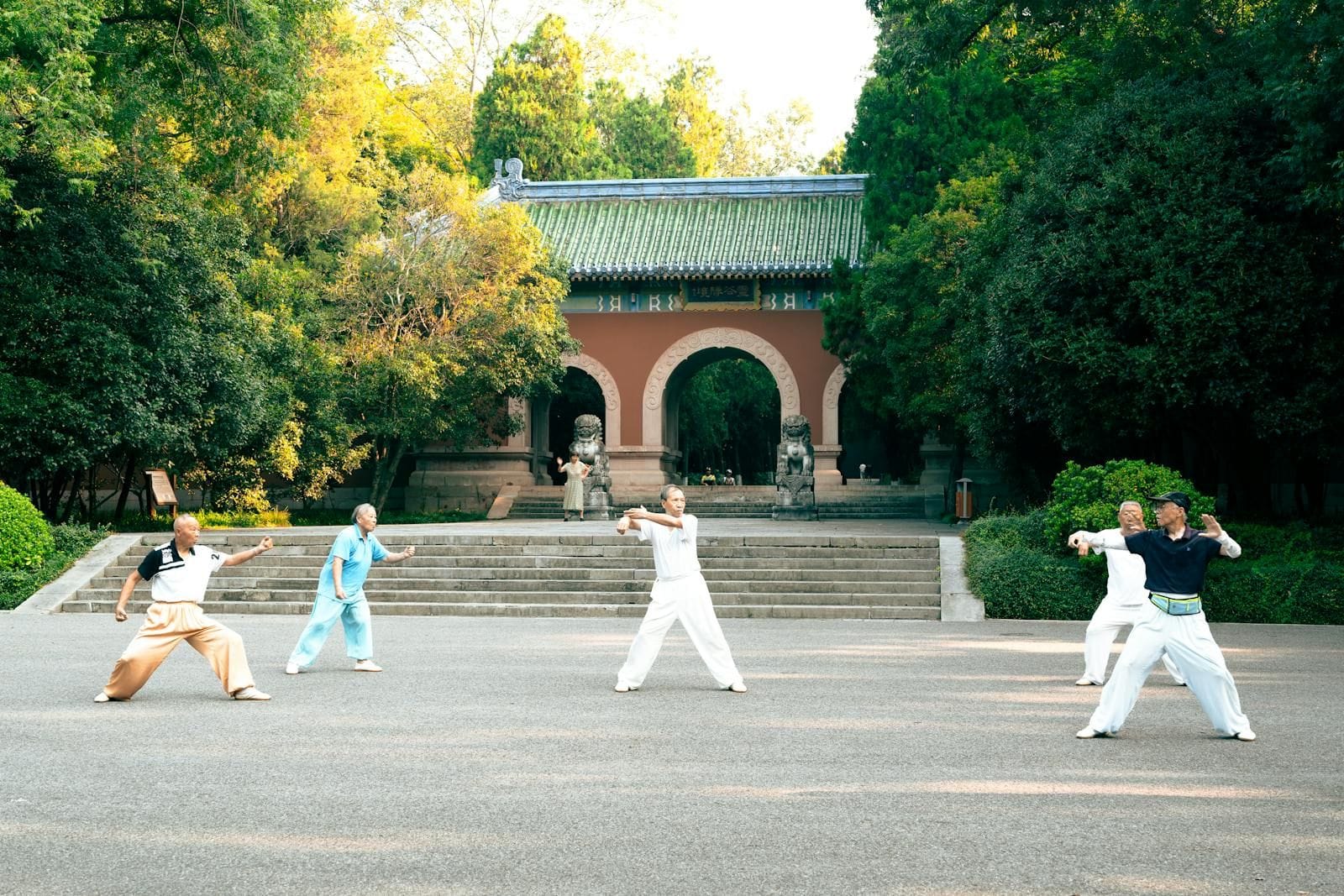
One in four Americans over the age of sixty-five falls every year, according to the Centers for Disease Control and Prevention . Falls are now the leading cause of injury-related death in that age group, and the fall-death rate has risen by 21 percent since 2018 to a national figure of 78.4 deaths per 100,000 adults sixty-five and older. Roughly three million older adults end up in emergency rooms every year for fall-related injuries; about a million end up admitted. Among the long list of interventions designed to push those numbers down — home modifications, vision correction, medication review, resistance training, balance classes — one practice keeps surfacing at the top of the evidence pile, and most American families have never tried it.
Tai chi is a Chinese movement practice three centuries older than the United States, performed slowly enough that it looks at first glance like it could not possibly be exercise. The research says otherwise — convincingly, and in language families can take to a cardiologist's office. This is a practical guide to what tai chi is, why it appears to work for older bodies, which style fits which person, what a first class actually looks like, and how to build the habit far enough that the research-level benefits arrive.
The Workout Behind the Largest Fall-Prevention Study
In 2018 a multi-institutional trial published in JAMA Internal Medicine randomized 670 older adults with a fall history into three groups — a tai chi program built around eight balance-focused movements, a multimodal exercise program, and a stretching control. Over six months the tai chi group recorded 152 falls; the multimodal exercise group, 218; the stretching group, 363. Tai chi reduced falls by 58 percent compared with stretching and 31 percent compared with the multimodal exercise program, in what at the time was the largest study of its kind.
A 2023 systematic review and meta-analysis in Frontiers in Public Health pooled 24 randomized controlled trials covering 5,469 participants and found that tai chi practice reduced overall fall risk by 24 percent (relative risk 0.76, 95 percent confidence interval 0.71–0.82). The effect held across both healthy older adults and those at elevated fall risk. It was strongest at twice-weekly practice and grew with longer overall duration. The same meta-analysis confirmed measurable improvements in the timed up-and-go test, the functional reach test, single-leg stance, and gait speed — the four metrics geriatricians lean on when they want to estimate someone's near-term fall risk.
The Centers for Disease Control and Prevention endorses tai chi as one of its evidence-based fall-prevention interventions, alongside Otago and a small handful of others. The U.S. Preventive Services Task Force gives community-based exercise for fall prevention in older adults a B-grade recommendation. None of this is folk-medicine speculation. The reason most American primary-care offices do not bring tai chi up by name is mostly about American familiarity with the practice — not the data.
Why a Slow Practice Moves the Numbers
Falls in older adults are almost never about strength alone. Sarcopenia matters, but the immediate cause of most falls is a failure of balance control — a body that does not know where it is in space quickly enough to correct a stumble. Three systems collaborate on that judgment: the visual system (where the room is), the vestibular system (where the head is), and proprioception (where the joints are). All three weaken with age, and at different rates. Tai chi trains all three simultaneously, slowly enough that the brain has time to re-calibrate them in real time.
The mechanics are unglamorous in print and obvious on a mat. Most tai chi movements involve a deliberate weight transfer from one leg to the other while a slow turn or arm sweep happens above. To do that without falling, the body has to find single-leg balance at a speed where it is forced to feel for it rather than catch itself. Knees stay soft, never locked. Hips rotate over the weighted foot. The trunk stays upright; eyes pick a horizon. The brain runs the same fall-prevention loop in slow motion that it will need to run in a hundredth of a second the next time someone steps onto a wet kitchen tile.
The other ingredients are aerobic and musculoskeletal. A thirty-minute class at moderate stance height puts a steady, low-grade load on the quadriceps, hamstrings, glutes, and calves — sustained quasi-isometric work that builds the lower-body strength older adults often lose decades before they notice. Breathing is deep and diaphragmatic, which is good for cardiovascular conditioning and turns out to also be a surprisingly effective intervention for stress and sleep. The social piece of attending a class twice a week — the same faces, the same teacher, the small unspoken accountability — is the reason these programs retain older adults better than gym-based routines.
The Five Styles, and the Two Most Worth Starting With
Tai chi has five major family styles: Chen, Yang, Wu, Sun, and Hao. Each is rooted in a particular family lineage going back three to four centuries. They share a vocabulary of postures and the same internal principles, but they differ in pace, stance depth, athleticism, and what they emphasize. For older adults the meaningful distinction collapses to two.
Yang style is by far the most widely taught form of tai chi outside China. Movements are large, slow, gentle, and flowing; stances are upright with modest knee bend. The 2023 meta-analysis found Yang style was the most effective for improving functional reach. If a class advertises itself simply as "tai chi for beginners" or "tai chi for seniors" in a Western community center, it is almost certainly teaching Yang. It is the default first style for a healthy older adult.
Sun style is the youngest of the five, developed in the early twentieth century by Sun Lutang. Stances are higher, steps are agile, and an unbroken "follow-step" pattern (the rear foot follows the front foot rather than holding ground) makes the practice gentler on knees and hips. In 1997, Dr. Paul Lam, a Sydney family physician who developed arthritis himself, adapted Sun-style tai chi into a twelve-movement curriculum specifically for people with arthritis. That curriculum, Tai Chi for Arthritis and Fall Prevention , is the program the CDC recognizes for fall prevention and the Arthritis Foundation endorses. If knees, hips, or a recent joint replacement are part of the picture, Sun is the right starting style. Movement is only half of arthritis comfort, though — many older adults also lean on over-the-counter pain relievers, so it helps to understand acetaminophen's side effects in older adults before taking it day after day.
Chen style is the oldest and the closest to tai chi's martial-art origins; movements alternate between slow flow and quick, explosive bursts, with deep stances and jumping kicks in the advanced forms. It is not a starting point for older adults. Wu style — smaller-frame, more leaning postures — is occasionally taught to seniors but has thinner research support for fall prevention than Yang or Sun. Hao style places strong emphasis on internal energy work and is generally taught only to advanced practitioners. Most American teachers a beginner over sixty-five will encounter teach Yang, Sun, or a school-specific simplified form derived from one of the two.
Tai Chi for Arthritis and Fall Prevention: The CDC-Recognized Program
Of every senior-targeted tai chi curriculum currently taught in the United States, Tai Chi for Arthritis and Fall Prevention is the one with the deepest evidence base and the widest community footprint. Dr. Paul Lam's Tai Chi for Health Institute trains community instructors through a standardized one-day workshop, and licensed leaders run classes through senior centers, YMCAs, hospital wellness programs, county aging departments, and a long list of nonprofit partners across all fifty states.
The curriculum is twelve movements — six basic and six advanced — preceded by a warm-up and closed with a cool-down. A standard class runs forty-five minutes to an hour. Most participants meet twice a week for eight weeks (or once a week for sixteen weeks), with the National Council on Aging's evidence-based-program guidance specifying sixteen total class hours as the minimum effective dose. Home practice between classes is encouraged but not required to capture the research-validated benefit.
In New Jersey, where the state Division of Aging Services maintains an evidence-based-program directory , the Arthritis Foundation's licensed Tai Chi from the Arthritis Foundation classes run through county Departments of Aging and specific senior wellness centers. The same program is taught under slightly different names — "Moving for Better Balance" is the Oregon Research Institute's eight-form variant, also CDC-recognized — at YMCAs across the state including the YMCA of the Jersey Shore's Active Older Adults catalogue. The point for a beginning student is recognizing the program credentialing on the flyer: a Tai Chi for Health Institute or Arthritis Foundation certification means the instructor has been trained in the research-grade curriculum, not just a generic adaptation.
Tai Chi Walking: The Smaller Practice That Sneaks Into a Daily Routine
The single most important micro-skill inside tai chi is also the one that translates most cleanly into the rest of an older adult's day. Tai Chi Walking is a deliberate slow-motion variant of ordinary walking in which the body's full weight is settled onto one foot before the other is lifted, lifted in a controlled arc, placed heel-first, and the weight rolled onto it before the rear foot leaves the ground. Said in print it sounds odd. Done in person it is the calmest, most aware walking most adults have ever experienced — and the body learns it quickly.
Dr. Lam's institute describes Tai Chi Walking as a daily building-block practice that can be done alongside formal class attendance or as a standalone routine for adults who cannot get to a class. Three to five minutes performed inside the house each morning, with one hand lightly on a kitchen counter for safety, trains the same single-leg-stability loop the formal forms train. For adults whose balance is unsteady enough that an unsupported forms class would be unsafe to start, this is the safer entry point and the recommended starting practice.
The principles also translate to ordinary walking around the house: one foot at a time, weight fully transferred before the next step, eyes up rather than at the floor, breath through the diaphragm. Families who walk this way alongside a parent through a kitchen or down a hallway often notice within weeks that the parent's natural gait has started to slow, even out, and become more deliberate — which is, in plain terms, what fall-risk reduction looks like in a hallway.
What a First Class Actually Looks Like
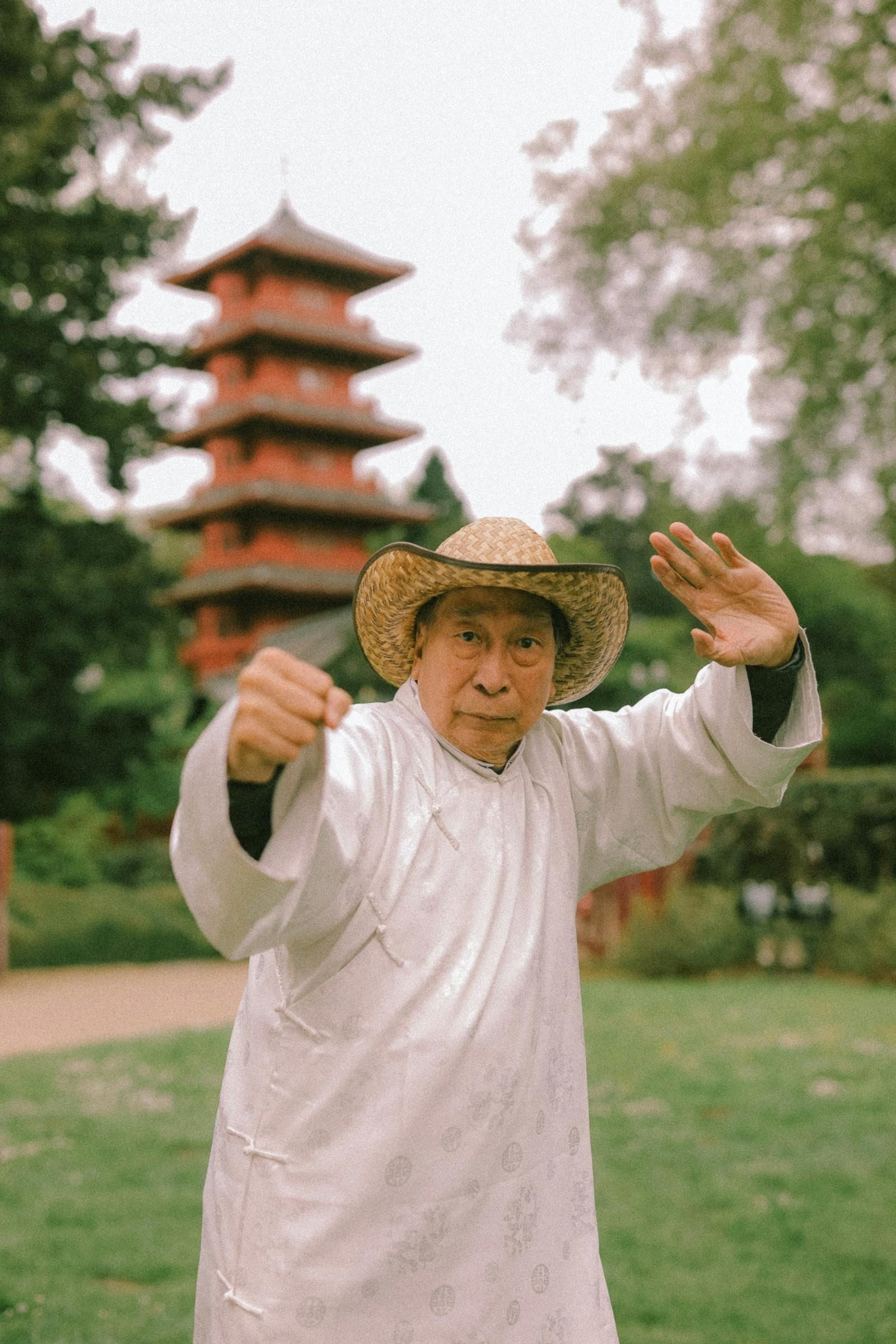
Most beginners over sixty arrive at a tai chi class with three worries — that they will fall behind, that their joints will hurt, and that they will be the only one there who has never done this before. None of these turn out to be true in a well-run class, but the gap between the expectation and the actual experience is the reason a quarter of first-time attendees do not return for a second class. Knowing what to expect closes the gap.
Class structure is consistent across most senior-targeted programs. The first ten minutes are warm-ups — shoulder rolls, gentle head turns, ankle circles, hip rolls, knee circles, slow weight shifts side to side. The next twenty-five to thirty minutes are the forms themselves, broken down to one or two postures per session at the beginning and practiced as transition sequences as the weeks go on. The last five to ten minutes are cool-down — slow walking, gentle stretches, sometimes a closing breath sequence done standing. Nobody touches the floor. Nobody lies down. Nobody is asked to do anything that requires lifting a knee higher than mid-thigh.
Dress is the easiest part. Loose pants, loose top, flat soft shoes with a non-skid sole (no heels, no flip-flops, no thick athletic shoes that would mute foot-placement awareness). Avoid socks on smooth floors. Bring water; most teachers do not break during a class, but a slow sip between sets is fine. The teacher will demonstrate every movement before asking the class to follow, and a good instructor will move through the group watching individual stances rather than performing the entire form at the front.
The first day's discomfort is almost always in the quadriceps, not the joints. Holding a softly bent knee for thirty minutes is unfamiliar work for an older adult who has not done lower-body strength training in years. That ache fades within two weeks. If joint pain instead of muscle ache shows up — sharp, located inside the joint, persistent into the next day — that is the signal to tell the instructor and modify stance height. Sun-style curricula and the Tai Chi for Arthritis program are designed for exactly this adjustment.
The Twelve-Week Path Most Beginners Don't Quit
The single biggest predictor of long-term tai chi practice is not athletic background, age, or starting health — it is finishing the first twelve weeks. The early dropouts cluster in weeks two through four, when the muscle ache is real and the form vocabulary feels overwhelming. The plateau cluster sits at weeks six through eight, when the novice has memorized the opening movements and started to wonder whether the slowness is doing anything. Almost everyone who pushes through both clusters keeps practicing for years.
A realistic first twelve weeks looks like this. Weeks one and two: attend twice weekly, expect leg soreness, do nothing extra at home. Weeks three and four: keep the twice-weekly class attendance, add a five-minute Tai Chi Walking practice at home three mornings a week. Weeks five through eight: continue twice weekly in class, lengthen home practice to ten minutes of any combination of Tai Chi Walking and the warm-ups taught in class, and start watching one video at home weekly for the form currently being taught. Weeks nine through twelve: the home practice begins to feel like its own routine, the class forms start connecting into longer sequences, and the body's sense of weight on one leg becomes noticeably easier to find than in week one.
Three common mistakes derail the first three months. The first is going too fast — adding home sessions that exceed what the class teacher has covered, copying advanced YouTube forms before the foundation is in. The second is comparing oneself to other students; everyone arrives with different bodies and different histories, and tai chi is one of the rare practices where visibly being "behind" the next student does not slow the research-validated benefit at all. The third is intermittent attendance — missing a week, missing another, then quitting because the form has moved past where memory left it. The fix is to attend even when memory has slipped, and trust the instructor to bring the student back into sequence.
When Tai Chi Is the Wrong Move
Tai chi is one of the safest forms of exercise studied in older adults, but it is not universally indicated, and a small set of conditions call for a conversation with a clinician before starting. The Tai Chi for Health Institute's safety guidance is detailed; the most relevant pieces for older adults are short to summarize.
Recent joint surgery or injection. Knee replacement, hip replacement, shoulder repair, or a corticosteroid injection within the past six months calls for surgeon clearance before beginning any tai chi practice. Once cleared, modifications matter: hip-replacement patients should avoid crossing the affected leg across the body's midline; knee-surgery patients should stand fully upright between movements until knee strength returns.
Active arthritis flare. Active joint inflammation with heat, redness, and swelling should be treated medically before starting; tai chi is gentle but does not exempt an inflamed joint from load. Once the flare is resolved, Sun-style Tai Chi for Arthritis is the indicated starting curriculum.
Severe cardiovascular or pulmonary disease, uncontrolled. Adults with unstable angina, decompensated heart failure, severe valvular disease, or oxygen-dependent COPD should clear any exercise program with their cardiologist or pulmonologist first. For most stable cardiopulmonary patients, tai chi is one of the safer exercise prescriptions available; it has been studied specifically in heart-failure populations and shows benefit. The conversation is about individual fit, not categorical exclusion.
Severe acute pain. Active sciatic nerve inflammation, an acute lumbar disc episode, or any sharp movement-related pain that has not been clinically assessed is a stop sign. The slow, weight-bearing nature of tai chi will not aggravate most chronic stable pain, but it is not a diagnostic substitute for a physician.
Dementia with poor instruction-following. Tai chi has been studied with promising results in mild-to-moderate cognitive impairment, including a small amount of evidence for slowed cognitive decline in regular practitioners. For a person with advanced dementia who can no longer follow multi-step verbal cues, however, seated forms with one-on-one guidance from a familiar caregiver are the realistic option, not a group class.
Finding a Class, In Person and on Screen
In-person classes are the higher-yield option for a first-time student. The combination of an instructor's eye on individual stance, the social structure of a recurring class, and the unspoken accountability of a weekly schedule produces better retention than any home video program in the published literature. Three sources cover most American zip codes:
County or township senior services. Almost every county-level aging-services department in New Jersey, New York, Pennsylvania, and Florida runs free or low-cost evidence-based tai chi classes through senior centers. The Somerset County NJ Senior Wellness Centers, for example, run multiple weekly tai chi classes at no charge; similar programs operate in Monmouth, Middlesex, Bergen, Union, Ocean, and Mercer counties. Sarasota County in Florida runs comparable programs through its Senior Friendship Centers.
YMCAs and JCCs. Most YMCA branches run tai chi as part of their Active Older Adults catalogue, often under the "Moving for Better Balance" brand or as "Arthritis Foundation Exercise Class." Membership is typically required but most branches offer reduced rates for adults sixty-five and over.
Hospital wellness programs and arthritis chapters. Local arthritis foundation chapters maintain instructor directories; many regional hospital systems run their own community wellness departments offering Tai Chi for Arthritis at modest cost.
For adults whose schedule, transportation, or stamina make classroom attendance difficult, supervised online options have matured. The Tai Chi for Health Institute publishes a complete Tai Chi for Arthritis curriculum on DVD and as streaming lessons; Dr. Paul Lam's introductory beginner course is available free on YouTube. The Harvard Medical School-affiliated programs and several CDC-grantee programs offer hybrid models — in-person weekly with Zoom support — that work well for older adults who miss a session.
The reality on the ground, particularly for an older adult who has stopped driving or whose balance is unsteady enough that getting to and from a community-center parking lot is itself a fall risk, is that transportation often turns out to be the binding constraint. A few hours a week of in-home companion care through a caregiver who drives the parent to a Tuesday class and stays for the hour is the kind of practical bridge that turns a "I keep meaning to try it" into a sustained twelve-week start. The same caregiver who supports the fall-prevention exercise habit is the one our mobility-focused caregivers are trained to be — steady arms in transitions, awareness of the home's slip points, an extra set of eyes on the parent's gait as it changes through the program. Across the Bergen County, New Jersey branch and our Sarasota, Florida franchise, where retired communities concentrate, this is one of the more common shapes of in-home help our caregivers end up providing — not the dramatic medical assistance families picture, but the quieter logistical scaffolding that lets a parent build a habit they did not have a way to start.
Frequently Asked Questions
Does tai chi really prevent falls in older adults? Yes, and the evidence is unusually strong. A 2018 trial published in JAMA Internal Medicine reduced falls by 58 percent compared with a stretching program and 31 percent compared with a multimodal exercise program. A 2023 meta-analysis of 24 randomized controlled trials covering 5,469 participants found tai chi reduced fall risk by 24 percent overall, with the effect strongest when practiced twice weekly for at least eight weeks. The CDC lists tai chi among its evidence-based fall-prevention programs.
Which style of tai chi is best for someone over 70? Yang style is the most popular and the most accessible for first-time learners — flowing upright postures and modest knee bend, the version most general "tai chi for seniors" classes teach. Sun style is the basis of Dr. Paul Lam's CDC-recognized Tai Chi for Arthritis and Fall Prevention program; its higher stance and follow-step pattern are gentler on knees and hips and make it the better starting point if arthritis is in the picture. Chen, Wu, and Hao styles are valuable practices but not first-line for older adults.
How long until I see results? Balance and stability begin shifting after four to six weeks of twice-weekly practice. Research-validated fall-risk reductions appear at the eight- to sixteen-week mark, and the Tai Chi for Arthritis and Fall Prevention curriculum specifies sixteen total class hours as the minimum effective dose. The gains compound over years — long-term practitioners show measurable improvements in gait speed, single-leg stance time, and the timed-up-and-go test across multiple longitudinal studies.
Can I do tai chi if I have arthritis or a recent joint replacement? Yes, with adjustments. Tai Chi for Arthritis was designed by a physician with arthritis specifically for this population, and the Arthritis Foundation has endorsed it. People with knee arthritis should stand up between movements until lower-body strength builds and should avoid turning a foot while the knee is bent and weight-bearing. Anyone with a recent hip replacement should avoid crossing the affected foot across the body's midline. Recent knee surgery or corticosteroid injection within six months calls for surgeon clearance first.
Do I need to be flexible or fit to start? No. Tai chi was developed precisely for people who are stiff, deconditioned, or recovering. Movements are slow, joints stay soft (slightly bent, never locked), and the practice meets the body where it is. The balance and gait improvements in the research literature were measured against starting populations that, on average, were not athletic.
Can tai chi be practiced seated? Yes. The Tai Chi for Health Institute publishes a Seated Tai Chi for Arthritis program designed for wheelchair users and people with mobility limits that rule out standing practice. Side-to-side weight shifts, alternating heel and toe lifts, upper-body forms, and breath work translate well to the seated form, and many seated practitioners gradually transition to standing forms over months as core strength returns.
How much does a tai chi class cost? Most community-center, library, and senior-center classes run between zero and fifteen dollars per session, and many YMCA, township parks-department, and county senior-services programs run free or by donation. Hospital-system wellness programs sometimes charge fifteen to twenty-five dollars. CDC-recognized programs run through state aging departments are often free of charge for adults over sixty. Online courses through Dr. Paul Lam's institute and similar providers range from free YouTube introductions up to fifty dollars per month for full curriculum access.
A Slow Discipline, on a Long Clock
The hard thing to internalize about tai chi is also the most important: every single research benefit it produces is the product of consistent practice over time, never a single class that fixes anything. Fall risk does not measurably drop at week three; it drops at month four. Balance does not improve from a five-minute YouTube introduction; it improves from a steady hundred and twenty hours of practice spread across a year. The practice is built for adults whose remaining decades are long enough that small daily investments compound into outcomes measurable in the clinical literature.
Which is also the reason it tends to fit later life so well. The body of an adult in their seventies is no longer chasing a peak; it is preserving range, conserving balance, sustaining the capacity to move freely through the rooms of a familiar home and the streets of a familiar neighborhood for as many more years as the rest of the body will allow. Tai chi is one of the rare interventions in the geriatric playbook whose benefits accumulate the longer you do it, with negligible injury risk, in clothing the practitioner already owns, in a space the practitioner can find within a few miles of their own door, paid for largely by the local township or county.
Start with one class. Find the program credential on the flyer. Wear soft shoes and loose pants. Expect to feel it in the quadriceps for the first two weeks. Plan to attend twice a week for sixteen weeks before judging whether it has helped. And then — most likely — keep going, on the slow clock the practice was always meant to be lived on.
Hero photograph by Da Na. In-post photographs by Ersin and Cheng Shi Song. All via Pexels.
Frequently Asked Questions
Does tai chi really prevent falls in older adults?
Yes, and the evidence is unusually strong. A 2018 trial published in JAMA Internal Medicine reduced falls by 58 percent compared with a stretching program and 31 percent compared with a multimodal exercise program. A 2023 meta-analysis of 24 randomized controlled trials covering 5,469 participants found tai chi reduced fall risk by 24 percent overall, with the effect strongest when practiced twice weekly for at least eight weeks. The Centers for Disease Control and Prevention lists tai chi among its evidence-based fall-prevention programs.
Which style of tai chi is best for someone over 70?
Yang style is the most popular and the most accessible for first-time learners — flowing upright postures and modest knee bend, the version most general 'tai chi for seniors' classes teach. Sun style is the basis of Dr. Paul Lam's CDC-recognized Tai Chi for Arthritis and Fall Prevention program; its higher stance and follow-step pattern are gentler on knees and hips and make it the better starting point if arthritis is in the picture. Chen, Wu, and Hao styles are valuable practices but not first-line for older adults.
How long until I see results?
Balance and stability begin shifting after four to six weeks of twice-weekly practice. Research-validated fall-risk reductions appear at the eight- to sixteen-week mark, and the Tai Chi for Arthritis and Fall Prevention curriculum specifies sixteen total class hours as the minimum effective dose. The gains compound over years — long-term practitioners show measurable improvements in gait speed, single-leg stance time, and the 'timed-up-and-go' test across multiple longitudinal studies.
Can I do tai chi if I have arthritis or a recent joint replacement?
Yes, with adjustments. Tai Chi for Arthritis was designed by a physician with arthritis specifically for this population, and the Arthritis Foundation has endorsed it. People with knee arthritis should stand up between movements until lower-body strength builds and should avoid turning a foot while the knee is bent and weight-bearing. Anyone with a recent hip replacement should avoid crossing the affected foot across the body's midline. Recent knee surgery or corticosteroid injection within six months calls for surgeon clearance first.
Do I need to be flexible or fit to start?
No. Tai chi was developed precisely for people who are stiff, deconditioned, or recovering. Movements are slow, joints stay soft (slightly bent, never locked), and the practice meets the body where it is. The balance and gait improvements in the research literature were measured against starting populations that, on average, were not athletic.
Can tai chi be practiced seated?
Yes. The Tai Chi for Health Institute publishes a Seated Tai Chi for Arthritis program designed for wheelchair users and people with mobility limits that rule out standing practice. Side-to-side weight shifts, alternating heel and toe lifts, upper-body forms, and breath work translate well to the seated form, and many seated practitioners gradually transition to standing forms over months as core strength returns.
How much does a tai chi class cost?
Most community-center, library, and senior-center classes run between zero and fifteen dollars per session, and many YMCA, township parks-department, and county senior-services programs run free or by donation. Hospital-system wellness programs sometimes charge fifteen to twenty-five dollars. CDC-recognized programs run through state aging departments are often free of charge for adults over sixty. Online courses through Dr. Paul Lam's institute and similar providers range from free YouTube introductions up to fifty dollars per month for full curriculum access.