When Swallowing Gets Harder With Age
Swallowing trouble is common with age but rarely just aging. The signs to watch, why silent aspiration is dangerous, and how a dysphagia diet works.

Trouble swallowing is one of the most common problems almost no one talks about. Researchers estimate it affects roughly eight percent of the world's population, close to 590 million people, and the numbers climb steeply with age. Among adults over 70, studies put the rate anywhere from a quarter to more than half, depending on how it is measured and where people live. In one striking finding, more than nine in ten older patients hospitalized with pneumonia turned out to have an underlying swallowing problem that no one had flagged.
The medical name for it is dysphagia, and it sits in a strange blind spot. It rarely announces itself. It creeps in as a cough at dinner, a voice that turns a little wet after a sip of tea, a meal that used to take twenty minutes and now takes an hour. Families notice the small things without connecting them, and the person living with it often hides the struggle out of embarrassment. This is a guide to what those signs mean, why they matter more than they look, and how a well-built dysphagia diet lets most people keep eating safely, and by mouth, for a long time.
First, the Part That's Just Aging
Some slowing of the swallow is normal, and it helps to name it so you do not panic at the first sign of change. Specialists call the healthy version presbyphagia. With age, the muscles of the mouth and throat lose a little strength, the swallow takes a fraction longer to trigger, and clearing food from the throat is less efficient than it was at 40. On its own, that is not dangerous and does not call for any special diet. It is the swallowing equivalent of a slower walking pace.
Dysphagia is a different animal. It is not a slower version of normal but a disorder, and it shows up as consequences: coughing, choking, a wet voice, weight loss, dehydration, or a chest that keeps getting infected. Age raises the odds, and so do the conditions that become more common in later life, above all stroke, Parkinson's disease, and dementia, each of which can disrupt the precise timing a safe swallow depends on. The practical rule is simple. A slightly slower, uneventful meal is aging. Coughing, sticking, and weight loss are not, and they deserve a look.
The Signs That Cross the Line
A safe swallow is a fast, coordinated relay: the tongue moves the food back, the airway seals shut, and the throat squeezes everything down toward the stomach in under two seconds. Dysphagia is any breakdown in that relay, and the tells are usually visible at the table if you know what to look for.
- Coughing or throat-clearing during or right after eating or drinking, especially with thin liquids like water.
- A wet, gurgly, or hoarse voice after a swallow, as if the person needs to clear their throat to talk.
- Food or pills that feel stuck, or a sensation of something caught in the throat or chest.
- Drooling, or food kept in the cheeks, sometimes discovered long after the meal is over.
- Meals that drag on, extra effort to chew and swallow, or quietly giving up partway through a plate.
- Weight loss, avoiding certain foods, or eating alone to hide the difficulty from family.
One sign carries more weight than the rest: repeated chest infections or bouts of pneumonia. That pattern often points to aspiration, and it can be the only outward clue that something is wrong. Because dysphagia so often travels alongside a fading appetite, it is worth reading these signs together with the ones covered in our guide to dehydration in older adults, since a person who finds drinking difficult will often quietly stop.
The Danger You Can't Hear
The word that matters most in swallowing safety is aspiration: food, drink, or saliva slipping past the vocal cords and into the airway instead of the stomach. In a healthy person, a stray drop triggers a hard, protective cough. The frightening feature of dysphagia in older adults is that this alarm often fails. Researchers estimate that more than half of aspiration in people with swallowing problems is silent, meaning it happens with no cough, no gasp, no outward sign at all.
That silence is why aspiration is so easy to miss and so serious. Material that reaches the lungs, particularly when it carries bacteria from the mouth, can lead to aspiration pneumonia, one of the leading reasons frail older adults land in the hospital and one of the harder infections to recover from at an advanced age. It is also why two habits that seem to have nothing to do with swallowing matter enormously: keeping the mouth clean, which cuts the bacteria that ride along on any stray drop, and watching for low-grade fevers or that telltale wet voice in someone who never seems to cough. Silent does not mean harmless. It means you have to look, not listen.
Why It Snowballs: Weight, Water, and the Lungs
Left unaddressed, a swallowing problem rarely stays a swallowing problem. It pulls three other things down with it. The first is nutrition. When eating becomes work, people eat less, and studies find malnutrition in roughly a quarter to nearly half of those with dysphagia. The second is hydration, for the cruel reason that thin water is often the single hardest thing to swallow safely, so the person most in need of fluids is the one who most avoids them. The third is the lungs, through the aspiration described above.
Each of these feeds the others. Poor nutrition weakens the very muscles the swallow depends on, which worsens the dysphagia, which further shrinks intake. Dehydration thickens saliva and dulls alertness at meals. It is a downward spiral, and the reason specialists treat swallowing problems early and aggressively is to break the loop before a manageable difficulty becomes a crisis of weight, weakness, and repeated hospital stays.
What a Speech Pathologist Actually Changes
The specialist for swallowing is not the type of professional most families expect. It is a speech-language pathologist, or SLP, whose training covers the same muscles used for both speech and swallowing. When a doctor suspects dysphagia, a referral to an SLP is the pivotal step, and it is worth asking for by name rather than waiting for it to be offered.
An SLP does more than watch someone eat, though a bedside evaluation of how the person handles different textures is part of it. When needed, they use imaging that shows the swallow in motion, a moving X-ray of a barium-coated bite, or a tiny camera passed through the nose to watch the throat directly. These tests reveal exactly where the breakdown happens and, crucially, whether the person is aspirating silently. From there the SLP builds a plan: specific swallowing exercises to rebuild strength, positioning and technique changes such as tucking the chin to protect the airway, and the centerpiece for most people, a texture-modified diet pitched at the exact level that is safe without being needlessly restrictive.
A Dysphagia Diet, in Eight Levels
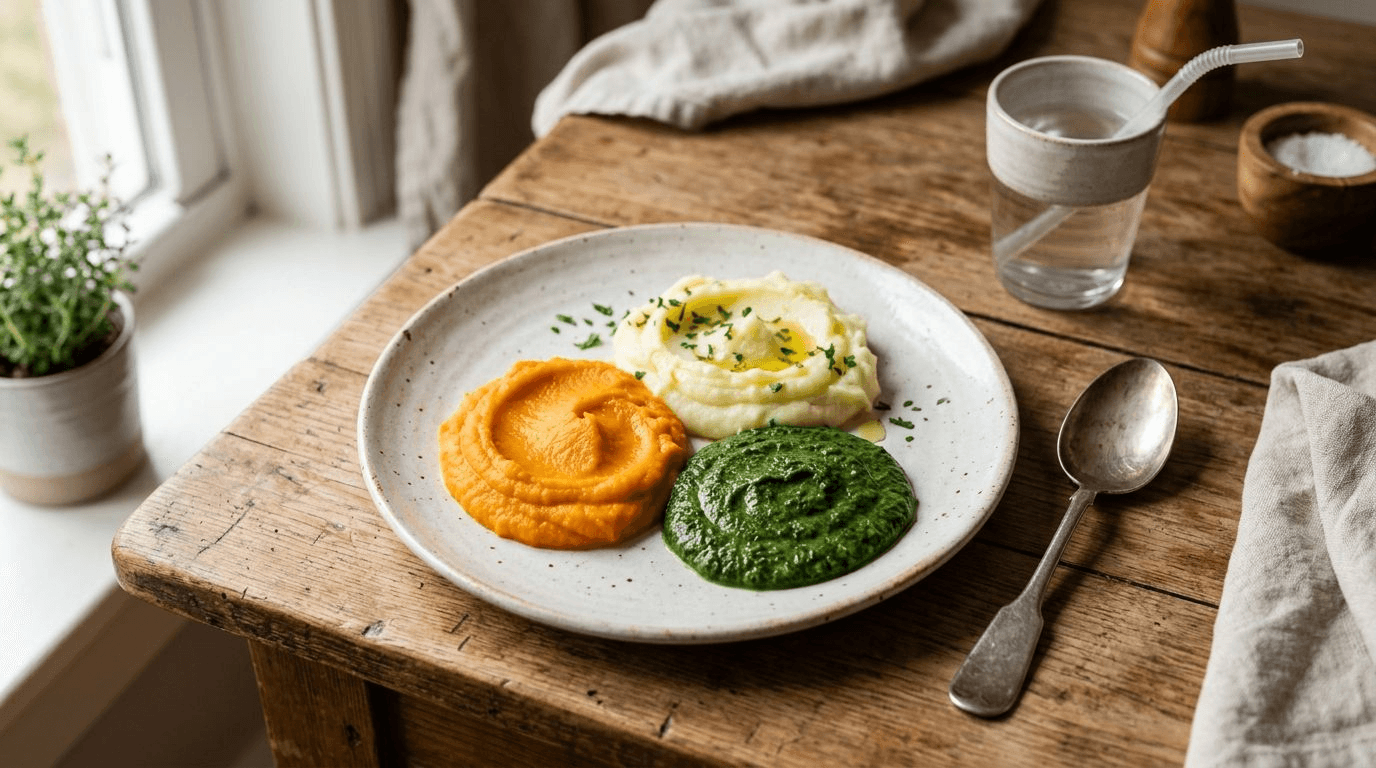
A dysphagia diet has two jobs: make solid food easier to control, and slow liquids down so the airway has time to close before the drink arrives. For years, hospitals used a jumble of local terms, nectar-thick, honey-thick, mechanical soft, that meant different things in different places. Today most of the world has standardized on the International Dysphagia Diet Standardisation Initiative, or IDDSI, a single scale of eight levels from 0 to 7 with shared names and color codes. Drinks run from level 0 up to 4; foods run from level 3 up to 7, overlapping in the middle where a food and a drink can share the same thickness.
| Level | Name | What it is like |
|---|---|---|
| 0 | Thin | Ordinary water; flows fast, no thickening |
| 1 | Slightly Thick | A touch thicker than water, like a runny nectar |
| 2 | Mildly Thick (nectar) | Sips from a cup or straw with mild effort |
| 3 | Moderately Thick (honey) / Liquidised food | Drunk from a cup, too thick for a straw; smooth, no lumps |
| 4 | Extremely Thick (pudding) / Pureed food | Eaten with a spoon, holds its shape, needs no chewing |
| 5 | Minced & Moist food | Small soft lumps, easily mashed with the tongue |
| 6 | Soft & Bite-Sized food | Soft, tender pieces cut small; no knife needed |
| 7 | Regular / Easy to Chew | Everyday foods, or soft normal-texture versions of them |
Thickened liquids do the heavy lifting on the drinks side. Adding a starch- or gum-based thickener slows the flow so a person has time to seal the airway before the liquid reaches it. There is a balance to strike, though: drinks that are made too thick leave residue behind in the throat, which brings its own risk, which is exactly why the level is prescribed rather than guessed. On the food side, the goal is always the least restrictive level that is still safe. Pureeing everything is not the aim; keeping a person eating the most normal food they can handle is.
Making the Table Safer Tonight
Texture is only half the picture. How a meal is served changes the odds as much as what is on the plate, and these habits cost nothing to adopt while you wait for a professional evaluation.
- Sit fully upright. A 90-degree posture at the table, and staying upright for 20 to 30 minutes after eating, uses gravity to keep food heading the right way.
- Slow everything down. Small bites and small sips, the fork set down between mouthfuls, and no second bite until the first is fully swallowed.
- Cut the distractions. Turn off the television and keep conversation for between bites, not during them. Swallowing needs attention.
- Avoid mixed textures unless a professional has cleared them: no cereal swimming in milk, no broth full of chunks, no fruit floating in juice.
- Check the mouth is clear before the next bite, and keep up oral care after meals to hold down the bacteria that make aspiration dangerous.
- Handle medications carefully. Never assume a pill can be crushed or opened; some cannot, so ask the pharmacist how to give each one safely.

This is often where a steady extra person changes the whole picture. Preparing food to a precise texture, thickening drinks to the right level for every cup, and simply being present and unhurried through a meal that now demands attention is a lot to carry alone, three times a day. A personal care aide can handle hands-on help at the table for someone who needs it, while a companion caregiver can shop, prepare texture-modified meals, and turn eating back into company rather than a chore. It pairs naturally with sorting out how meals get to the table in the first place. For families we support across Bergen County, New Jersey, that reliable presence at mealtimes is frequently what keeps a swallowing problem from turning into a hospital stay.
The Goal Isn't Puree. It's Dinner.
It is easy to hear "texture-modified diet" and picture beige trays and lost pleasure. That is the wrong picture, and it is not the goal. Modern dysphagia care is built around the least restrictive plan that keeps a person safe, because eating is not only fuel. It is one of the last reliable pleasures and one of the most social acts we have, and protecting the enjoyment of it is part of the job, not a luxury on top of it.
So if the meals in your family have started running long, if the coughing at the table has become a quiet routine, or if pneumonia keeps returning for no clear reason, treat it as the signal it is and start with a doctor and a speech-language pathologist. Swallowing problems are common, they are serious, and they are, with the right diet and a little help, remarkably manageable. Handled early, most people go on eating the food they love, at the table with the people they love, which was the whole point all along.
Frequently Asked Questions
What is a dysphagia diet?
A dysphagia diet is a way of preparing food and drink so that a person with a swallowing problem can eat and drink safely. It has two parts: foods are softened, minced, or pureed to a texture the person can manage without choking, and thin drinks like water, coffee, and juice are thickened so they flow slowly enough to swallow without slipping into the airway. Most professionals now describe these textures using the IDDSI framework, an international scale of eight levels from thin liquids up to regular food. A speech-language pathologist decides which level is right after evaluating the swallow, because the goal is the least restrictive texture that is still safe, not simply the softest one.
What are the signs of swallowing problems in the elderly?
Watch for coughing or throat-clearing during or right after eating and drinking, a wet or gurgly voice after swallowing, food or pills that feel stuck, drooling or food kept in the cheeks, and meals that take much longer than they used to. Over time you may also see unexplained weight loss, avoidance of certain foods or of eating in company, and repeated chest infections or bouts of pneumonia. Repeated pneumonia is an especially important clue, because it can be the only outward sign of silent aspiration, where food or liquid enters the airway without triggering a cough. Any of these signs is worth raising with a doctor.
Is difficulty swallowing a normal part of aging?
Not exactly. Aging does change the swallow: the muscles weaken slightly and the whole sequence slows down, a normal shift that specialists call presbyphagia. On its own that is not dangerous and does not require a special diet. Dysphagia is different. It is a disorder, not just a slower version of normal, and it shows up as coughing, choking, a wet voice, weight loss, or recurrent pneumonia. Age raises the risk, and conditions common in later life such as stroke, Parkinson's disease, and dementia raise it further, but true swallowing difficulty should always be evaluated rather than written off as getting older.
What foods should be avoided with dysphagia?
The exact list depends on the texture level a speech-language pathologist assigns, but some foods are risky for almost anyone with a swallowing problem. Hard, crunchy, or crumbly foods like nuts, raw vegetables, chips, and dry crackers are difficult to control. Tough or chewy items such as steak and doughy bread can form a dense lump. Stringy or fibrous foods like celery and pineapple are hard to break down. The trickiest of all are mixed textures, where solid pieces sit in liquid, such as cereal in milk, minestrone soup, or fruit in juice, because the thin liquid can rush ahead into the airway while the solids lag behind. Thin liquids themselves are often the biggest hazard, which is why they are commonly thickened.
When should someone see a doctor about swallowing problems?
Soon. Occasional trouble when eating too fast or not chewing well is not a concern, but a pattern of coughing at meals, food sticking, a wet voice, weight loss, or repeated chest infections should prompt a call to the doctor without waiting. Ask for a referral to a speech-language pathologist, who is the specialist in swallowing and can run a proper evaluation, sometimes with imaging that watches the swallow in motion. Seek urgent help right away if the person is choking and cannot clear it, cannot breathe, or suddenly cannot swallow at all. Catching dysphagia early is what keeps a manageable problem from becoming a hospital stay.