Glaucoma: The Sight Thief That Gives No Warning
Most glaucoma has no early symptoms until vision is already lost. The warning signs, who is at risk, and why one eye exam protects your sight.
You came here looking for the symptoms of glaucoma, so here is the uncomfortable truth first: for the most common form of the disease, there usually are none. No ache, no blur you would notice, no moment where something feels wrong. By the time vision loss is obvious, a meaningful amount of sight is already gone for good. That is not a reason to panic. It is the single most important thing to understand about glaucoma, because it changes what you should actually do about it.
An estimated 4.2 million Americans are living with glaucoma, and about half of them do not know it, according to the Centers for Disease Control and Prevention. It is the second leading cause of blindness in the world, and for people over 60 it is one of the leading causes of vision loss in the United States. And yet most of that damage is preventable, because a quick, painless eye exam can catch the disease years before it takes anything. This guide answers the questions families actually ask, in the order they tend to ask them.
Does Glaucoma Have Early Warning Signs?
For open-angle glaucoma, the type that accounts for the large majority of cases, the honest answer is no. The Glaucoma Research Foundation calls it the silent thief of sight for good reason. Damage begins at the edges of your visual field, in the peripheral vision you rarely think about, and the brain is remarkably good at filling in the gaps. One eye quietly covers for the other. The loss creeps inward so slowly, over years, that there is no day you wake up and notice it. People often do not realize anything is wrong until they are bumping into door frames, missing steps, or struggling to drive, and by then the optic nerve has already been injured in ways that cannot be undone.
This is the heart of why glaucoma is so dangerous and, paradoxically, so manageable. It is dangerous because it hides. It is manageable because it moves slowly enough that, if you look for it on a schedule, you will almost always find it with plenty of vision left to protect. The catch is that you have to go looking. The disease will not tap you on the shoulder.
Which Glaucoma Symptoms Are a Medical Emergency?
There is one form of glaucoma that does announce itself, loudly, and it is worth knowing cold because minutes matter. Acute angle-closure glaucoma happens when the eye's drainage angle closes suddenly and pressure spikes within hours. The Mayo Clinic describes its hallmarks as severe eye pain, a sudden bad headache, nausea or vomiting, blurred vision, halos or colored rings around lights, and a red eye. Some people feel so sick to their stomach that they assume it is a migraine or a virus and wait it out at home.
Do not wait. Untreated, an acute attack can destroy vision in a day or two. If you or an older adult you care for develops this cluster of symptoms, treat it like the emergency it is: go to an emergency room or reach an eye doctor right away. This is the rare case where the symptoms you came looking for are real, immediate, and not to be ignored.
What Actually Causes Glaucoma?
Picture the eye as a sink with the tap always running. It constantly produces a clear fluid that nourishes the front of the eye, and that fluid is supposed to drain away at exactly the rate it is made. In glaucoma, the drain works poorly. Fluid backs up, pressure inside the eye climbs, and that elevated pressure presses on the optic nerve, the bundle of more than a million fibers that carries everything you see to your brain. Push on those fibers long enough and they die, one by one, taking pieces of your visual field with them.
Because nerve fibers do not regenerate, the vision they carried is gone permanently. What scientists still cannot fully explain is why the drainage falters in the first place in open-angle glaucoma, and why some people suffer optic-nerve damage even at normal eye pressure. That uncertainty is precisely why there is no way to reliably prevent glaucoma and no symptom to wait for. The only dependable defense is finding it early through an exam.

Who Is Most at Risk — and Is It Hereditary?
Some of the biggest risk factors are ones you cannot change, and knowing them is the whole point, because they tell you how closely to watch. Age is the first: risk climbs steadily after 60. Family history is one of the strongest, so a parent or sibling with glaucoma should put it on your radar and likely move up your screening schedule. Race matters too. The CDC reports that Black Americans are six to eight times more likely to develop glaucoma than white Americans and often develop it at younger ages, and people of Hispanic heritage face elevated risk as they age.
Other risk factors include diabetes, which roughly doubles the odds, very high eye pressure, extreme nearsightedness, long-term steroid use, and previous eye injuries. None of these guarantees you will get glaucoma, and plenty of people with no risk factors still develop it. But if several of these describe you or your parent, that is not a cause for alarm so much as a clear instruction: get on a regular eye-exam schedule and tell the doctor your history.
How Do Doctors Test for Glaucoma?
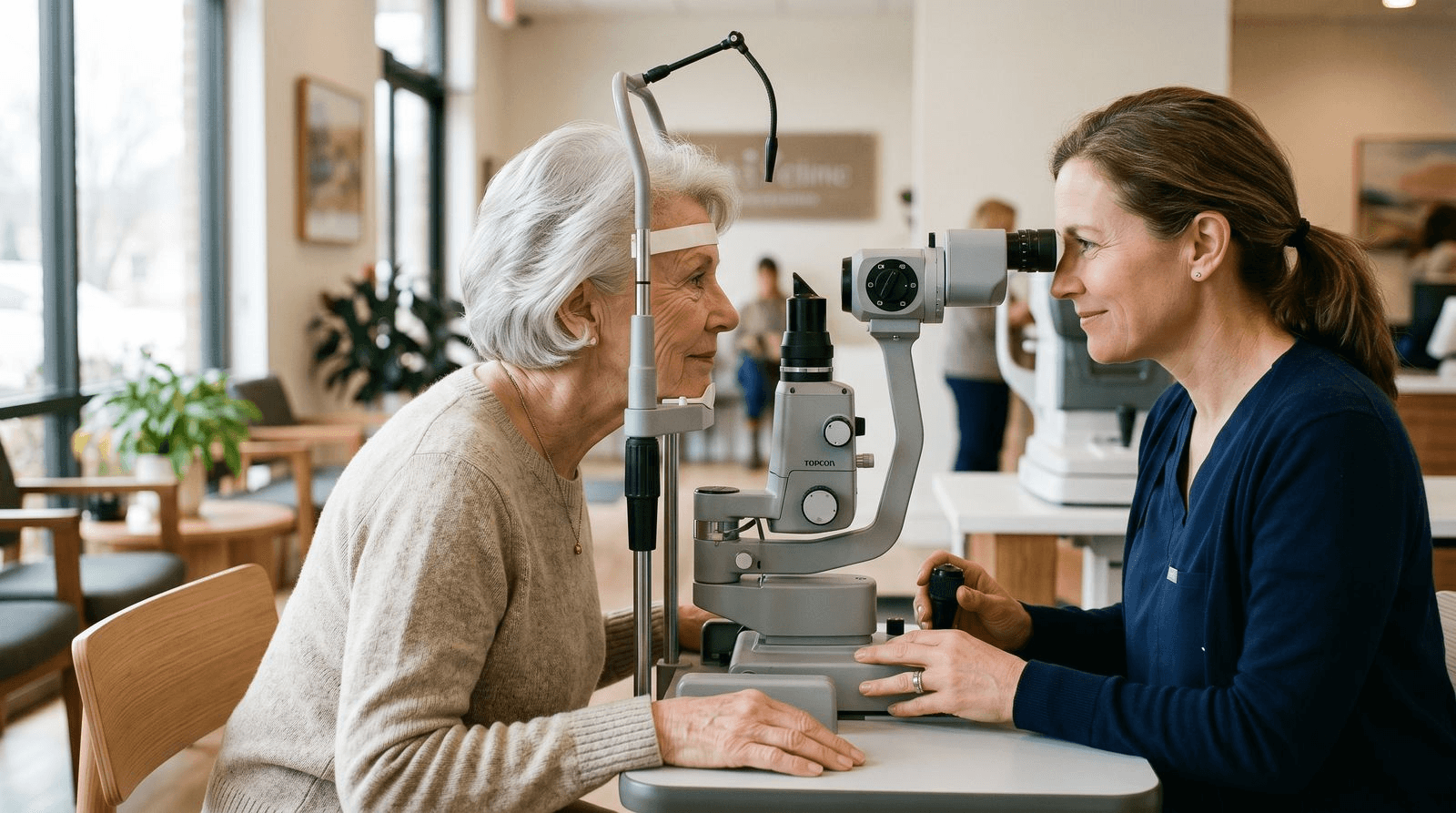
The reassuring part is how simple the test is. There is no needle and no pain. During a comprehensive dilated eye exam, the National Eye Institute explains, the doctor puts in drops to widen your pupils, then looks directly at the optic nerve for early signs of damage. A quick pressure check measures the fluid pressure inside the eye, and a visual field test maps your side vision to reveal blind spots you cannot feel. Together these catch glaucoma long before you would ever notice a change yourself.
How often should you go? The American Academy of Ophthalmology suggests a complete eye exam every one to two years for adults over 65, and every one to three years from 55 to 64, with more frequent checks for anyone at higher risk. If it has been more than a couple of years since a parent's last dilated exam, scheduling one is among the highest-value things you can do for their independence, precisely because the disease gives them no reason to schedule it themselves.
Glaucoma or Cataracts — What's the Difference?
These two get confused constantly, partly because both become common with age and both can blur the future of someone's sight. But they are very different problems. A cataract is a clouding of the eye's lens; it scatters light, fogs and dims vision, and it is fixable. Cataract surgery replaces the cloudy lens and routinely restores clear sight, which is why it is one of the most common and successful operations performed. If your concern is a recently scheduled procedure, our guide to what to expect during cataract surgery recovery walks through the days afterward.
Glaucoma is the opposite kind of problem. It damages the optic nerve, not the lens, and that damage is permanent. Cataracts steal vision in a way you can usually see coming and undo; glaucoma steals it invisibly and forever. The two can coexist, and both are found in the same routine eye exam, which is one more reason not to skip it. Treating a cataract restores what was lost. Treating glaucoma protects what remains.
Can Glaucoma Be Treated or Reversed?
Vision already lost to glaucoma cannot be recovered, and there is no cure yet. That sounds grim until you hear the other half: treatment is genuinely effective at stopping the disease where it stands. Every approach works by lowering the pressure inside the eye. The first line is usually prescription eye drops used every day, which either slow fluid production or improve drainage. When drops are not enough, laser procedures and surgery can open or create new drainage pathways. Most people diagnosed early and treated consistently keep functional vision for the rest of their lives.
The phrase to underline there is treated consistently. Glaucoma treatment only works if it actually happens, day after day, year after year, and that is harder than it sounds for the older adults most affected.
Why Are the Daily Eye Drops So Hard to Keep Up?
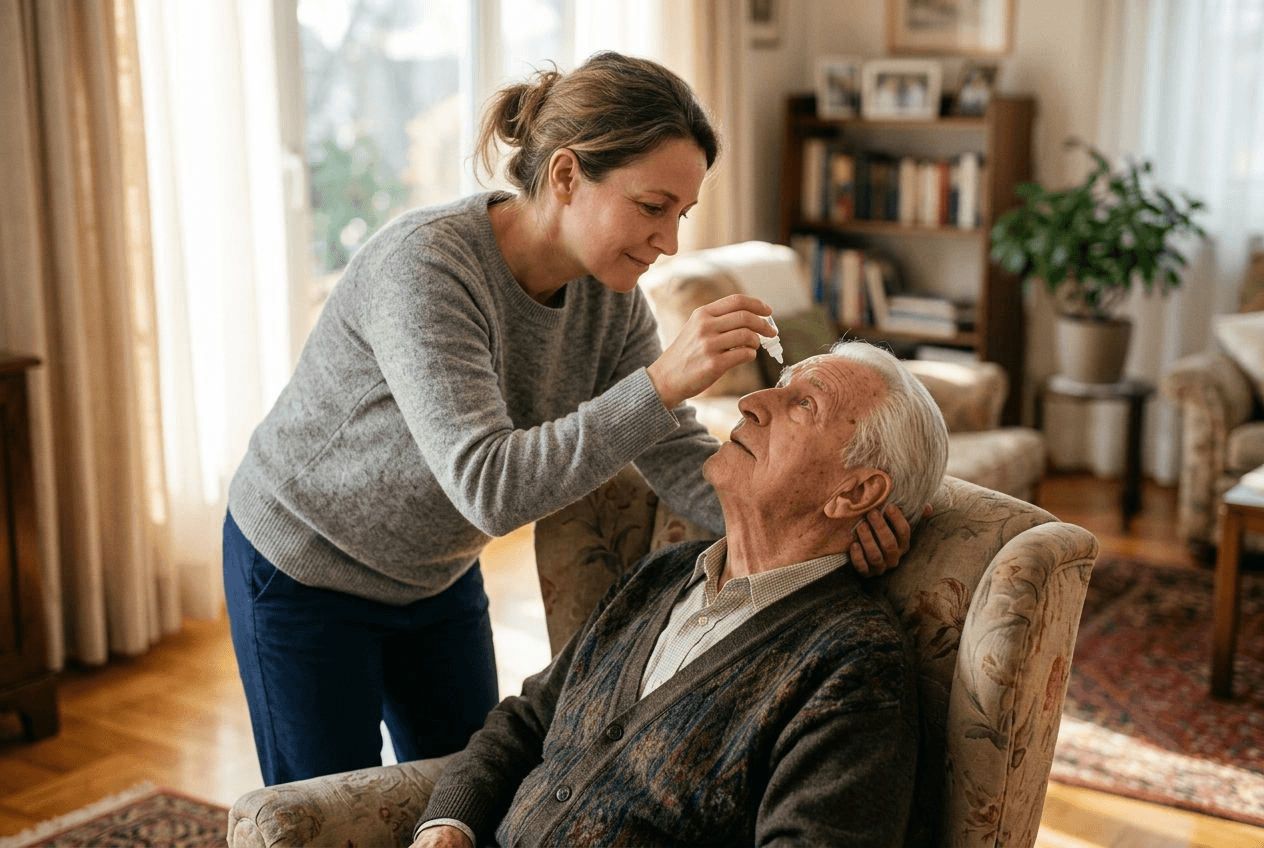
On paper, glaucoma treatment is simple: a drop or two in each eye, every day. In practice it defeats a surprising number of people. Arthritic hands struggle to squeeze a tiny bottle and aim it. Tremor and low vision make it hard to know whether the drop landed in the eye or ran down the cheek. There are often several bottles on different schedules, with instructions to wait five minutes between them and to press gently at the inner corner of the eye afterward. Research on glaucoma care has found that a large share of patients miss doses or stop refilling entirely, and that missing follow-up appointments, frequently because of a lack of transportation, is one of the biggest reasons the disease quietly progresses despite a working prescription.
This is where steady, in-home support changes outcomes in a very concrete way. A caregiver can build the drops into the same anchor point every morning so a dose is never forgotten, help an unsteady hand get the medication where it belongs, and keep the bottles and their separate schedules straight. Our in-home personal care aides do exactly this kind of daily routine work, and because eye drops are rarely the only medication in the cabinet, it folds naturally into broader medication management for seniors. Just as important is getting to the eye doctor in the first place: our companion care and transportation removes the missed-appointment problem that lets treatable glaucoma slip. Families near our Sarasota, Florida office, where so much of the community is over 65, often lean on this kind of help precisely because vision health depends less on the prescription than on whether it is actually followed.
So What Should You Actually Do This Year?
If you take one thing from all of this, let it be a calendar reminder rather than a worry. Glaucoma is frightening only when it is ignored, because ignoring it is the one thing it counts on. Found early, it is among the most manageable of the serious eye diseases. So the action items are refreshingly plain. If you or a parent is over 60 and has not had a dilated eye exam in the last year or two, book one. If glaucoma, diabetes, or African or Hispanic heritage is part of the family picture, mention it and ask how often to come back. If a diagnosis already exists, make the daily drops as automatic as brushing teeth, and make sure someone is there to help if hands or memory make that hard.
None of this replaces your own eye doctor, who should guide every decision about screening and treatment. But the most powerful move against a disease that gives no warning is not a symptom to watch for. It is an appointment to keep, this year and every year after.
Frequently Asked Questions
What are the first signs of glaucoma?
For the most common form, open-angle glaucoma, there are usually no first signs at all. It is painless and develops so slowly that people do not notice the gradual loss of side vision until a great deal of it is already gone. That is why glaucoma is called the silent thief of sight, and why a comprehensive eye exam, not a symptom, is what catches it early. A separate and far less common form, acute angle-closure glaucoma, does cause sudden, dramatic symptoms and is a medical emergency.
Is glaucoma a medical emergency?
Open-angle glaucoma is a chronic condition managed over years, not an emergency. But acute angle-closure glaucoma is a true emergency: severe eye pain, a sudden headache, nausea or vomiting, blurred vision, halos or rainbow rings around lights, and a red eye can come on within hours. Without fast treatment it can cause permanent vision loss in a day or two, so anyone with these symptoms should go to an emergency room or call an eye doctor immediately.
What causes glaucoma?
Most glaucoma is linked to pressure inside the eye. The eye continuously makes a clear fluid that should drain away at the same rate. When the drainage system works poorly, fluid backs up, pressure rises, and over time that pressure damages the optic nerve, the cable that carries images from the eye to the brain. Damaged nerve fibers do not grow back, which is why lost vision cannot be restored. Scientists do not know exactly why the drainage falters in the most common type, which is part of why regular screening matters so much.
Is glaucoma hereditary?
Family history is one of the strongest risk factors. Having a parent or sibling with glaucoma raises your own risk several times over, so if it runs in your family you should tell your eye doctor and likely be screened more often. Heredity is not the whole story, though. Age over 60, being of African or Hispanic descent, diabetes, very high eye pressure, and past eye injuries all raise risk as well. Black Americans are six to eight times more likely to develop glaucoma and tend to develop it younger.
Can glaucoma be cured or reversed?
There is no cure yet, and vision already lost to glaucoma cannot be brought back. What treatment can do is powerful, however: by lowering eye pressure with daily drops, laser, or surgery, doctors can halt or sharply slow further damage, and most people who are diagnosed early and stick with treatment keep useful vision for life. The goal is to protect the sight you still have, which is exactly why catching it before symptoms appear changes everything.
How often should older adults have their eyes checked for glaucoma?
The American Academy of Ophthalmology recommends a comprehensive eye exam every one to two years for adults over 65, and every one to three years for those 55 to 64. Anyone with risk factors such as a family history, diabetes, or African or Hispanic heritage should ask their eye doctor about checking more often. The exam is simple and painless, and it is the only reliable way to find glaucoma before it steals vision.