Private Duty Nursing vs. Private Duty Care
Private duty nursing and private duty care sound alike but mean different things. A plain guide to what each covers and which one your family needs.
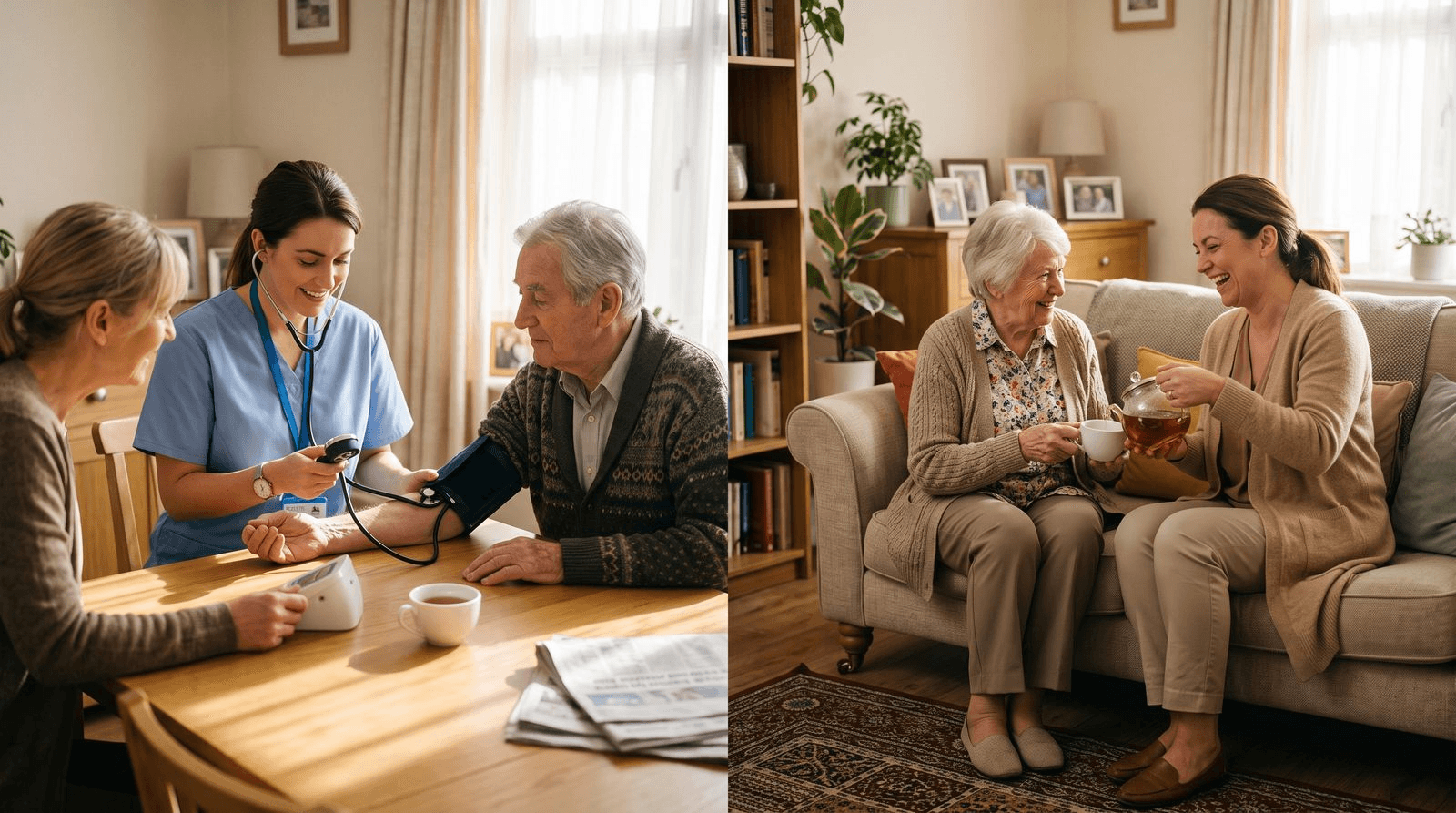
When a parent starts needing more help than the family can manage, the search usually begins with a phrase typed into Google late at night. Often that phrase is "private duty nursing." It sounds like the whole answer, one professional who moves in and handles everything. But the term hides a split that trips up a surprising number of families, because two very different services sit only one word apart: private duty nursing and private duty care.
Getting the two straight is not pedantry. It changes who you hire, what they are legally allowed to do, what it costs, and whether the help even matches the problem. Families routinely go looking for a nurse and discover that what their mother actually needs is a caregiver, or the reverse. This is a plain-language guide to the difference, and to figuring out which one your situation calls for.
Two Phrases, One Word of Difference
Start with the words themselves. "Private duty" simply means one-on-one care brought to a person wherever they live, rather than care delivered in a facility or shared across many patients. It describes the arrangement, not the skill level. The skill level is in the second word.
Private duty nursing is skilled medical care given by a licensed nurse. Private duty care, often written as private duty home care, is non-medical help given by a trained caregiver. Everything else, the confusion about cost, coverage, and who can do what, flows from that one distinction. The clearest test is to ask a single question about any task: does it require a nursing license? If yes, it is nursing. If it is hands-on help with the business of daily life, it is care. The line the two never cross is the same one the government draws between medical and non-medical support, as MedlinePlus lays out in its overview of home care services.
What a Private Duty Nurse Does
A private duty nurse is a licensed clinician, either a registered nurse (RN) or a licensed practical nurse (LPN). Because of that license, a private duty nurse can perform hands-on medical tasks that no non-medical worker is permitted to touch:
Wound, catheter, and ostomy care. Injections, IV therapy, and infusions. Tracheostomy and ventilator management. Feeding-tube care. Administering medications, not merely reminding. Clinical monitoring of someone whose condition can change quickly, and skilled judgment about when a change needs a doctor. Private duty nursing typically runs in long shifts, from eight hours to around-the-clock, and continues for as long as the medical need lasts, which can be months or years.
This is the care families need when a loved one is technology-dependent, medically fragile, or living with a complex chronic condition that requires continuous clinical oversight at home. It is distinct from the short, doctor-ordered home health care that Medicare covers after a hospital stay, which is brief, intermittent, and ends once the person recovers. Private duty nursing is ongoing and does not hinge on a discharge.
What a Private Duty Caregiver Does
A private duty caregiver, the role you may also see called a home health aide, personal care aide, or companion, is a trained non-medical worker who helps with the ordinary tasks that keep a person safe and comfortable at home. That is bathing, dressing, grooming, and toileting; preparing meals and helping with eating; light housekeeping and laundry; help moving safely around the house and getting to appointments; medication reminders; and the plain company that keeps isolation at bay.
What a caregiver cannot do is anything that legally requires a nursing license. A caregiver can set out a pill organizer, remind someone it is time, and hand them the bottle; a caregiver cannot give an injection, manage an IV, or change a sterile dressing. That boundary is not a shortcoming, it is the definition of the role. And for a great many older adults, this is exactly the help they need, which is why non-medical private duty caregiver support is the most-used form of in-home help by a wide margin. The everyday tasks it covers, what the professionals call the activities of daily living, are what most people actually struggle with first, long before any nurse is needed.
Nursing vs. Care, Side by Side
| Question | Private duty nursing | Private duty care |
|---|---|---|
| Who provides it | Licensed nurse (RN or LPN) | Trained non-medical caregiver or aide |
| Type of tasks | Medical: wound care, injections, IV, tube and vent care | Non-medical: bathing, meals, mobility, companionship |
| Medication | Can administer | Can remind and prompt only |
| Doctor's order | Often required, always for insurance | Not required |
| Typical duration | Ongoing, as long as the medical need lasts | Ongoing, scaled to daily-living needs |
| Relative cost per hour | Higher (licensed clinician) | Lower (non-medical support) |
| Who usually needs it | Medically complex or technology-dependent | Anyone needing help with daily life |
The Coverage Question, Answered Plainly
Much of the confusion between the two services is really confusion about who pays, so it helps to be blunt. Medicare does not routinely pay for either one. It covers short, intermittent, doctor-ordered home health from a certified agency, and it treats non-medical help with daily living as custodial care, which it generally will not cover. Continuous private duty nursing over long shifts falls outside the Medicare home health benefit too.
That leaves a handful of real funding routes for both nursing and care: paying privately, a long-term care insurance policy, certain veterans benefits, or a state Medicaid waiver for those who financially qualify. Skilled private duty nursing costs meaningfully more per hour than non-medical care, because it requires a licensed clinician; non-medical care is billed hourly and rises for overnight, live-in, or around-the-clock coverage. Because rates swing so much by region and provider, the only figure worth trusting is a written quote for the exact hours and level of care you need. If the medical-versus-non-medical line still feels blurry, our guide to home health care versus home care walks through it in more detail.
Which One Your Situation Calls For
Here is the fastest way to sort it out. Look at the actual tasks your loved one needs done this week, and run them through a short checklist.
You likely need private duty nursing if any task on the list legally requires a nurse: wound or catheter care, injections or IV therapy, a feeding tube, a tracheostomy or ventilator, or a medication regimen that must be administered rather than simply prompted. If a clinician needs to monitor a fragile condition and act on what they observe, that is nursing.
You likely need private duty care if the struggles are with the ordinary rhythm of the day: getting safely in and out of the shower, dressing, cooking, remembering medications, moving around without falling, getting to appointments, or simply being alone too much. This describes the large majority of families, and it is met by companion care and personal care rather than a nurse.
Be honest about drift. Needs change. A person may start with a few hours of caregiver help, then develop a medical need that adds nursing on top. The point of the checklist is to match the help to the tasks in front of you now, and to reassess when they change, rather than over-buying a nurse for work a caregiver does better and more affordably, or under-buying care when a clinical task has quietly appeared.
When the Honest Answer Is Both
For plenty of families, the two are not either-or. Consider an older adult recovering from a stroke who needs a nurse for a daily dressing change and medication management, but also needs someone there the other twenty-three hours to help with meals, bathing, and safe movement. The nurse handles the clinical slice; the caregiver handles the day. Layering them is common, and it is usually far more affordable than staffing a licensed nurse around the clock for tasks a caregiver is fully qualified to do.
This is the arrangement where knowing the difference pays off most directly. A family that understands the split can put a nurse where the license is genuinely required and fill the rest of the hours with non-medical care, instead of paying clinician rates for companionship. Always Responsive Home Care is a private-pay, non-medical provider: we deliver the private duty care side, the caregivers and aides who cover daily living, and when a clinical need calls for skilled private duty nursing we help families coordinate with the licensed nursing providers who handle it. We serve families across New Jersey, from Bergen County to Middlesex County, and along Florida's Gulf Coast from our Sarasota office.
Matching the Help to the Need
The word that separates private duty nursing from private duty care is small, but the decision behind it is not. Nursing is for the tasks that require a license. Care is for the tasks that make up a life: eating, washing, moving, and not being alone. Most families need the second, some need the first, and a fair number need them woven together.
So before you hire anyone, write down what actually needs doing this week and ask the one question that cuts through the marketing language: does this task require a nurse, or does it require a helping hand? Answer that honestly, and you will know exactly which door to knock on, and you will not overpay for the wrong kind of help.
Frequently Asked Questions
What is private duty nursing?
Private duty nursing is skilled, one-on-one medical care provided in the home by a licensed nurse, either a registered nurse (RN) or a licensed practical nurse (LPN). Unlike a short home-health visit ordered after a hospital stay, private duty nursing can cover long shifts, from eight hours up to around-the-clock, for someone with ongoing complex medical needs. Typical tasks include wound and catheter care, injections and IV therapy, tracheostomy or ventilator management, feeding-tube care, and administering medications on a schedule. Because these tasks require a nursing license, they cannot legally be done by a non-medical caregiver. Private duty nursing is most common for people with serious chronic conditions, technology-dependent care needs, or a child or adult who needs continuous clinical monitoring at home.
What is the difference between private duty nursing and home health care?
Both bring care into the home, but they differ in scope, duration, and who orders them. Home health care is short-term, doctor-ordered skilled care from a Medicare-certified agency, a nurse or therapist who visits intermittently, usually to help someone recover from surgery, an illness, or a hospital stay, then discharges them once they improve. Private duty nursing is continuous, one-on-one nursing for an extended period, arranged directly by the family rather than triggered by a doctor's discharge order, and it is generally not time-limited. In short, home health is brief and recovery-focused; private duty nursing is ongoing and support-focused. A third category, private duty care, is non-medical help with daily living and is different from both.
Is a private duty nurse the same as a caregiver?
No. A private duty nurse is a licensed clinician (RN or LPN) who can perform medical tasks. A caregiver, sometimes called a home health aide, personal care aide, or companion, is a trained non-medical worker who helps with the activities of daily living: bathing, dressing, grooming, meals, light housekeeping, mobility, transportation, and companionship. A caregiver can remind someone to take medication and hand them the bottle, but cannot inject it or manage an IV. The distinction matters because many families search for a private duty nurse when what they actually need, and can hire more affordably, is a private duty caregiver.
Does Medicare pay for private duty nursing?
Generally, no. Medicare covers short-term, intermittent skilled home health that a doctor orders and a certified agency provides, not continuous, long-shift private duty nursing at home. It also does not pay for non-medical private duty care such as help with bathing, meals, or supervision, which Medicare classifies as custodial care. As a result, both private duty nursing and private duty care are most often paid for privately, and sometimes through long-term care insurance, certain veterans benefits, or a state Medicaid waiver for those who qualify. Always confirm coverage with the specific program before assuming it will pay.
How much does a private duty nurse cost?
Costs vary widely by region, by whether the provider is an RN or an LPN, and by the number of hours. Skilled private duty nursing generally costs considerably more per hour than non-medical private duty care, because it requires a licensed clinician. Non-medical caregiver help is charged at an hourly rate that rises for overnight, live-in, or around-the-clock coverage. Because rates differ so much by market and provider, the most reliable figure is a written quote from a local agency for the exact hours and level of care you need. This guide describes the types of care rather than quoting prices.
Do you need a doctor's order for private duty nursing?
It depends on how the care is paid for. When a family arranges and pays for private duty nursing directly, a physician's order is not always required to begin, though a nurse will still assess needs and build a care plan, and any prescribed treatments require a doctor's orders. When private duty nursing is billed to insurance, a Medicaid waiver, or another payer, that payer almost always requires a physician's order and documentation of medical necessity. Non-medical private duty care never requires a doctor's order, since it involves no clinical tasks.