Better Balance Is a Skill You Can Practice
A quick self-test, then a leveled home routine of balance exercises for seniors: simple moves to retrain steadiness and lower fall risk.
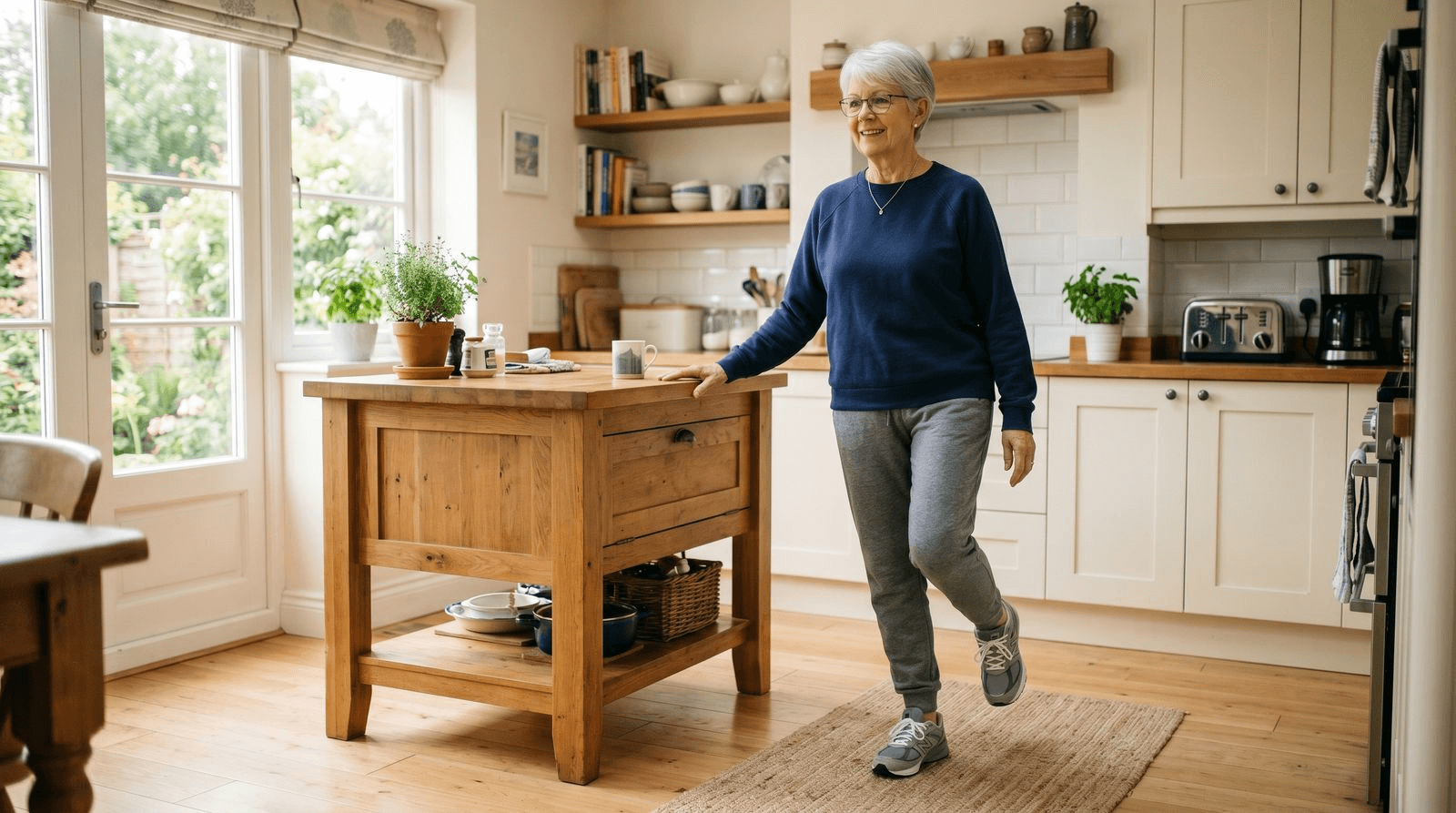
Stand up for a moment, somewhere you can reach a counter. Put your feet together, side by side, and let go with your hands. Can you hold it, steady, for ten seconds? Now try the harder version: slide one foot forward so its heel touches the toes of the other, a straight heel-to-toe line, and hold that for ten. If the second one made you grab the counter, you are not unusual, and you are not stuck there. You have just done the first stance of a quick screening that clinicians use, and you have found exactly where your balance training should begin.
Balance gets talked about as if it were a fixed possession, something you either still have or have quietly lost. It is closer to a skill, like a language: neglected, it fades; practiced, it comes back. This is a guide to practicing it at home, written for older adults and the families beside them. It moves from a simple self-test to a routine you build in three levels, with the safety rules that keep the practice from becoming the very thing it is meant to prevent. None of it replaces your own doctor or a physical therapist, especially if you have had a fall or feel unsteady on your feet. What follows is a sensible place to start.
Try the Four-Stance Test Right Now
The little experiment you just did is the heart of the four-stage balance test used in the CDC's fall-prevention program. It walks through four standing positions, each harder than the last, and you try to hold each one for ten seconds while standing near something sturdy. First, feet together side by side. Second, the instep of one foot touching the big toe of the other. Third, the full heel-to-toe stance, one foot directly in front of the other. Fourth, standing on one foot. The position where you start to wobble or need to hold on is your honest starting line, and someone who cannot hold the heel-to-toe stance for ten seconds is considered at higher risk of a fall.
Treat that result as information, not a verdict. It matters because falls are not a small problem. According to the Centers for Disease Control and Prevention, more than one in four adults aged sixty-five and older falls each year, falls are the leading cause of injury in that age group, and a single fall doubles the odds of falling again. Yet the same agency is blunt about the hopeful part: falling is not a normal, unavoidable part of aging. It can be prevented, and balance practice is one of the most direct ways to do it.
Balance Isn't a Trait, It's a System You Can Retrain
Staying upright feels automatic, but it is actually a quiet collaboration. Your inner ear senses which way is up, your eyes track the world around you, and sensors in your joints and feet report where your body is in space. Your brain blends all three and tells your leg and core muscles to make hundreds of tiny corrections a minute. With age, each input can dull a little and the muscles can weaken, so the corrections come slower. That is why a younger person catches a stumble and an older person sometimes cannot.
The encouraging news is that every part of that system answers to practice. Challenge your balance on purpose, in small safe doses, and the sensors sharpen, the muscles strengthen, and the corrections speed back up. The National Institute on Aging recommends exactly this combination of balance and strength work, and notes that activities like tai chi, yoga, and Pilates improve both at once. The body keeps its ability to relearn steadiness for life. You simply have to give it the reps.
Level 1: Find Your Footing
The first level is static: holding still in positions that narrow your base of support, with both hands resting on a counter or a heavy, non-rolling chair. The goal is to feel steady, not to test your nerve. Feet-together stand is the foundation, simply standing with your feet touching side by side and holding for ten to thirty seconds. From there, the weight shift teaches your body to move its center of gravity safely: stand with feet hip-width apart and slowly sway your weight onto one foot, then the other, as if lightly stepping side to side without lifting your feet. Then comes the single-leg stand, the move that pays the biggest dividends: hold the counter, lift one foot a few inches off the floor, and balance on the other for as long as it feels safe, working toward ten seconds before switching.
Start each move with both hands on the support and do it five to ten times, the dose suggested by the National Council on Aging, which advises keeping something sturdy to hold and a chair nearby to rest. The progress you are looking for at this level is not a new exercise. It is needing less of your hands. When two-handed holds feel easy, try one hand, then a couple of fingertips. That quiet loosening of your grip is the whole point.
Level 2: Add Movement
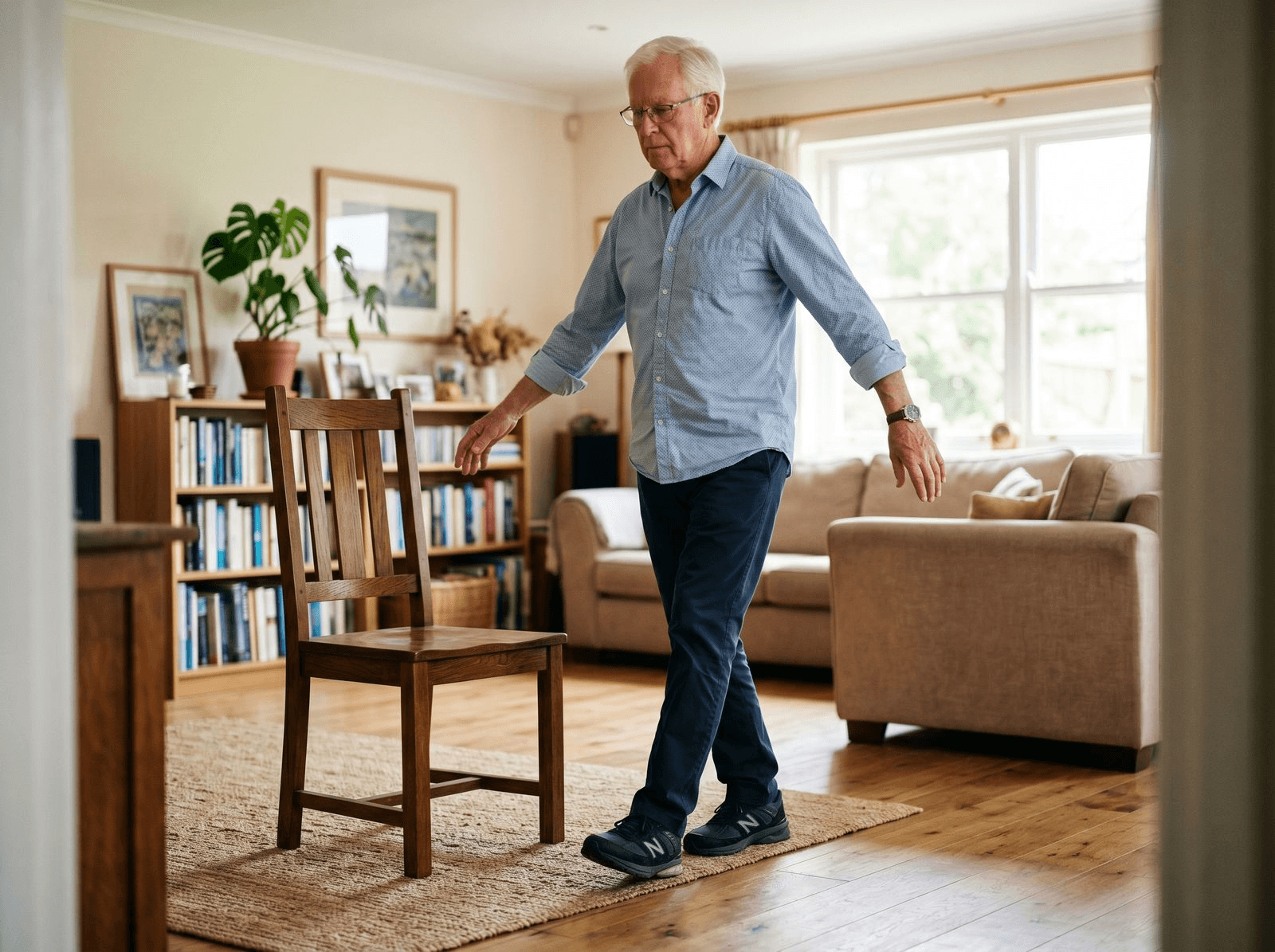
Real life does not happen standing still, so the second level puts your balance in motion while support is still close at hand. The signature move is heel-to-toe walking, sometimes called the tandem walk: place one foot directly in front of the other so heel meets toe, take ten to twenty slow steps in a straight line along a counter or hallway wall, and let your fingers brush the surface only if you need them. Heel and toe raises build the lower legs and ankles that do so much of the steadying: rise up onto the balls of your feet, lower slowly, then rock back onto your heels with your toes lifted. Marching in place, lifting each knee in turn while holding lightly to the counter, trains the single-leg balance you use with every step you take.
The sit-to-stand belongs here too, doubling as a balance and strength move: from a firm chair, lean slightly forward and push up to standing through your heels, then lower back down with control, using your hands only as much as you must. Keep every motion slow enough that you could stop it at any instant. Speed is where wobbles turn into falls; control is where balance is built.
Level 3: Rehearse Real Life
The top level trains the situations that actually trip people up: turning, reaching, looking away, walking on different surfaces. Move here only once the level-two work feels secure, and keep your sturdy support within reach even though you are using it less. One-leg stand with a head turn adds the inner-ear challenge of moving your gaze: balance on one foot and slowly turn your head side to side, the way you would to check for traffic or find someone's voice in a room. Tandem walking with a turn takes the heel-to-toe walk and adds a careful pivot at the end, since turning is when many falls happen. Reaching and stepping, gently stretching to place a light object on a shelf or stepping over a low obstacle like a rolled towel, rehearses the ordinary reaches and steps of a normal day.
This is also where a gentle, structured class earns its reputation. Tai chi, in particular, is one of the most thoroughly studied fall-prevention activities there is, stringing slow shifts of weight and single-leg moments into a flowing routine that trains everything above at once. If a guided practice appeals to you more than a solo counter session, a beginner tai chi class is a natural next step from this routine.
How Much, How Often, and Staying Safe
Balance rewards frequency more than duration. A few minutes on most days of the week does more than one long weekly session, partly because the skill is use-it-or-keep-it and partly because short, pleasant sessions are the ones people actually repeat. Fold a single-leg stand into brushing your teeth, a few heel raises into waiting for the kettle, a heel-to-toe walk into the trip down the hall. Pair this with muscle-strengthening on at least two days a week, the standard guideline for older adults, because strong legs and trained balance prevent falls as a team, not alone. Walking is wonderful for the heart, but on its own it does not build balance, so it supplements this work rather than replacing it.
A short safety checklist keeps the practice firmly in the safe column. Always work within arm's reach of a counter, heavy table, or wall you can grab, and keep a chair behind or beside you to sit down. Wear supportive shoes rather than socks or loose slippers. Clear the floor of throw rugs, cords, and clutter, and practice in good light. Begin every move holding on, and ease off only as you feel steady. Stop and check with your doctor if a move brings on dizziness, chest discomfort, or sharp pain, and talk with a physical therapist first if you have had a recent fall, take medicines that leave you lightheaded, or feel unsteady much of the time. Practicing balance should feel like a manageable challenge, never a gamble.
Why a Spotter Changes Everything
Here is the part that no exercise list captures: the hardest thing about balance training is not any single move, it is doing it again tomorrow, and the day after. This is where another person quietly changes the math. Someone who stands nearby, watches for a wobble during the standing work, counts the seconds out loud, and notices the first time you held the one-foot stance without grabbing on turns a good intention into a steady habit, and makes the practice measurably safer while they are at it.
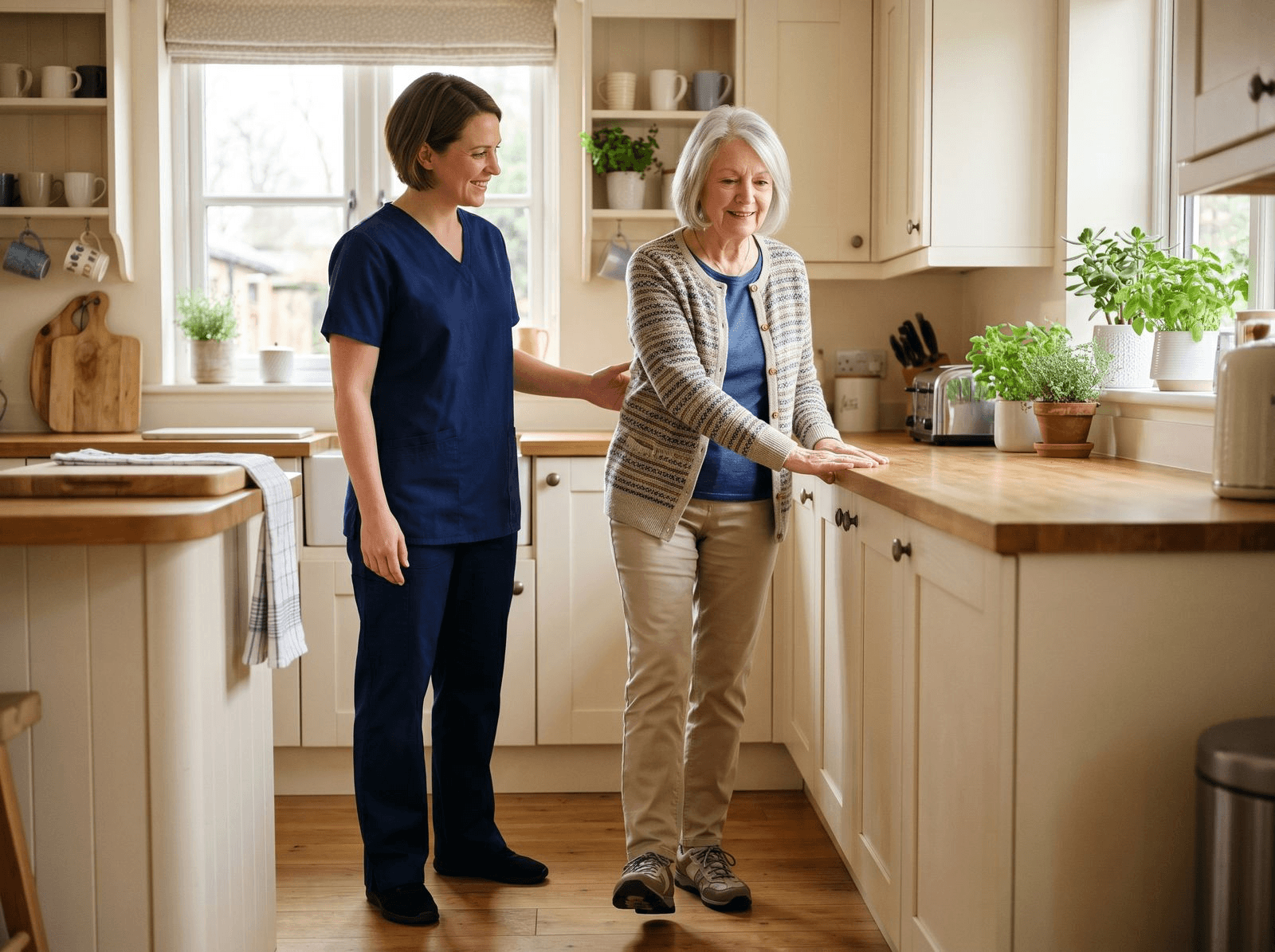
For families who live far away or are simply stretched thin, this steady presence is one of the most valuable and least dramatic things an in-home caregiver provides. A companion caregiver can keep the short balance session on the calendar, offer a hand and a word of encouragement, and quietly track the small wins that prove it is working. When unsteadiness is the larger worry, our in-home mobility support pairs that consistency with hands-on help moving safely through the day. Families near our Ocean County, New Jersey office often build a few minutes of balance practice into a parent's week of care for exactly this reason, because the caregiver who is already there for the day is also the person who makes the exercise actually happen. Steady footing at home goes hand in hand with a safe home, too, and our guide to bathroom safety for seniors covers the room where balance is tested most.
A Few Weeks From Now
Run the four-stance test again in three or four weeks, after some most-days practice. Many people find they can hold a stance they could not manage at the start, or that they reach for the counter a beat later than they used to. Those small wins are the system retraining itself in real time, the sensors and muscles answering the reps you gave them. Steadier feet are not a matter of luck or of holding on to the balance you have left. They are a skill, and like any skill, the way in is to start where you are today, hold the counter, and practice.
Frequently Asked Questions
How can seniors improve their balance at home?
Balance improves with regular, slightly challenging practice. Stand near a sturdy counter and work through a small set of moves a few days a week: holding narrow and one-footed stances, shifting your weight, rising onto your toes, and walking heel-to-toe in a straight line. Start with whatever you can do safely while holding on, then gradually use less support and add a little movement. Most people notice they feel steadier within a few weeks, well before the change is dramatic.
What is the best balance exercise for seniors?
There is no single best move, but standing on one foot and heel-to-toe (tandem) walking are two of the most useful, because they train the exact skills you need to catch yourself and stay upright while walking. The most effective exercises are done standing and gently challenge your balance, which is why seated work alone, while a fine starting point, is not enough on its own. Tai chi, which strings these skills together in slow motion, is one of the most studied fall-prevention activities of all.
How often should seniors do balance exercises?
Aim for some balance practice on most days of the week. Balance responds well to frequent short sessions, so five or ten minutes daily, or a few minutes folded into things you already do at the counter, beats one long weekly session. National guidelines also recommend pairing balance work with muscle-strengthening at least two days a week, since strong legs and good balance protect against falls together.
Are balance exercises safe if you are afraid of falling?
Yes, when you set up for safety. Always practice within arm's reach of a sturdy counter, heavy table, or wall you can grab, keep a chair nearby to sit and rest, wear supportive shoes rather than socks or loose slippers, and have a phone or another person close by. Begin every move holding on with both hands and only ease off your grip as you feel steady. Fear of falling is common, and gentle, supported practice is one of the best ways to rebuild confidence.
Can you really improve balance after 70 or 80?
Yes. Balance is a trainable skill at any age, not a fixed trait that simply fades. The systems that keep you steady, including leg strength, the sensors in your joints, and your inner ear, all respond to practice. Studies of older adults, including frail ones in their eighties and nineties, consistently show meaningful gains in steadiness and a lower risk of falls after a few months of regular balance and strength exercise.
Do balance exercises actually prevent falls?
The evidence is strong. Exercise programs that include challenging balance work, often combined with strength training, reduce the rate of falls in older adults living at home. Tai chi and structured routines such as the Otago program have been shown to cut falls substantially. Balance exercise is one of the few fall-prevention steps that also makes everyday life feel easier, which is part of why it works: people keep doing it.