Older Bodies Need More Protein, Not Less
Older adults need more protein than most get, not less. How much per day, the best food sources, and when a protein drink or powder really helps.

Somewhere after 30, the body starts a slow, silent subtraction. Muscle mass drops by three to five percent each decade, and most people lose close to a third of it over a lifetime without ever feeling the moment it happens. The decline speeds up in the seventies and eighties, right when strength matters most for staying steady, getting off the couch, and recovering from an illness. And here is the part almost no one is told: roughly half of adults over 50 do not eat enough protein to fight back. In one study of nearly 12,000 people aged 51 and up, about 46 percent fell short of the daily recommendation.
The advice most older adults have absorbed over a lifetime, eat less, go easy on the meat, keep it light, turns out to be exactly backward for the one nutrient that protects independence. This is a plain-language guide to how much protein an older body actually needs, where the best of it comes from, and when a protein drink or powder earns its place on the counter.
The Muscle You Lose Without Noticing
The medical name for age-related muscle loss is sarcopenia, and it is not a disease so much as a drift. Muscle is living tissue in constant turnover, built up and broken down every day, and with age the building side slows while the breaking-down side keeps pace. Add the quieter months of a bad winter, a hospital stay, or a stretch of eating poorly, and the loss accelerates. A single week of bed rest can cost an older adult a disproportionate amount of leg muscle that takes far longer than a week to rebuild.
This matters far beyond appearance. Muscle is what rises from a chair, climbs a stair, and catches a stumble before it becomes a fall. It is also a metabolic reserve the body draws on during illness; people with more muscle tend to survive serious infections and surgeries better and recover faster. Protein is the raw material for all of it, and while no amount of eating reverses aging, adequate protein paired with a little resistance exercise is the best-proven way to slow the drift. The two work together: protein supplies the bricks, and gentle strength training is the signal that tells the body to lay them down.
The Number Most Older Adults Miss
The official Recommended Dietary Allowance for protein is 0.8 grams per kilogram of body weight, which works out to about 0.36 grams per pound. For a 165-pound person that is roughly 60 grams a day. The trouble is that this number was set decades ago to prevent outright deficiency in the average adult, not to preserve muscle in an older one, and researchers who study aging now consider it too low for people past 65, recommending closer to 1.0 to 1.2 grams per kilogram instead.
A simpler way to think about it: aim for about half a gram of protein per pound of body weight per day. A 130-pound woman lands near 65 grams, a 180-pound man near 90. The exact figure is less important than clearing the low RDA bar and, crucially, spreading protein through the day. The body can only put so much toward building muscle in one sitting, and the threshold that flips the switch is roughly 25 to 30 grams of protein in a meal. Three meals that each hit that mark do far more than a skimpy breakfast, a light lunch, and a steak at dinner that adds up to the same total.
Why the Old Advice Runs Backward
There is a real biological reason older adults need more protein, not less. It is called anabolic resistance: aging muscle responds less efficiently to a given amount of protein than young muscle does. A serving that would trigger muscle building in a 25-year-old may fall just short in a 75-year-old, so the older body needs a slightly larger push to get the same result. That is why the "eat light" instinct, sensible enough for the heart or the waistline, works against the muscles that keep a person on their feet.
Appetite complicates it further. Hunger naturally shrinks with age, illness and medications can flatten it, and dental trouble or a fading appetite can turn a full meal into a chore. The result is a squeeze from both sides: the body needs more protein at the very age when eating enough of anything gets harder. Recognizing that squeeze is the whole point, because it changes the goal from "eat healthy" to something concrete, hit the protein first, at every meal, before the appetite runs out.
Food First: Where Protein Really Comes From
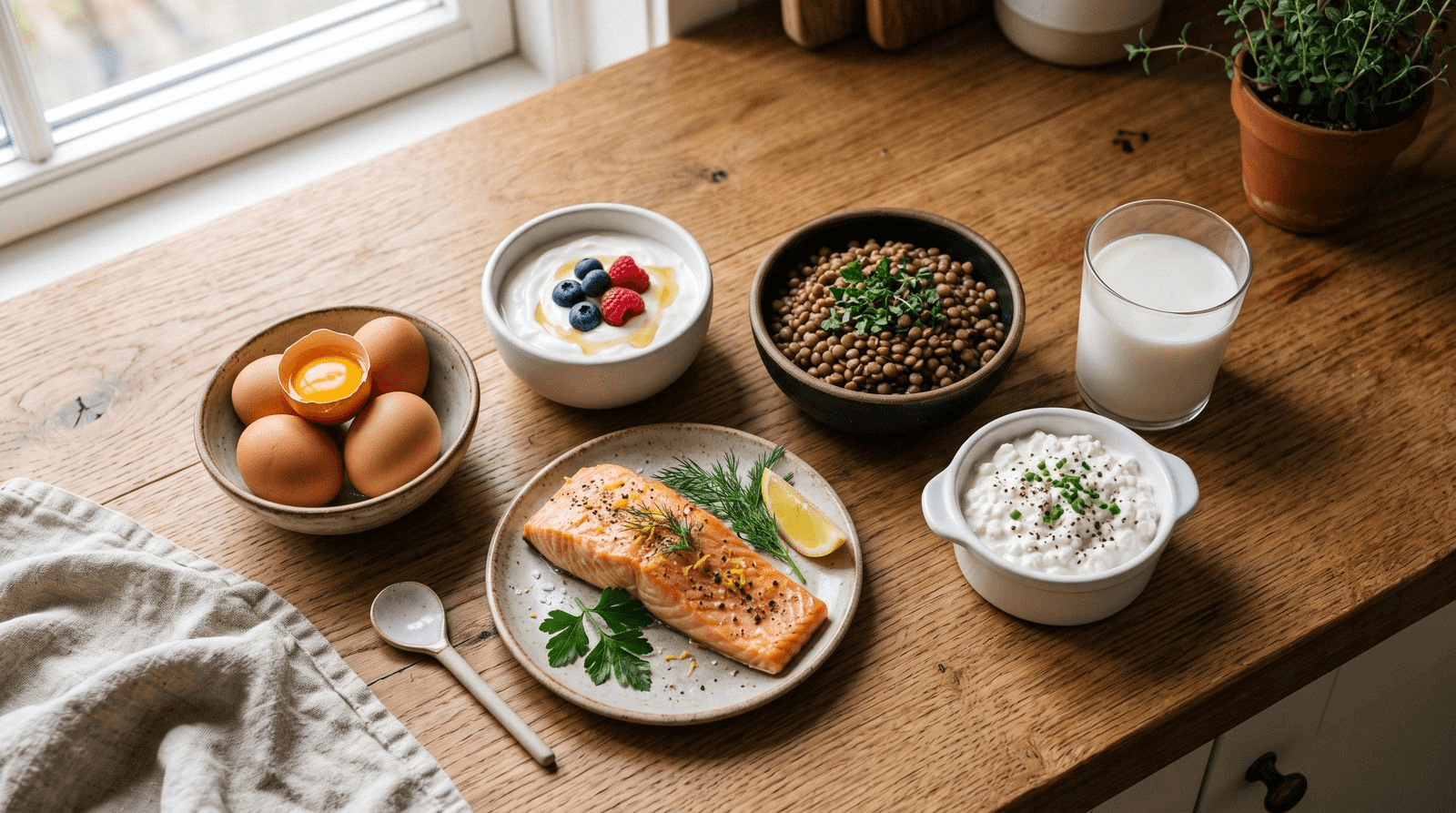
Before any powder or shake, the answer is on the plate. The most efficient sources pack a lot of protein into a small, easy-to-eat portion, which is exactly what an older adult with a modest appetite needs. Dairy and eggs have a second advantage: they are soft, familiar, and simple to swallow. Here is what everyday foods actually deliver.
| Food | Typical serving | Protein |
|---|---|---|
| Chicken or turkey breast | 3 oz, cooked | ~26 g |
| Canned tuna or salmon | 3 oz | ~20 g |
| Greek yogurt | 6 oz | ~17 g |
| Cottage cheese | 1/2 cup | ~14 g |
| Lentils or beans | 1 cup, cooked | ~18 g |
| Two large eggs | 2 eggs | ~12 g |
| Milk | 1 cup | ~8 g |
| Peanut butter | 2 tbsp | ~7 g |
The practical move is to build each meal around one of these rather than around bread, cereal, or potatoes. Scrambled eggs before the toast. Greek yogurt stirred into the oatmeal. Beans added to the soup, tuna onto the salad, a glass of milk instead of juice. None of it requires cooking a different dinner; it just leads with the protein so the most valuable food goes in while hunger lasts.
When a Shake Earns Its Place
For all the "food first" wisdom, there are real situations where a protein drink is the smart choice, not a shortcut. When appetite has shrunk to a few bites, when chewing is painful or swallowing is difficult, when someone is recovering from surgery or an illness and needs more protein than a small plate can hold, a shake does something a plate cannot: it delivers 20 to 30 grams of protein in a form that goes down easily and quickly. For a frail older adult who tires halfway through a meal, that can be the difference between meeting the day's target and missing it again.
Protein drinks come in two broad forms. Ready-to-drink cartons, the kind sold as nutrition shakes, are convenient and shelf-stable, handy to keep by the chair. Powders mixed into milk, a smoothie, or even mashed into oatmeal cost less per serving and let you control what goes in. Either can work. The key is to treat the drink as one part of the day's protein, sitting alongside real meals rather than replacing them, so the person still gets the fiber, vitamins, and simple enjoyment that only food provides.
How to Read a Protein Drink Label
The shelf of shakes and powders is confusing by design, but a few numbers cut through it. When you pick one up, look for these:
- 20 to 30 grams of protein per serving. Enough to clear the muscle-building threshold in a single drink. Below about 15 grams, it is more of a snack than a strategy.
- Low added sugar. Many drinks marketed for seniors carry as much sugar as a soda. Compare labels and favor the ones under roughly 10 grams of added sugar; a diabetic older adult should look harder still.
- A complete protein. Whey and casein from dairy are complete and rich in leucine, the amino acid that flips the muscle switch. Soy is the strongest plant option; pea protein is a good dairy-free choice, ideally blended with rice.
- Added vitamin D, B12, and calcium. A small bonus, since older adults often run low on all three, and the fortified versions cost little more.
- A taste they will actually drink. The best product is the one that gets finished. Buy a single serving before a tub, and let the person judge.
Lactose intolerance is worth a thought here, since it grows more common with age; a plant-based powder or a lactose-free ready-to-drink shake avoids the bloating that would otherwise make someone quietly abandon the whole idea.
The One Caution That Changes the Math
Everything above assumes healthy kidneys, and for most older adults that assumption holds; there is no good evidence that a higher-protein diet harms normal kidney function. But the math changes for anyone with chronic kidney disease or a history of kidney stones. Damaged kidneys can struggle to clear the byproducts of protein metabolism, and for those individuals a doctor or dietitian usually recommends limiting protein, not increasing it. Very high intakes can also contribute to dehydration, which older adults are already prone to.
So the honest bottom line has two halves. The great majority of older adults are eating too little protein and would benefit from more. A smaller group with kidney disease needs the opposite, and for them raising intake is a conversation to have with a physician first. If a kidney condition is anywhere in the picture, set the target with a professional before reaching for the powder.

Getting It Onto the Plate
Knowing the target is the easy part. Hitting it, three meals a day, when someone lives alone and cooking for one feels like too much bother, is where good intentions quietly fail. This is often where a steady hand at home changes the arithmetic. Shopping for the eggs, yogurt, and canned fish; cooking a protein into lunch instead of leaving toast on the counter; blending a smoothie in the afternoon and sitting down while it gets drunk, those small, repeated acts are what turn a daily number into daily habit.
A companion caregiver can handle the groceries and the cooking and, just as importantly, keep a person company at the table, since people reliably eat more in good company than alone. For someone who also needs hands-on help, personal care folds mealtime support into the rest of the day. Families we support across Monmouth County, New Jersey often find that this ordinary presence at mealtimes, paired with a dependable way to get food in the door, does more to protect an aging parent's strength than any single supplement on the shelf.
A Change Measured in Years
Protein is not glamorous, and adding a few grams to breakfast will never feel like a medical breakthrough. But muscle is the quiet infrastructure of independence, the thing that gets a person up off the floor, out to the garden, and home from the hospital. Preserving it is one of the few levers that genuinely bends the arc of aging, and it is largely built at the kitchen table.
So the move is small and starts tomorrow morning. Lead each meal with the protein, aim for a palm-sized portion at every sitting, keep a shake on hand for the days appetite runs thin, and check with a doctor first if kidneys are a concern. Do that steadily, and the payoff arrives not as a number on a scale but as steadier steps, easier chairs, and more years of doing the ordinary things without help.
For a fuller picture of eating well in later life, our guides on what to do when appetite fades and pairing good nutrition with simple strength training are the natural next reads. Protein does its best work with a plan around it.
Frequently Asked Questions
How much protein do seniors need per day?
More than the standard guideline suggests. The Recommended Dietary Allowance is 0.8 grams of protein per kilogram of body weight, about 0.36 grams per pound, but that figure was set to prevent deficiency, not to protect aging muscle. Panels of researchers who study older adults now recommend roughly 1.0 to 1.2 grams per kilogram, and up to about 1.5 for those who are ill, recovering, or already losing muscle. A simple working rule is about half a gram of protein per pound of body weight, so a 150-pound person aims for around 70 to 80 grams a day. Just as important as the total is the timing: spreading it across meals in 25-to-30-gram portions does more for muscle than eating most of it at dinner. Anyone with kidney disease should agree on a target with their doctor before raising intake.
Are protein drinks good for seniors?
They can be genuinely useful, as a supplement rather than a replacement for food. A ready-to-drink shake or a scoop of powder in milk is an easy way to add 20 to 30 grams of protein when a full meal feels like too much, which is common when appetite fades, chewing is difficult, or someone is recovering from an illness or a hospital stay. The cautions are simple. Many drinks marketed as nutrition shakes are also high in added sugar, so it is worth comparing labels. And a shake should fill a gap, not crowd out real meals, since whole foods bring fiber, vitamins, and the pleasure of eating that a carton cannot. For most healthy older adults a daily protein drink is safe; for anyone with kidney disease, check with a doctor first.
What is the best protein powder for seniors?
There is no single best brand, but there are features worth looking for. Aim for about 20 to 30 grams of protein per serving, keep added sugar low, and favor a complete protein: whey and casein from dairy are complete and rich in leucine, the amino acid that triggers muscle building, while soy is the strongest complete plant option and pea protein is a good dairy-free choice, ideally blended with rice to round out its amino acids. Powders fortified with vitamin D, B12, and calcium are a small bonus for older adults, who often run low on all three. Beyond the label, the best powder is the one a person will actually drink, so taste, easy mixing, and cost matter more than any marketing claim. Whichever you choose, treat it as one part of the day's protein, not the whole of it.
Can too much protein harm an older adult's kidneys?
For someone with healthy kidneys, the higher protein intake that benefits aging muscle is considered safe, and there is no good evidence it damages normal kidneys. The picture is different for anyone with chronic kidney disease or a history of kidney stones, where a high-protein diet can add strain and usually needs to be limited rather than increased. Very high intakes, well above what these targets call for, can also contribute to dehydration. The practical answer is that most older adults should worry about getting too little protein, not too much, but that raising intake is a conversation to have with a doctor or dietitian when a kidney condition is in the picture.
What are the best high-protein foods for older adults?
The most reliable sources are also the most ordinary. Eggs, Greek yogurt, cottage cheese, milk, poultry, fish, and canned tuna all deliver a lot of protein in a small, easy-to-eat portion, and dairy has the added advantage of being soft and simple to swallow. Beans, lentils, tofu, and nut butters add plant protein along with fiber, which helps digestion. For an older adult with a small appetite, the trick is to lead with the protein at each meal, the eggs before the toast, the yogurt before the fruit, so the most valuable food goes in while hunger lasts. Building each meal around one of these staples, rather than around bread, pasta, or potatoes, is the single easiest way to hit a daily target without a supplement.