A Head-to-Toe Stretching Routine for Seniors
A gentle head-to-toe stretching routine for seniors — seated and standing moves for the neck, back, hips, legs, with safe hold times and arthritis tips.
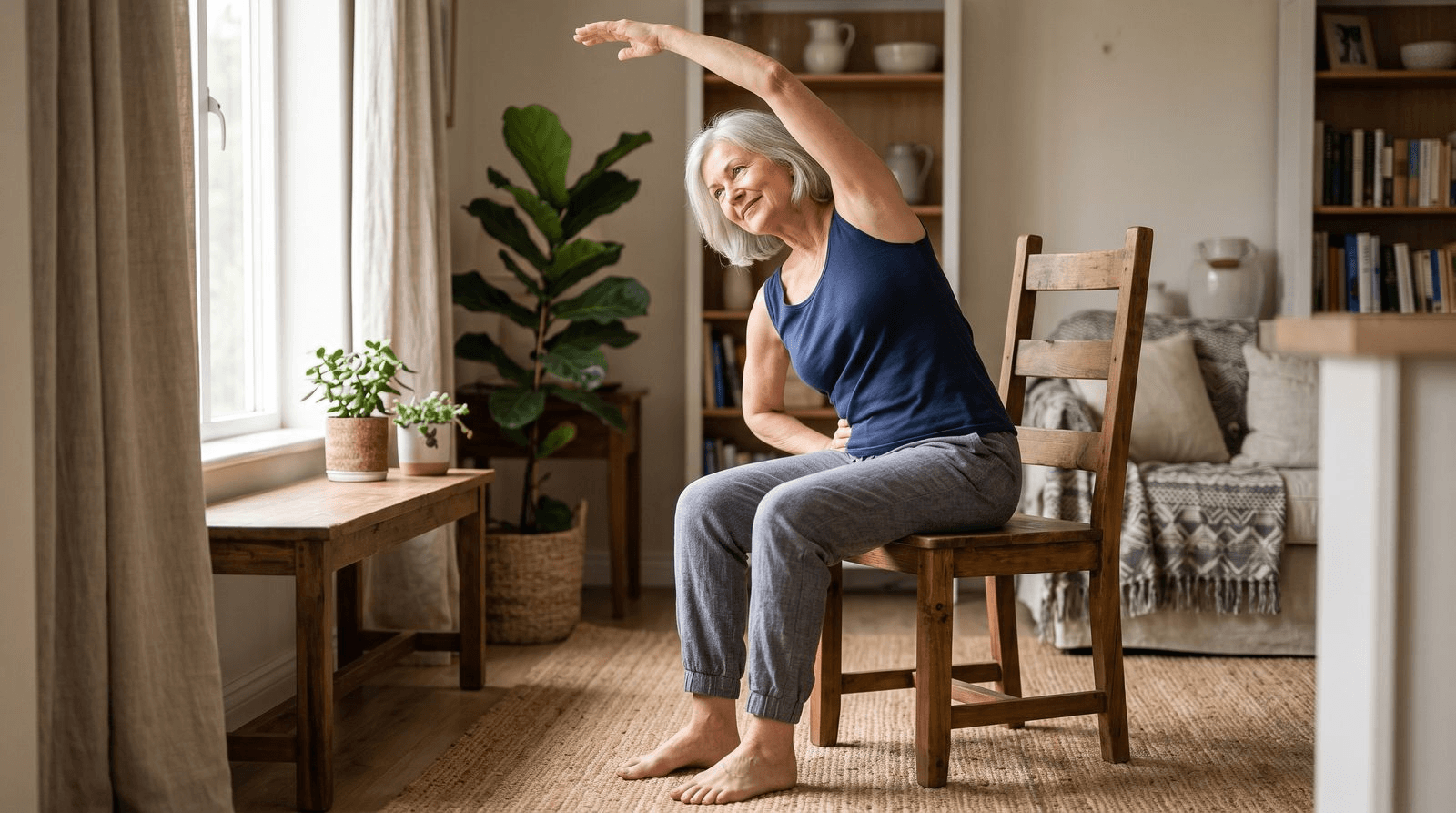
Notice the small motions a day asks of you: reaching the top shelf for a coffee mug, turning your head to check traffic before you back out of the driveway, bending to pull on a sock, twisting to grab the seatbelt. None of them feel like exercise, and that is exactly why they get harder so quietly. The muscles and tendons that let a joint move through its full range gradually shorten with age and disuse, and one ordinary morning the shelf is a little farther, the turn is a little stiffer, and getting out of a low chair takes a small heave it never used to.
Stretching is how you keep that range. A few minutes of gentle stretching exercises for seniors, done on most days, keeps the body moving freely enough to do its own errands — and unlike most fitness advice, almost all of it can be done sitting in a chair. This is a head-to-toe routine you can follow start to finish, with the rules that keep it safe, the stretches grouped by body region, a short morning sequence, and modifications for arthritis and old injuries.
Why Reaching and Turning Get Harder With Age
Flexibility is simply the ability of a joint to move through its full range of motion, and like strength and balance, it fades when it goes unused. Muscles lose some of their natural elasticity, tendons stiffen, and the connective tissue around joints tightens — a process that speeds up with the long stretches of sitting that fill many older days. The result is not dramatic. It is the slow narrowing of what your body can comfortably do: a shorter reach, a stiffer neck, a stride that quietly shrinks.
That narrowing matters more than it sounds, because range of motion is what everyday independence runs on. The federal National Institute on Aging puts it plainly: stretching helps you keep moving freely enough to do the things daily life requires, like reaching down to tie your shoes or unloading the dishwasher. Tight hips and hamstrings shorten your gait and pull at your posture; stiff shoulders make dressing and washing your hair a struggle; locked-up ankles make every step less sure. Loosening all of it back up is what the rest of this routine does — and it pairs naturally with the balance work and strength training that round out a complete week of movement.
The Rules That Keep Stretching Safe
Stretching is gentle by nature, but a few ground rules separate a routine that helps from one that strains. Read these once before you start, and the rest of the routine takes care of itself.
- Stretch warm muscles, not cold ones. Cold muscles do not lengthen well and are easier to pull. Walk for a few minutes, circle your arms, or stretch right after a walk or a strength session — never reach for your toes the second you get out of bed.
- Hold, do not bounce. Move slowly into each position and hold it still. Bouncing to push deeper, as Mayo Clinic warns, can injure a muscle and actually make it tighter.
- Feel tension, never pain. A stretch should produce a gentle pull, not a sharp or burning sensation. If it hurts, ease back to the point where it does not, and hold there. Pain is the body saying stop, not try harder.
- Keep breathing. Hold each stretch for 10 to 30 seconds while breathing normally, then release and repeat it three or four times. Holding your breath tenses the very muscles you are trying to loosen.
- Use support when balance is a question. Do standing stretches near a counter, a sturdy chair, or a wall you can touch. When in doubt, do the seated version — every region below has one.
Warm Up First (Two Minutes)
Before the stretches themselves, give the body a brief warm-up so the muscles are pliable. Two or three minutes is plenty: march gently in place or walk to the end of the hall and back, roll your shoulders forward and back several times, circle your wrists and ankles, and swing your arms loosely across your body. The goal is only to raise a little warmth and get the joints moving — not to tire yourself out. If you are stretching after a walk, a water-aerobics class, or strength work, you are already warm and can begin straight away.
Neck, Shoulders, and Upper Back
The upper body holds tension from sleep, screens, and the simple habit of looking down, and it is where stiffness most often turns into headaches and a hunched posture. All of these can be done seated tall in a chair.
- Neck tilts. Sitting or standing tall, gently lower one ear toward that shoulder until you feel a stretch along the opposite side of the neck. Hold, return to center, and switch sides. Keep the shoulders down and relaxed — let the head's own weight do the work rather than pulling with your hand.
- Shoulder rolls and squeezes. Roll both shoulders slowly backward in big circles several times, then draw the shoulder blades together as if pinching a pencil between them and hold. This counteracts the rounded-forward posture that creeps in with age.
- Across-the-body arm stretch. Bring one arm straight across your chest and use the other hand to draw it gently closer, feeling the stretch in the back of the shoulder. Hold and switch.
- Overhead reach. Lace your fingers together and press your palms up toward the ceiling, lengthening the whole upper body and the sides of the torso. This is the same reach you use for the top shelf — practicing it keeps it available.
Lower Back and Spine
A mobile spine is what lets you twist to reach a seatbelt, glance behind you, and bend without your back protesting. These keep the trunk loose without any strain.
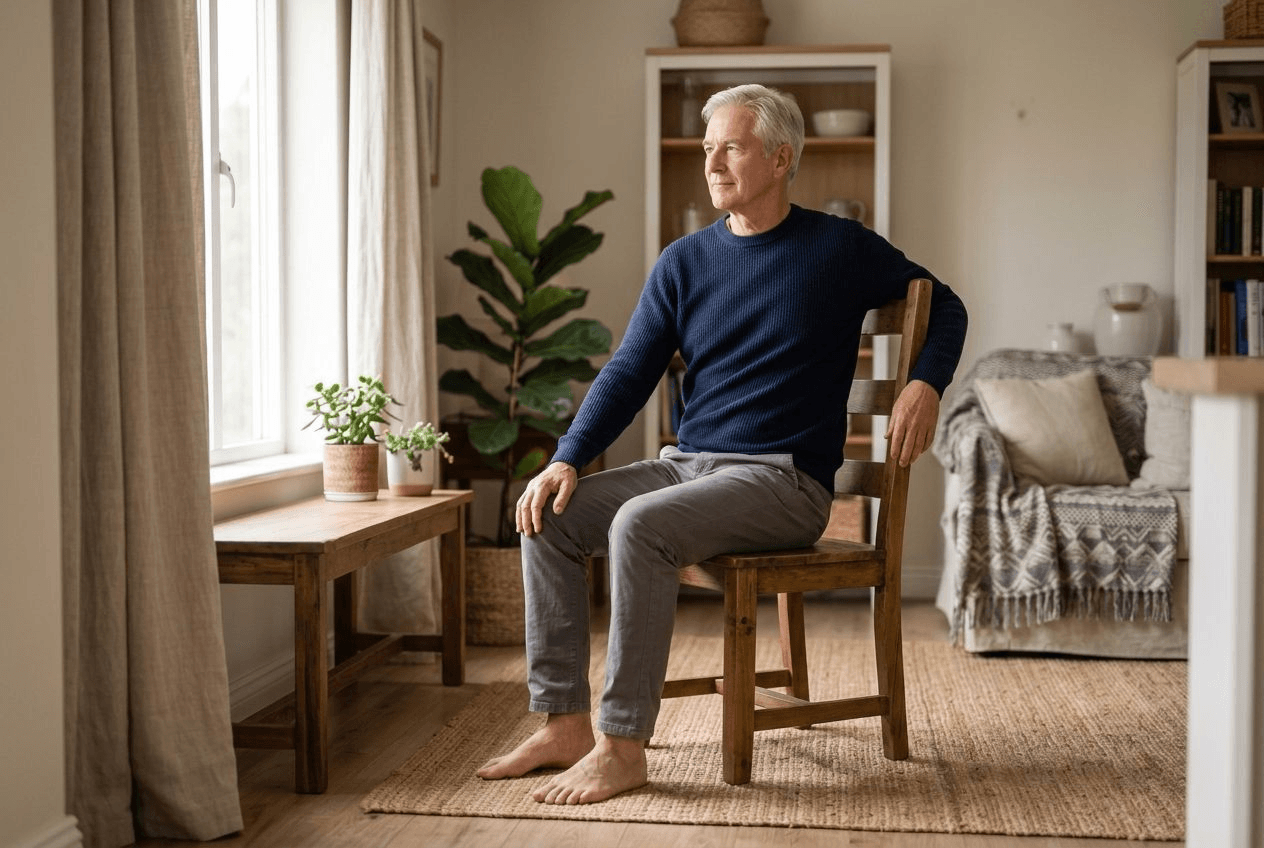
- Seated spinal twist. Sit tall with feet flat on the floor. Place your right hand on your left knee and your left hand on the chair beside or behind you, then gently turn your torso to the left, looking over your shoulder. Hold, return to center, and twist to the other side. Move from the waist, slowly, and never force the turn.
- Seated cat-cow. Hands on your knees, arch your back and lift your chest as you breathe in, then round your spine and tuck your chin as you breathe out. Flowing slowly between the two for several breaths gently mobilizes the whole spine.
- Knee-to-chest (lying or seated). Lying on your back with knees bent, draw one knee toward your chest with both hands and hold, then switch. Seated, simply lift one knee toward your chest and clasp your hands beneath it. Both ease the lower back.
Hips and Hip Flexors
Hours of sitting leave the hip flexors — the muscles at the front of the hip — short and tight, which tugs the lower back and shortens the stride. Loosening the hips is one of the highest-payoff things an older adult can do for walking and balance.
- Seated figure-four. Sitting in a chair, rest one ankle on the opposite thigh so the bent leg makes a number four, then sit tall and lean forward gently from the hips until you feel a stretch deep in the hip and buttock. Hold and switch legs. This is the seated, safe version of a stretch that otherwise needs the floor.
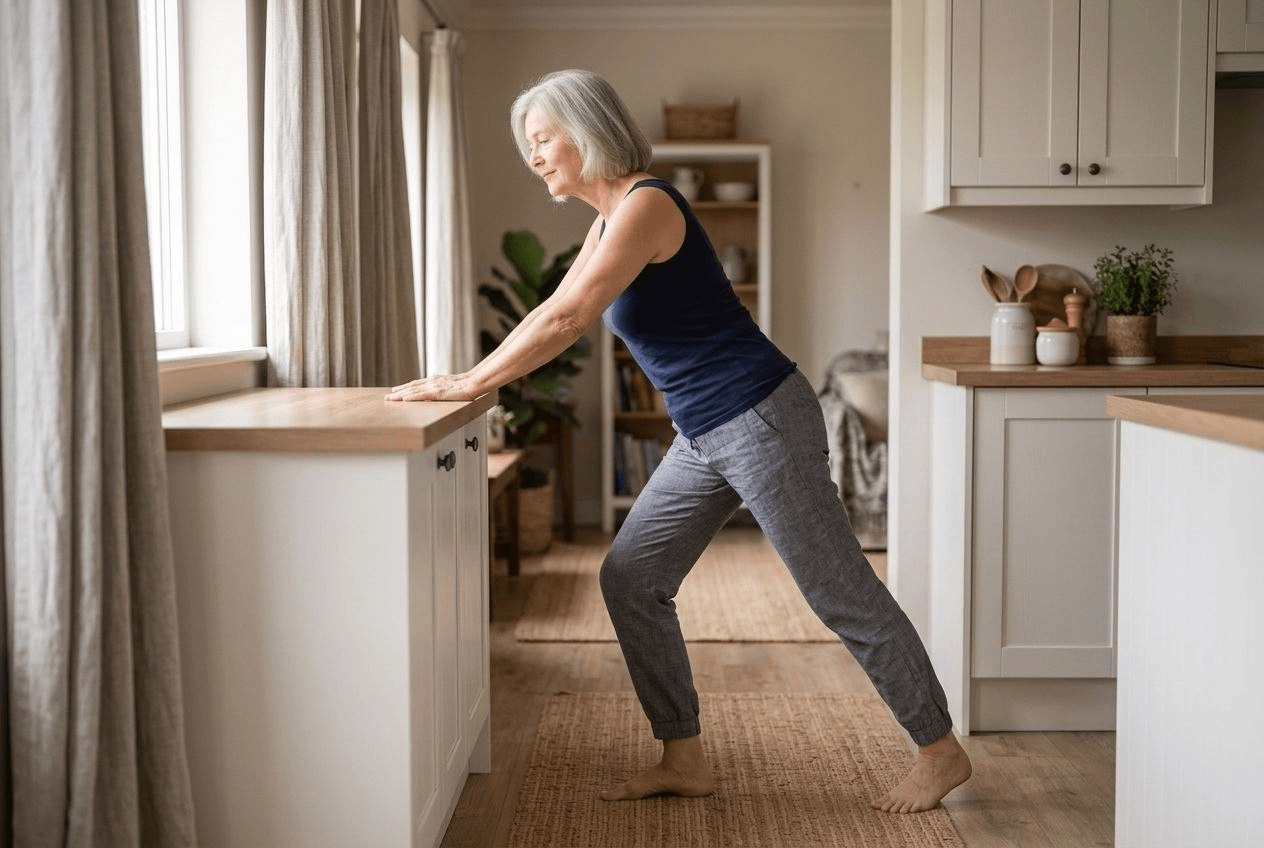
- Standing hip-flexor stretch. Holding a counter for support, step one foot back, keep it flat, and gently press your hips forward while keeping your torso upright. You will feel the stretch across the front of the back hip. Hold and switch.
- Seated inner-thigh stretch. Sitting with feet wider than your hips, place your hands on your thighs and lean forward slightly with a straight back to open the inner thighs and groin — the muscles that help you get up from a low seat or the floor.
Hamstrings and Calves
Tight hamstrings and calves are quiet trouble: they limit how far you can bend forward, flatten your stride, and make the ankles less responsive — all of which affect balance. These two are worth doing every single day.
- Seated hamstring stretch. Sit toward the front of a sturdy chair and straighten one leg out in front of you with the heel on the floor and toes pointing up. Keeping your back straight, hinge forward gently from the hips until you feel a pull along the back of the thigh. Hold, then switch legs. Leading with the chest rather than rounding the back keeps it safe for the lower back.
- Standing calf stretch. Face a wall or counter, hands on it, and step one foot well back with the heel pressed down and the back leg straight. Lean toward the wall until you feel the stretch in the calf of the back leg. Hold and switch. Stiff calves are a common reason stepping off a curb feels uncertain.
- Ankle circles and points. Seated, lift one foot off the floor and slowly circle the ankle several times each direction, then point and flex the toes. Supple ankles make the first steps out of bed steadier and every step after surer.
Hands, Wrists, and Ankles
The small joints are easy to forget and quick to stiffen, and they govern the fine, fiddly tasks — buttons, jar lids, keys — that frustrate people most. A minute on each keeps them working.
- Finger and hand stretches. Spread the fingers wide, hold, then make a loose fist; repeat several times. Gently draw each thumb back and touch it to the base of the little finger. This eases the morning stiffness that makes a coffee jar feel welded shut.
- Wrist stretches. Hold one arm straight out, palm down, and use the other hand to gently bend the wrist down, then up, holding each. Helpful for anyone whose hands feel tight from arthritis or gripping a cane or walker.
- Ankle and foot stretch. Seated, write the alphabet in the air with your big toe, one foot at a time. It is a playful way to take the ankle through its full range, and supple feet and ankles are foundational to steady walking.
A 10-Minute Morning Routine, Start to Finish
Stiffness is usually worst first thing in the morning, after a night of stillness, which makes a short morning routine one of the most useful habits an older adult can build. Do not stretch the moment you wake — move around the bedroom for a minute or two first so the muscles are warm. Then work head to toe, holding each for about 20 seconds and repeating a couple of times:
- Shoulder rolls and a few overhead reaches to open the upper body.
- Gentle neck tilts to each side.
- A seated spinal twist each way.
- Seated cat-cow for several slow breaths.
- A seated hamstring stretch on each leg.
- A seated figure-four to open each hip.
- Ankle circles and toe points on both feet.
- Finger spreads and a few wrist bends to finish.
The whole sequence takes about ten minutes and asks nothing of you but a sturdy chair. Anchor it to something you already do — the coffee brewing, the morning news — and it stops being a task you have to remember and becomes simply part of waking up. Tied to a daily habit, gentle daily stretches keep the morning creak from becoming the day's baseline.
Stretching With Arthritis or Old Injuries
Stretching and arthritis can sound like a contradiction, but gentle range-of-motion movement is one of the better things you can do for stiff, achy joints — moving a joint through its range helps reduce stiffness and keeps it usable. The adjustments are common-sense ones: warm up a little longer, perhaps with a warm shower beforehand, keep every movement slow and well within a comfortable range, and stop short of pain rather than pushing through it. On a flare-up day, a shorter and gentler version still earns its keep; the goal on bad days is to keep the joint moving, not to make progress.
A few situations call for professional guidance first. Anyone recovering from a joint replacement, living with significant osteoporosis, or managing a back or neck condition should ask their doctor or a physical therapist which movements to favor and which to skip — a quick conversation that tailors the routine and rules out anything risky. For an older adult who is unsteady, recovering from a fall, or simply nervous about starting, having someone there for the first weeks makes all the difference. Our mobility-care caregivers help clients move safely through gentle exercise and daily activity, providing a steady hand and a watchful eye, and our personal-care aides fold that same support into the morning routine — a stretch session done together is a stretch session that actually happens.
Make It Stick
Flexibility is the rare kind of fitness that asks for very little and gives back quickly. There is no equipment to buy, no class to drive to, and no real risk when you follow the simple rules — stretch warm, hold gently, breathe, and never chase pain. Within a few weeks of stretching on most days, the top shelf comes back into reach, the shoulder check before changing lanes stops being a whole-body turn, and rising from a chair gets a little easier. None of it makes headlines, but all of it is what staying independent at home actually looks like.
When stiffness, arthritis, or recovery from a fall makes moving freely hard to manage alone, a little steady help keeps a body in motion rather than letting it settle. For families across our Monmouth County, New Jersey service area and beyond, a companion-care visit can be the gentle nudge and friendly company that turns good intentions into a daily habit — someone to do the morning stretches alongside, so the routine sticks and the day starts a little looser than it would have alone.
This article is general wellness information, not medical advice. Before starting a new exercise routine — especially with arthritis, osteoporosis, a recent joint replacement, or a heart or balance condition — check with your physician or a physical therapist.
Frequently Asked Questions
How long should a senior hold a stretch?
Hold each static stretch for 10 to 30 seconds, breathing normally the whole time, then release and repeat it three or four times. There is no benefit to holding longer than about 30 seconds for most muscle groups, and there is no need to push into pain — you should feel a gentle pull, not a sharp or burning sensation. If 30 seconds feels like too much at first, start with 10 and build up. Bouncing or jerking into a stretch can strain a muscle, so move into each position slowly and stay there. For real gains in flexibility, the total time matters more than any single hold: aim for a few minutes per muscle group spread across most days of the week.
What are the best chair stretches for seniors?
Seated stretches are ideal when balance is a concern, and a sturdy chair without wheels lets you cover most of the body. A seated spinal twist loosens the back: sit tall, place one hand on the opposite knee, and gently turn toward that side. A seated hamstring stretch — straightening one leg with the heel on the floor and leaning forward from the hips — eases tight thighs. Overhead and across-the-body arm reaches open the shoulders, gentle neck tilts release the upper back, and seated ankle circles and toe points keep the lower legs limber. Each is held 10 to 30 seconds and repeated a few times. Done together they make a complete routine you never have to stand up for.
When is the best time of day for seniors to stretch?
Any time you will actually do it is the best time, but two windows work especially well. A short morning routine eases the overnight stiffness that makes the first steps out of bed feel creaky, and it wakes up the joints before a day of moving around. Stretching in the evening, after the muscles have been used all day and are naturally warm, tends to produce the deepest, most comfortable stretch and can help you wind down for sleep. The one rule that matters more than the clock is to stretch warm muscles, not cold ones — so move around for a few minutes first, or stretch right after a walk, rather than reaching for your toes the instant you wake up.
Are stretching exercises safe for seniors with arthritis?
Yes, and gentle stretching is one of the better things you can do for arthritic joints, because moving a joint through its range of motion helps reduce stiffness and keeps it usable. The key is to keep the movements slow and within a comfortable range, to warm up first with a few minutes of easy motion or a warm shower, and to stop short of pain rather than forcing the joint. Flare-ups are a signal to ease off, not to quit entirely — on stiff days a shorter, gentler version still helps. Anyone with significant joint disease, a recent joint replacement, or osteoporosis should check with their doctor or a physical therapist about which movements to favor or avoid.
How often should older adults stretch?
Most days of the week is the goal. Flexibility responds to how often and how much total time you stretch, not to occasional long sessions, so a little nearly every day beats one big effort on Sunday. A practical target is to stretch the major muscle groups on at least three days a week, and ideally most days, accumulating a few minutes per muscle group over the week. Because the routine is gentle and much of it can be done seated, daily stretching is realistic for most older adults. Pairing it with something you already do every day — morning coffee, the evening news — is the simplest way to make it stick.
What stretches should seniors avoid?
Skip anything that forces a joint past a comfortable range or puts the spine and neck at risk. Deep forward folds that round the back — touching the toes from standing — strain the lower spine and are risky for anyone with osteoporosis; do a seated hamstring stretch instead. Full neck rolls that drop the head all the way back can pinch the neck, so stick to gentle side-to-side and chin-to-chest tilts. Avoid ballistic, bouncing stretches, any move done on cold muscles, and standing balance stretches without something sturdy to hold. Stop short of pain every time — a stretch should feel like a gentle pull, never a sharp or burning sensation. Anyone with a recent joint replacement, significant osteoporosis, or a spine condition should clear their routine with a doctor or physical therapist first.
Can stretching help prevent falls in older adults?
Stretching supports fall prevention, though it works best as one piece of a larger routine. Tight hips, hamstrings, and ankles shorten your stride and throw off posture and balance, so restoring range of motion in those areas makes walking steadier and getting up from a chair easier. That said, the strongest fall protection comes from combining flexibility work with strength training and dedicated balance exercises. Federal guidelines recommend older adults include all of these — aerobic activity, muscle strengthening, and balance training — each week. Think of stretching as the part that keeps you moving freely, with strength and balance work doing the heavy lifting on stability.