What to Say When Dementia Changes the Conversation
How to talk to someone with dementia: the one mental shift, the phrases to use and skip, and how to handle the moments that stump every family.

More than seven million Americans are living with Alzheimer's disease, and the family members caring for them provide close to nineteen billion hours of unpaid help a year, according to the Alzheimer's Association. Almost none of that time comes with training. One day you are simply talking to your mother the way you always have, and the next the same words land wrong. A gentle correction brings tears. A simple question draws a blank. A story you have heard three times arrives again as if brand new.
Here is the reassuring part buried in a hard diagnosis: the way you talk to someone with dementia is one of the few things still fully in your hands, and small changes make an outsized difference. You cannot argue the disease away, but you can stop the exchanges that end in frustration for you both. This is a practical guide to what actually works, the one mental shift that changes everything, how to set up a moment before you speak, the phrases to reach for and the ones to drop, and how to handle the specific conversations that stump nearly every family.
The One Shift That Changes Every Conversation
If you take only one idea from this page, take this one: stop trying to be right, and start responding to the feeling. In ordinary conversation we trade information, correct each other, and expect logic to win. Dementia quietly changes the rules. The disease damages the parts of the brain that hold recent facts and follow reason, so a well-aimed correction does not land as help. It lands as an argument the person cannot win, and it leaves them anxious or ashamed without fixing anything.
What survives, often deep into the illness, is emotion. Your loved one may forget what you said within a minute but hold the feeling it gave them for hours. That is the opening. When your father insists it is time to pick the kids up from school, the useful question is not "how do I explain that the kids are grown?" It is "what is he feeling, and how do I meet it?" Usually the answer is a need for purpose, or safety, or company. Care specialists call the broad approach validation: you step into the person's reality and honor the emotion inside it, rather than dragging them back into yours. Once you make that switch, most of the specific techniques below become obvious.
Set the Scene Before You Say a Word
A surprising share of communication trouble is really environment trouble. A television murmuring in the corner, a busy room, or a rushed approach can overwhelm a brain that now processes slowly. Before the conversation even begins, stack the deck in your favor:
- Cut the competing noise. Turn off the TV or radio and, if you can, move somewhere quieter. Background sound your brain filters out effortlessly is a wall to theirs.
- Approach from the front, and get low. Come into their line of sight rather than calling from another room or appearing at their side. Sit or crouch so you are at eye level, not standing over them, and make easy eye contact.
- Lead with your name and your bond. Skip "do you know who I am?" Open with "Hi Mom, it's Sarah," so the person never has to pass a test to talk with you.
- Slow everything down. Keep sentences short and about one thing at a time. Say it, then wait, and then wait longer than feels natural. A reply can take many seconds to form.
- Let your face and hands talk too. A warm smile, a nod, and a gentle touch on the hand carry meaning even when the words slip away, so let your body say "you are safe with me."
None of this requires special skill, and the payoff is immediate. The National Institute on Aging stresses the same fundamentals: a calm tone, one idea at a time, and plenty of patience while the person finds their words.

What to Say, and What to Skip
Once the setting is right, the wording matters. A few small substitutions, repeated all day, change the whole tone of a household. The pattern is simple: replace anything that quizzes memory or corrects reality with something that offers a choice, a reassurance, or a fact the person no longer has to retrieve.
| Instead of saying | Try saying |
|---|---|
| "Do you remember me?" | "Hi Mom, it's Sarah, your daughter." |
| "You already asked me that." | Answer again, calmly, as if it were the first time. |
| "Dad died years ago." | "You really miss him, don't you? He loved you." |
| "What do you want for lunch?" | "Would you like soup or a sandwich?" |
| "You can't do that." | "Let's try it this way." |
| "What did you do today?" | "You look like you had a restful afternoon." |
The thread running through the right-hand column is that it never asks the person to prove what they can no longer do. Yes-or-no questions and two-option choices give them a way to take part without the panic of a blank. And notice that "answer again as if it were the first time" is a real strategy, not a failure of patience: the repeated question usually signals an underlying worry, and a steady, unbothered answer is what settles it.
"I Want to Go Home" and Other Moments That Stump Everyone
Some exchanges come up in almost every family, and each has a response that works better than the instinctive one.
"I want to go home" when they are already home. This is rarely about the address. Home stands in for a feeling of safety and belonging that the moment isn't providing, often a childhood house or an earlier chapter of life. Don't argue the deed to the house. Reassure first, "you're safe here with me," then redirect to something comforting, or ask softly, "tell me about home," to learn what they are reaching for.
Asking for someone who has died. Reorienting your mother to her husband's death makes her mourn it fresh each time. Answer the emotion instead: "You're thinking about Dad. He adored you." Then gently move toward a shared memory or a photo. In early stages some people can hold the truth; later, comfort almost always beats correction.
The same question, over and over. Behind the loop is usually anxiety, not stubbornness. Answering the same way each time, without a trace of "you just asked," reassures the worry underneath. If it is relentless, a note they can read or a small change of activity can break the cycle.
Refusing a shower, a meal, or a coat. Pushing hardens the refusal. Back off, try again in ten minutes, and offer control where you can: "the blue sweater or the gray one?" A light, unhurried tone often carries the moment that a direct order cannot.
Accusations, like a missing purse. When a person can't find something, the mind sometimes fills the gap with a theft. Don't defend yourself or reason it away. Say "let's find it together," join the search, and let the moment pass. Being trusted again in five minutes matters more than being proven innocent now.
When Words Stop Working, Connection Doesn't
As dementia advances, spoken language may thin out to a few words or fall away entirely. Families often describe this as the hardest stretch, and understandably so. But losing words is not the same as losing the person, and it is not the end of communication. The channels that carry warmth, tone of voice, a held hand, a familiar face, an old song, are exactly the ones that endure.
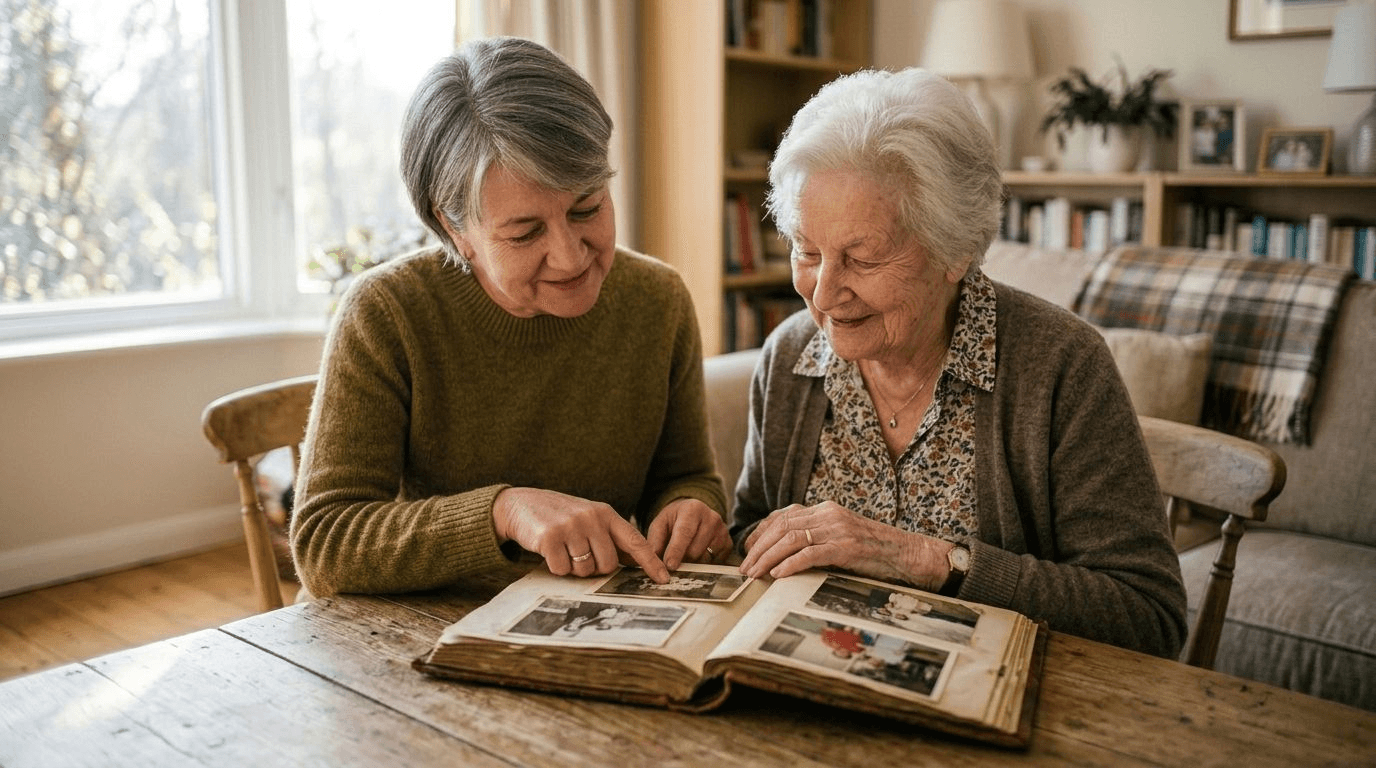
This is where presence outweighs conversation. Sit close. Hold a hand and let the quiet be enough. Play the music they loved at twenty, which can reach past the damage and light up a face when nothing else will. Turn the pages of a photo album together, not as a memory quiz but as a warm, no-pressure ramble through faces and places. You are still saying the most important thing, "I am here, and you are loved," without needing a single word to answer back.
Take Care of the Person Doing the Talking
Every technique here asks something of you: patience when you are depleted, calm when you are grieving, a light tone on a day that is anything but. You will not manage it every time. You will snap, or correct out of habit, or run out of gentleness by dinner. That does not make you a bad daughter or son. It makes you a human being doing one of the most demanding jobs there is, and the honest fix is not to try harder but to get relief before the tank hits empty.
That relief can be a trained caregiver who does this every day. A caregiver experienced in in-home dementia care brings the calm, unhurried approach above as second nature, and gives your loved one steady, familiar company inside their own home, where routine and surroundings do so much of the reassuring. Just as important, it gives you room to be the son or daughter again instead of the full-time manager of hard moments. Even a few hours through respite care can reset your patience and protect the relationship from the strain of doing it all alone. For families around Bergen County, New Jersey, that mix of professional support at home and a lighter load on the family is often what makes the day-to-day sustainable.
The Conversation Is Still Worth Having
It helps to redefine what a good conversation even means now. The goal is no longer accuracy, a tidy exchange of facts, or getting your loved one to agree with reality. The goal is connection, a stretch of minutes in which they feel safe, seen, and loved. Measured that way, a chat that wanders, repeats, or lands nowhere in particular can still be a complete success.
Your mother may not remember that you visited. She will, in the way that counts, remember how the visit felt, and so will you. Meet her where she is, respond to the feeling under the words, and let go of being right. The disease takes a great deal, but the thing you are actually after in every conversation, the sense of being together, is one of the last things it touches.
Frequently Asked Questions
What should you not say to someone with dementia?
Avoid anything that tests their memory or corrects their reality. Skip "Do you remember me?", "You already asked me that", and "That's not true." Don't reason, argue, or remind them of a painful fact like a spouse's death, since it forces them to grieve it again and rarely sticks. Steer clear of open-ended questions that rely on recall, such as "What did you do today?", and drop commands like "You can't do that." These phrases tend to trigger frustration, embarrassment, or anxiety without changing anything. Instead, greet them by name, keep statements short and positive, and respond to the emotion you see rather than the accuracy of the words.
How do you comfort someone with dementia who is upset?
Stay calm, lower your voice, and slow down, because a person with dementia reads your tone and body language long after words get hard to follow. Get to their eye level, make gentle eye contact, and, if they are comfortable with it, use a reassuring touch on the hand or arm. Acknowledge the feeling out loud: "That sounds frightening" or "I'm right here with you." Don't try to argue them out of the emotion or explain why it isn't warranted. Once they feel heard, gently redirect to something soothing and familiar, like a favorite snack, a walk, a photo album, or a song from their youth. Often the fastest way to calm the moment is simply to remove whatever noise, crowd, or demand set it off.
Why do people with dementia say they want to go home when they are already home?
"I want to go home" is usually not about a physical address. For many people with dementia, home stands for a feeling of safety, comfort, and belonging that the present moment isn't giving them, and they may be reaching back toward a childhood house or an earlier time in life. Arguing that they are already home, or pointing to the furniture and photos to prove it, tends to increase the distress rather than settle it. A better response is to acknowledge the feeling and reassure: "You're safe here with me," then redirect gently to a comforting activity. Some families ask a soft follow-up like "Tell me about home," which can reveal what the person is actually longing for and give you a way to provide a piece of that comfort.
Is it okay to lie to someone with dementia?
Care experts increasingly favor an approach sometimes called a therapeutic fib, where you prioritize the person's emotional peace over strict factual accuracy. If your mother asks for her late husband, insisting he died can force her to relive fresh grief every time. Responding to the feeling instead, with something like "You really miss him, don't you? He loved you so much," is kinder and more effective. The goal is never to deceive for your own convenience but to protect the person from needless pain and fear. In earlier stages, many people can still handle gentle truth, so read the person in front of you. As the disease progresses, meeting them in their reality, rather than dragging them into yours, usually causes far less suffering.
How do you talk to a dementia patient who is angry or agitated?
First, don't take it personally and don't argue back, because agitation is often the disease and unmet needs talking, not the person. Check for a simple cause: pain, hunger, thirst, needing the bathroom, too much noise, or fatigue late in the day. Keep your own face and voice calm, give them space, and avoid cornering them physically or with rapid questions. Acknowledge the emotion, agree where you can, and accept blame even if nothing is your fault, since being right matters far less than de-escalating. Then redirect to a calmer activity or setting. If anger and evening restlessness are a regular pattern, our guide to <a class="link" href="/blog/how-to-manage-sundowning-in-dementia-a-caregivers-guide-for-families">managing sundowning in dementia</a> covers the daily rhythms that tend to help.